

May 18 & 20, 2023
Atlanta Symphony Hall, Woodruff Arts Center
Atlanta, Georgia – USA
Paolo Bortolameolli, conductor; Christina and Michelle Naughton, pianos.
Vítězslava KAPRÁLOVÁ: Military Sinfonietta, Op. 11
Bohuslav MARTINŮ: Concerto for Two Pianos and Orchestra
Antonín DVOŘÁK: Symphony No. 8
Mark Gresham | 22 MAY 2023
When a rising conductor is called in at the last moment to lead a major orchestra, it can sometimes be an unexpected ear-opening game changer, but more often it is not. Such a substitution happens more often in the orchestral world than one might expect from a layperson’s point of view.
For the Atlanta Symphony Orchestra’s concerts this past week, it was the third late replacement of a guest conductor in three months. First, Georgia native Roderick Cox substituted for guest conductor Ryan Bancroft on February 23 and 24, then Michael Francis filled in for the scheduled Nicholas Carter on April 27 & 29.
This time, Chilean-Italian Paolo Bortolameolli replaced the Czech conductor Petr Popelka, who had become ill and canceled. Popelka (born in 1986 in Prague) is a Czech conductor and composer — a Czech music specialist bringing a program of all-Czech music to Atlanta Symphony Hall. Since the 2020/2021 season, Popelka has been chief conductor of the Norwegian Radio Orchestra Oslo and principal guest conductor of the Janáček Philharmonic Orchestra (Ostrava, Czech Republic). He has also been the Prague Radio Orchestra’s chief conductor and artistic director since the current 2022/2023 season began. His illness this past week thwarted the expectations for a carefully-planned match of Czech conductor and Czech repertoire.
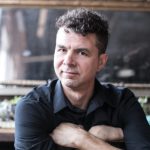
Under Bortolameolli, an assistant conductor at the Los Angeles Philharmonic, the ASO’s musical program remained unchanged: music by Vítězslava Kaprálová, Bohuslav Martinů, and Antonín Dvořák. His familiarity with the repertoire appears to have rested upon Dvořák’s Symphony No. 8 — a reasonable expectation under the circumstances.
The concert opened with Vítězslava Kaprálová’s Military Sinfonietta, Op. 11 (1937). Kaprálová was born into a musical family in 1915 in Brno, at the time part of the Austro-Hungarian Empire, and studied first at the Brno Conservatory (1930-1935), then with Vítězslav Novák and Václav Talich in Prague. She then moved to Partis and studied composition with Bohuslav Martinů (one of only a few) and conducting with Charles Munch.
The Military Sinfonietta (“Vojenská symfonieta”) is Kaprálová’s most important work. It was the composer’s graduation composition, concluding her studies at the Prague Conservatory, completing it at age 22 in February 1937, then conducting its premiere with the Czech Philharmonic that November. Kaprálová led the work again with the BBC Orchestra the following June.
A bold work filled with Czech national pride, the ASO’s performance emphasized brass and percussion over what is typically considered a more balanced orchestral palette, perhaps to the edge of brashness, but that was acceptable to me in the context of extra-musical fervor behind the piece.
Only in recent years do people speak about the love relationship between Martinů and Kaprálová, out of respect for Martinů’s wife. Kaprálová ultimately decided to marry Czech writer Jiří Mucha, the son of a famous painter Alfons Mucha, in 1940, only to die three weeks later at age 25, presumably from typhoid fever misdiagnosed as miliary tuberculosis, in the middle of the Second World War in France.
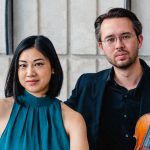
Twin sister pianists Christina and Michelle Naughton were the soloists for Martinů’s Concerto for Two Pianos and Orchestra (1943).

Double your pleasure: Christina and Michelle Naughton are soloists in Bohuslav Martinů’ “Concerto for Two Pianos and Orchestra.” (credit: Rand Lines)
The concerto’s two solo piano parts are fiendish in technical difficulty and their challenging rhythmic interplay with the orchestra. The Naughtons lived up to their part of the task with thrilling exuberance, although Bortolameolli mostly seemed to have his head in the score, so the orchestra’s part lacked the music’s distinctive Czech rhythmic character.
We would get that character in the Naughton sisters’ encore, the C major “Furiant,” the first and best known of Antonín Dvořák’s Op. 46 Slavonic Dances.
A satisfying performance of the optimistic, Bohemian folk-influenced Symphony No. 8 of Antonin Dvořák concluded the evening, even if the interpretation was in a more cosmopolitan manner, which is hardly unusual. It was did not feel “overdone” as is sometimes the case, and it was here that Bortolameolli seemed most at home with the music. ■
EXTERNAL LINKS:
- Atlanta Symphony Orchestra: aso.org
- Paolo Bortolameolli: paolobortolameolli.com
- Christina & Michelle Naughton: christinaandmichellenaughton.com

Read more by Mark Gresham.


.png)