
September 15, 2026
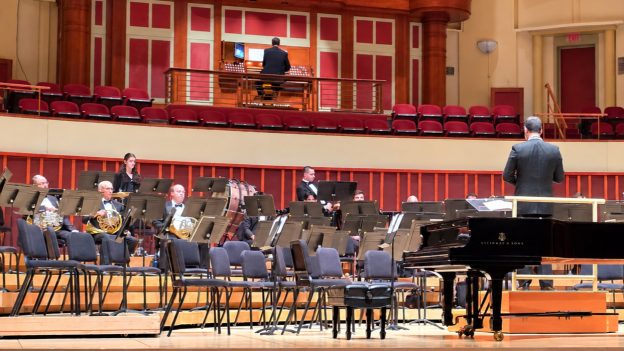
Schwartz Center for Performing Arts, Emory University
Atlanta, Georgia – USA
DeKalb Symphony Orchestra, Paul Bhasin, conductor; Albert Cano Smit, piano.
Eugène GIGOUT: Grand Chœur Dialogué, arranged by Ben Roundtree for organ and double brass quintet
Pyotr Ilyich TCHAIKOVSKY: Piano Concerto No. 1
Dmitri SHOSTAKOVICH: Symphony No. 9
William Ford | 17 SEP 2026
A community orchestra occupies a distinctive place in a city’s musical life. It gives student and amateur musicians an opportunity to participate in symphonic music-making while bringing orchestral repertoire to audiences outside the major professional institutions. For some listeners, it may also provide their first experience of hearing a symphony orchestra live.
The DeKalb Symphony Orchestra has filled that role in metro Atlanta for more than six decades. Its 62nd season opened September 15 under music director Paul Bhasin with a program that made few concessions to difficulty: Gigout’s Grand Chœur Dialogué, Tchaikovsky’s Piano Concerto No. 1 with Albert Cano Smit, and Shostakovich’s Symphony No. 9.
The orchestra performed at Emory University’s Schwartz Center for Performing Arts rather than its usual church home, an important change. The 825-seat Cherry Logan Emerson Concert Hall was purpose-built for classical music performance, unlike a church designed primarily for worship. As became apparent during the evening, that difference matters.
Bhasin, music director of the DeKalb Symphony since 2022, is also Director of Orchestral Studies at Emory University and holds the Donna and Marvin Schwartz Professorship in Music. A conductor and trumpeter, he has worked with academic, community and professional ensembles.
A Grand Beginning
Gigout’s Grand Chœur Dialogué provided a rousing opening. Published in 1881, it belongs to the French Romantic organ tradition and is built around its title idea: contrasting bodies of sound answering one another in dialogue. Here it was heard in Ben Roundtree’s arrangement for organ and double brass quintet.
It was difficult to imagine a more effective way of announcing that the season had begun. The organ (the organist was not identified in the program) produced wonderfully sharp attacks and releases, giving the phrases a crispness essential to the work’s ceremonial character. The brass faced the more difficult task of matching that precision through breath and articulation and generally succeeded. Organ and brass remained well balanced even at considerable volume.
Occasionally the trombones lost some of the melodic shape established by the organ, but this was a minor reservation in an exhilarating performance. The piece did what a concert opener should do: everyone in the room was awake.
Tchaikovsky and the Difference Between Playing and Interpreting
Tchaikovsky’s Piano Concerto No. 1 followed. Composed in 1874–75 and initially rejected by pianist Nikolai Rubinstein, it received its premiere in Boston with Hans von Bülow and became one of the most familiar concertos in the repertoire. Its three movements move from the famous grand opening and expansive mixture of virtuosity and lyricism through a graceful second movement to the rhythmic energy of the finale.
Spanish-Dutch pianist Albert Cano Smit, winner of First Prize at the 2019 Young Concert Artists Susan Wadsworth International Auditions, gave a capable and energetic performance and handled the concerto’s formidable technical demands with confidence. The interpretation was less persuasive. Tchaikovsky offers abundant opportunities to shape phrases toward emotional high points, and greater flexibility and rubato might have allowed those moments to register more strongly.
There were also occasions in the first movement when Cano Smit’s left and right hands seemed fractionally out of synchronization, interrupting the continuity of the melodic line and giving some phrases a slightly telegraphic quality. These were not major disruptions, but familiar music has a way of exposing small details.
The orchestra provided generally dependable support. Ensemble was largely secure, although the violins did not always play with unanimity and became overly prominent in some passages. The woodwinds were particularly attractive in the second movement, playing with considerable care, although at times one could almost hear that care at work rather than experience the music as entirely spontaneous.
Cano Smit offered a Brahms Intermezzo as an encore. It was competently and sensitively played, although its energy trailed away somewhat more than the music seemed to warrant. It did not substantially change the impression left by the concerto: accomplished professional pianism that stopped somewhat short of a distinctive interpretive statement.
Shostakovich Finds the Orchestra’s Sound
Shostakovich’s Ninth Symphony proved both the most revealing work of the evening and the one best matched to the DeKalb Symphony’s particular sound. Written in 1945, when a monumental celebration of Soviet victory was expected, the compact five-movement symphony instead offers wit, irony and apparent lightness interrupted by darker episodes. Its final three movements run together, carrying the listener from a frenetic Presto through an ominous Largo to an exuberant but unmistakably sardonic finale.
The work played to the orchestra’s strengths. Bright, flashy brass, sardonic woodwinds and shiny strings gave the score the sharply etched colors it needs. Qualities less advantageous in Tchaikovsky’s warmer Romantic world became assets in Shostakovich, whose music thrives on exposed instrumental personalities and abrupt changes of character.
There were occasional ensemble problems. Two violins entered prematurely near the beginning, and pizzicato passages in the third movement were not always precisely coordinated. Shostakovich’s transparent scoring leaves such discrepancies little place to hide.
They did not define the performance. The woodwinds were again a strength, and the bassoon solo late in the symphony was particularly fine, bringing character and expressive weight to one of its most exposed passages. Bhasin effectively maintained the contrasts among Shostakovich’s humor, aggression and darker undercurrents.
The Orchestra and the Room
The Schwartz Center also clarified a concern raised in my previous reviews of the DeKalb Symphony. I had criticized significant problems of orchestral balance while suspecting that the acoustics of the orchestra’s church home were partly responsible. At the Schwartz Center, those pervasive balance problems were largely absent. Individual lines were clearer, sections related more naturally to one another, and powerful passages developed without becoming congested.
The comparison suggests that much of my earlier criticism can be attributed to the architectural and acoustical characteristics of the orchestra’s regular performance space. Ensemble precision and string unanimity remain areas for improvement, but those are different matters from the balance problems I heard previously.
The DeKalb Symphony undertook a difficult program that revealed both its strengths and areas for continued growth. At the Schwartz Center, it was possible to hear both more clearly, and that clarity, along with some fine music making, was the most encouraging result of the evening. ■
EXTERNAL LINKS:
- DeKalb Symphony Orchestra: hdekalbsymphony.org
- Paul Bhasin: music.emory.edu/people/biography/bhasin-paul.html
- Albert Cano Smit: albertcanosmit.com

Read more by William Ford.



.png)