
September 18 & 19, 2026
Meymandi Concert Hall
Raleigh, North Carolina — USA
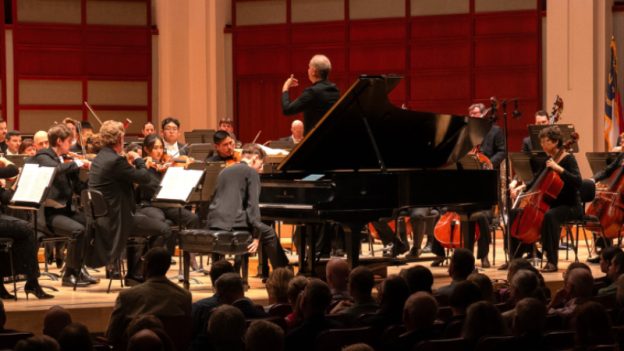
North Carolina Symphony; Carlos Miguel Prieto, conductor; Boris Giltburg, piano
Claude DEBUSSY Prélude à l’après-midi d’un faun (1894)
Claude DEBUSSY: Prélude à l’après-midi d’un faun (1894)
Silvestre REVUELTAS: (arr. José Yves LIMONTOUR): La noche de los mayas (1938/1960)
Igor STRAVINSKY: Petrushka (1911 / 1947)
Christopher Hill | 21 SEP 2026
Raleigh’s North Carolina Symphony opened its 2026–27 season with a concert that sandwiched a dark and dour Russian concerto between a tract of dappled French sunshine and a colorful French-Russian essay on love and the ironies of egoism. All the program’s works were first played between 1894 and 1911. All three are perennially popular, making this a fitting program for a gala opening event.
Conducting was music director Carlos Miguel Prieto, who in a few short years has left an indelible mark on this ensemble. A lot of conductors can build an orchestra up from middling good to very good. Prieto is the kind capable of taking a regional group from very good to the kind of refined virtuosity associated with major orchestras. Virtuosity of that kind cannot be merely technical; it must convey depth and soul. Audiences in Raleigh heard that level of music-making last spring. As it happens, this fall Prieto will be conducting major orchestras in Chicago and Minneapolis, along with other symphonic ensembles from coast to coast, California to Florida. He’ll also be conducting four concert series programs in Raleigh. If there’s a clue to something going on there, let’s ignore it and get on with the gala opening.
Debussy wrote Prélude à l’après-midi d’un faune between 1892 and 1894. It took a while because he was inventing a new kind of music. The Prélude may fairly be thought of as the first work in which musical impressionism came to full flower. (In a pre-concert talk, Prieto pointed out that the Prélude was given as a ballet in 1912 by the Ballets Russes, the same troupe that premiered Petrushka the year before, and that this ballet connection influenced him when putting together the program.)
Debussy’s lush music has gotten 130+ years of love since it was first heard, but the world it came from is distant, and many of us would be hard-pressed to say exactly what it has to do with a faun, or even exactly what a faun is.
For your reviewer, the key point is that the Prélude comes in the middle of a longish period of Parisian peace, between the German invasion of France in 1870 and the German invasion of France in 1914. When people stop killing each other and also have enough to eat, they tend to get playful, and all kinds of playful stuff was happening in the 1890s and 19-aughts. Artists like Aubrey Beardsley, Henri de Toulouse-Lautrec, and Gustav Klimt; writers like Stéphane Mallarmé and Maurice Maeterlinck; and musicians like Erik Satie and Claude Debussy: all liked to create imaginative artifices that shimmer between a recognizable world and a more idealized, imaginative world. That’s where Debussy’s Greek goat-boy lives, in that shimmer. His sensuality is made more intense by unprecedented attention to recognizable but fleeting sound-surface details, together with a continuous (and idealized) avoidance of resolution between the end of the first musical paragraph and the very last bars of the piece.
Such a world requires a baseline of safety. You can’t play it like the threat-obsessed world of Wagner (this was important to Debussy) or like Franck or Saint-Saëns. And under Prieto’s baton, the ensemble played it just like Debussy, with shifting, translucent textures and a wide range of emotional expression. Principal flutist Megan Torti opened the work with a solo as ravishing as anyone might wish for. She raised the bar and the other players responded in kind. Ten minutes of pure pleasure.
Debussy later became embarrassed by works he wrote before the Prélude, like the 1890 piano piece “Promenade sentimentale,” which he eventually revised 15 years later and renamed “Claire de lune.”
Similarly, Rachmaninoff was embarrassed by his youthful 1891 First Piano Concerto and stopped playing it publicly even before he wrote his Second Piano Concerto in 1900. Nine years elapsed between that masterpiece and the year he gave himself a second concerto to play, namely the Third Piano Concerto, dedicated to the great Galician pianist Josef Hoffmann.
During those intervening years the composer wrote two one-act operas, choral works, a long symphony, a long tone poem, a long piano sonata, a large set of piano variations, plus collections of songs and piano pieces. None of these works was spurned or scorned, and by 1909 Rachmaninoff could pretty much write for himself and expect his public to like (or at least respect) the results. In the Third Concerto, when writing for himself, Rachmaninoff pushed his own capabilities as a composer and pianist beyond their previous limits. Since Rachmaninoff was already a mature and masterful composer and perhaps the greatest pianist in an age of great pianists, the resulting concerto has been and will always be considered one of the most important ones in the repertory. Not by modernists, of course, who might think of him as Rach-moan-enough. That’s fine; modernists have the great Bartók and Schoenberg and Chávez and Carter and Babbitt piano concertos to enjoy.
Meanwhile, back at the shack, Bachtrack lists 30 performances of Rachmaninoff’s Third Piano Concerto in Europe and North America alone between now and next January. The one in Raleigh this weekend featured Tel Aviv–based pianist Boris Giltburg, born in Moscow in 1984. When Giltburg was five, his parents emigrated to Tel Aviv, which he still says is home.
Touring pianists need pied-à-terres, though, and in recent years Giltburg has also been spending time in Amsterdam. Giltburg records a lot for the Naxos label, and among those discs (which include the complete Beethoven sonatas) I’ll single out a recording of Rachmaninoff’s Third Piano Concerto, with Carlos Miguel Prieto conducting the Royal Scottish National Orchestra. In other words, this weekend’s performances were not of the getting-to-know-you variety. The two musicians have thought together about this work before.
In his pre-concert talk, Prieto advised that this would be a poetic performance. It was that, but it was many other things as well. No poet wants to be called a copycat, right? Well, among the 30 performances of Rach 3 being heard in Europe and North America this fall, I double-dog dare you to find another that sounds like Giltburg’s. First, only God and Giltburg know how many thousands of hours in basement practice rooms it took for him to be able to toss off this concerto’s original and longer first-movement cadenza as though it were Chopsticks. Giltburg’s performance overall sounded like the fastest these ears have ever heard, including Marta Argerich’s and Rachmaninoff’s own 78-RPM–minded recording. At the same time, the playing was totally controlled tonally, with delicate sounds flying by alongside thunderous ones.
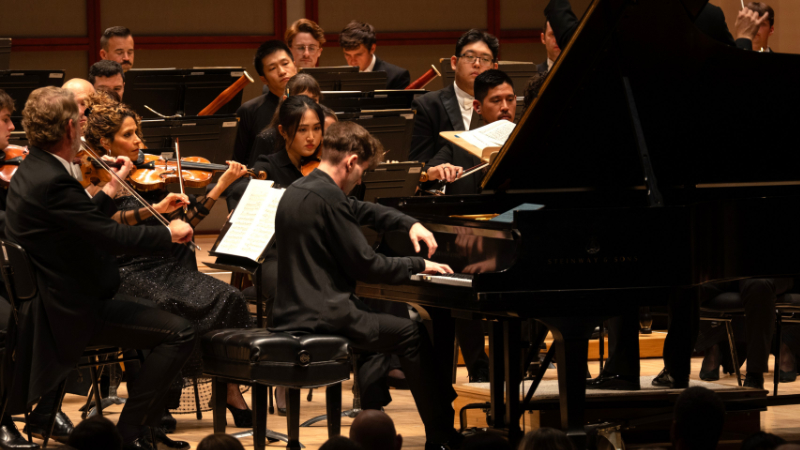
Pianist Boris Giltburg performs Rachmaninoff’s Third Piano Concerto with the North Carolina Symphony and music director Carlos Miguel Prieto. (courtesy of NCS) (courtesy of NCS)
The left-hand octaves in the last movement were nothing short of stunning — actually stunning. I was stunned. The most pronounced feature of this performance, to this reviewer at least, was its almost complete eschewal of the elegiac (sometimes the strings couldn’t help themselves). Interpretively, this was not just an extrovert’s Rachmaninoff but a take-no-prisoners Rachmaninoff. For those familiar with the score, it was surely striking how consistently Giltburg sped up during the precise passages where other pianists linger.
By no means, though, has Giltburg totally rejected performing tradition. By the mid-20th century, it had become common practice to take Rachmaninoff’s striking, simple opening 24 measures at a slower pace than the score indicates, then shift to a quicker pulse when the passagework begins. Rachmaninoff himself did not do this, but Giltburg did, as virtually everyone else did. But some shifts are more abrupt than others, and in this one the orchestra and soloist took a few bars to settle into the new tempo together. During the exposition of the first movement, Giltburg often played so softly that doubling solo lines in the orchestra, even the bassoon’s, could drown him out. A pity the band couldn’t break with traditional habits here, for Giltburg’s conception had both atmosphere and architecture in its favor. That said, from the development onward, Giltburg played louder and/or the orchestral soloists played softer, so all was well.
Whether Giltburg’s approach really fits the music is a matter of personal taste, at least in the first two movements. But in the last movement, with its quirky gothic ironies, Giltburg was revelatory. There wasn’t a single measure that merely connected other interesting stuff. Every note was vital, bracing, and totally alive. Not to mention unquestionably super-virtuosic. At the music’s end, a long-suppressed roar of appreciation rose immediately from the auditorium. And even a reviewer was forced to stand up if he wanted to see what was happening on the other side of the proscenium.
Giltburg required almost no coaxing to offer his encore, Scriabin’s well-known Étude in E Major, op. 8, no. 5, which he played with alternately tender and passionate brioso. The audience was charmed and stood for a second time.
Stravinsky’s Petrushka began life in Clarens, France, as a draft of a piano concerto, not too many months after Rachmaninoff played the premiere of his Third Piano Concerto in New York City. In an interview given not long after the ballet’s opening, Stravinsky said, in effect, that the work was intended to be a slap in the face to his old mentor, Rimsky-Korsakov, whose 1907 opera Le coq d’or sounds rather like Stravinsky’s 1910 ballet L’oiseau de feu. Whether this seeming hostility was manufactured for the press or was genuine, Stravinsky at that time was intimate with one of Rimsky-Korsakov’s sons and may have been responding indirectly to parenting issues. All you need to enjoy the music, however, is the music, which is indeed quite different from L’oiseau de feu, whose plebeian source material is a world away from cultivated skazka (fairy tale) fantasies.
Stravinsky had turned from studying composers like Roussel (especially the First Symphony) and Ravel to the more revolutionary aesthetic of Florent Schmitt, with whom he maintained friendly relations until Schmitt’s death in 1958. That influence was even more important for Le sacre du printemps, but it’s easy to hear in Petrushka, too. Despite its use of populist materials, Stravinsky’s second ballet belongs to its aesthetic period. Thus Petrushka employs a pit orchestra of immense size. Stravinsky made a concert suite, of course, using more or less identical instrumentation. Following the Great War, Stravinsky revised this instrumentation, and he did so again following World War 2, when he was starting to get regular gigs as conductor of his own works. The version played this weekend is that last one from 1947.
Your reviewer has been listening to Petrushka for 75 years yet is still astonished by the brilliance and originality of its sound world, especially when heard live in a performance as well-balanced and colorful as that of the North Carolina Symphony this weekend. What an orchestrator, and what a performance! There were a couple of small stumbles in difficult brass solos that kept this from being an ideal realization, but who wants to judge 37 minutes of superb execution by a single collective second of it? Not this reviewer. Prieto excels in Stravinsky, and one hopes Raleigh will someday get to hear him perform later works such as, say, the Symphony in Three Movements. For now we can be grateful for what we have, and at the work’s conclusion the audience did exactly that, with a demonstration of enthusiastic gratitude. ■
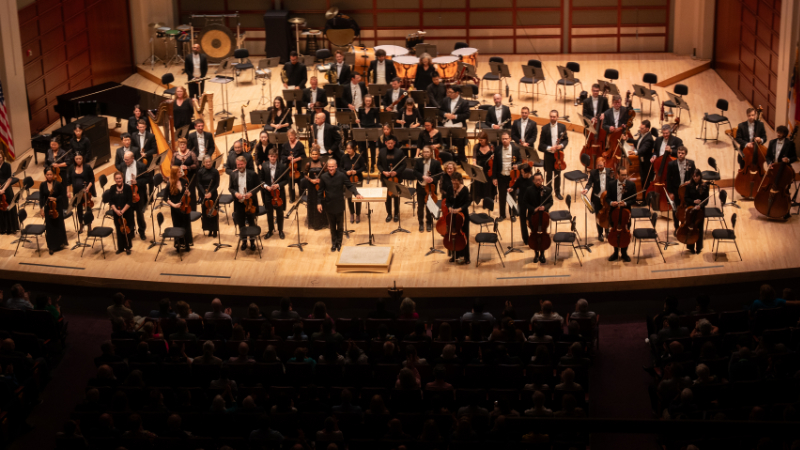
The North Carolina Symphony with its music director, Carlos Miguel Prieto. (courtesy of NCS)
EXTERNAL LINKS:
- North Carolina Symphony: ncsymphony.org
- Carlos Miguel Prieto: carlosmiguelprieto.com
- Boris Giltburg: borisgiltburg.com

Read more by Christopher Hill.


.png)