
Mark Gresham | 23 SEP 2026
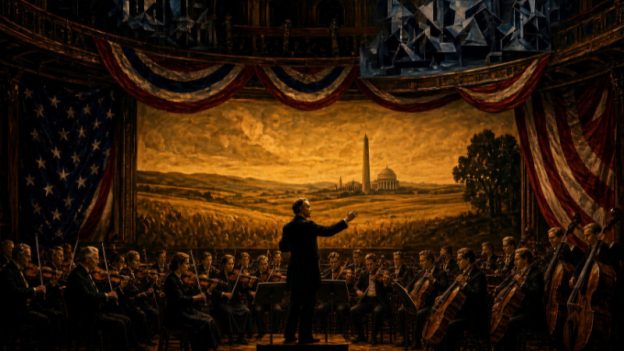
America’s Semiquincentennial gave the nation’s orchestras a rare civic opportunity. For one season they could have argued, in sound rather than press releases, that the United States produced a classical tradition after World War II that was not merely a well-funded European outpost with better marketing. They could have treated the country’s orchestral history as a body of work with a difficult, original mid- and late-century core. A striking number of them did not. They served the safest patriotic tokens—Copland, Gershwin, Bernstein, honorary Dvořák—plus a layer of identity-themed new commissions. The result is a civic pageant that treats American music as a brand rather than a repertoire.
The contrast with 1976 is instructive and unflattering. Fifty years ago the National Endowment for the Arts Bicentennial Orchestra Commissioning Project put major new scores onto the stages of six leading orchestras, at the center of a larger national commissioning effort. Elliott Carter wrote A Symphony of Three Orchestras for the New York Philharmonic, a Bicentennial commission that premiered in 1977. John Cage produced Renga and Apartment House 1776 for Boston’s Bicentennial commission. Jacob Druckman, Morton Subotnick, David del Tredici, and Leslie Bassett delivered works that were not “about America.” They were American modernism exercising the freedom the occasion supposedly celebrated. The emphasis was on commissioning and performing new orchestral works, rather than video packages or celebrity narrators that often accompany anniversary programming today. They came with the assumption that an anniversary was a reason to trust the more challenging music the country had recently made.
2026 had no equivalent national scale and far less appetite for difficulty. What the programs actually contain is easy to inventory because it repeats so faithfully. From Cedar Rapids and Oklahoma City to Pasadena, Missoula, New Jersey, and Atlanta, the recycled core appears: Copland’s Fanfare for the Common Man, Appalachian Spring, Lincoln Portrait, and Symphony No. 3; Gershwin’s Concerto in F, Rhapsody in Blue, excerpts from Porgy and Bess, and An American in Paris; Bernstein’s Symphonic Dances from “West Side Story” and a new arrangement of MASS; John Williams fanfares; and Dvořák’s “New World” Symphony treated as honorary American because it was premiered in Carnegie Hall and contains a famous English-horn tune. This cluster is the brochure. It photographs well. It does not require anyone to defend a harmonic language that still sounds like 1961.
Over that core sits the new-work overlay. Peter Boyer’s American Mosaic travels with narration and projections. Julia Wolfe’s Liberty Bell, commissioned in connection with the 250th anniversary and performed in Philadelphia during the 2026 celebrations, takes a different approach. Philip Glass’s “Lincoln” Symphony, premiered by the Boston Symphony Orchestra at Tanglewood after Glass withdrew it from the Kennedy Center, turns to the 16th president as its subject. Nkeiru Okoye’s A Time for Jubilee, marking the 60th anniversary of the Selma-to-Montgomery marches, brings the civil-rights movement into the American Semiquincentennial frame. Juan Pablo Contreras’s Symphony No. 1, “My Great Dream,” traces his journey from Mexico to U.S. citizenship, placing the immigrant experience within the broader American story. The New York Philharmonic commissioned 18 living composers to orchestrate variations from Frederic Rzewski’s The People United Will Never Be Defeated! turning a landmark solo-piano work into a collective orchestral statement. Orchestra Lumos commissioned Five American Portraits, a new work by five composers—Christopher Theofanidis, Nicky Sohn, Clarice Assad, Quinn Mason and Liam Cummins—for its 2026 anniversary season.
These pieces are far from worthless. Some of them are skillful. Collectively they function as the approved contemporary slot: narrative, topical, often explicitly about identity or civic virtue, and almost never in conversation with the American scores that made the mid-century orchestra a laboratory rather than a heritage site.
The missing American century is the one that actually happened after World War II. Charles Ives, whose major work preceded it, was finally being recognized as a distinctly American modernist; the 1947 Pulitzer Prize for his Third Symphony was followed by his famous dismissal of prizes as being “for boys.” The next generation, emerging after the war, included Elliott Carter, Roger Sessions, William Schuman, Milton Babbitt, Morton Feldman, George Crumb, Lou Harrison, Conlon Nancarrow, Leon Kirchner, Andrew Imbrie, and, later, Christopher Rouse, Steven Stucky, and Alvin Singleton. They solved problems of form, rhythm, and density that European models did not dictate. Their orchestral works are not footnotes. They are the evidence that American composers stopped asking permission. Their absence from anniversary seasons is not a scheduling accident. It is a statement that “American classical music,” for institutional purposes, means either the 1930s–50s populist style or the living-composer “identity” commission. Minimalism appears mainly as Glass and Adams, while performances of Steve Reich remain largely extra-orchestral. The high modernists and serialists are treated as specialist repertoire, which is another way of saying they are not part of the national story the orchestras are willing to tell in public.
The pattern persists for reasons that have nothing to do with ignorance. Anniversary concerts must sell and photograph well. A Carter symphony or a Crumb work does not produce the same video package as Lincoln Portrait plus a new “mosaic” with historic images and a familiar actor reading from the Founders. Programming departments have learned that Copland–Gershwin–Bernstein is the only pre-approved American canon that will not empty the hall on a Tuesday in September. The identity-themed commissions satisfy a different institutional need: they demonstrate that the orchestra has noticed the present. Neither habit requires anyone to revive the music that made American orchestras, for a few decades, something other than touring museums of the nineteenth century.
A serious anniversary season was available. It would have paired one familiar token with one substantial postwar score on the same night—Copland’s Appalachian Spring with Carter’s Variations for Orchestra, or Schuman’s Sixth Symphony after Gershwin. It would have revived a handful of the 1976 commissions instead of only generating new narrative pieces. It would have treated the mid-century modernists as part of the country’s achievement rather than as a tax that new-music presenters pay so the rest of the season can remain polite. That season did not happen at scale. What happened instead is a playlist.
The identity test was never whether orchestras could find American names. It was whether they would trust the harder American music of the last seventy-five years—the music that does not flatter the listener with recognition in the first eight bars, the music that does not come with a ready-made story about prairies, jazz, or the Founding. Most orchestras chose the brochure. An anniversary that cannot bear its own modernists is not celebrating a tradition. It is managing a brand. The country produced more than that. The institutions, this year, decided not to. ■

Read more by Mark Gresham.



.png)