

Marc-André Hamelin, piano.
Frank ZAPPA: Ruth is Sleeping (arr. Ali N Askin)
John CAGE: The Perilous Night (1944)
John OSWALD: Tip (2021)
Yehudi WYNER: A Refrain (2012)
Stefan WOLPE: Passacaglia (1936, rev. 1979)
Salvatore MARTIRANO: Stuck on Stella (1979)
Marc-André HAMELIN: Hexensabbat (2023)
Hyperion CDA68457
Formats: CD, digital
Release Date: November 202
Total Duration: 76:57
Giorgio Koukl | 12 DEC 2025
The title Found Objects / Sound Objects of this new Hyperion CD is a nice way to describe pianist Marc-André Hamelin’s intention to bring together seven composers, including himself, to demonstrate the full range of what a piano can produce in terms of variations and colorful atmospheres.
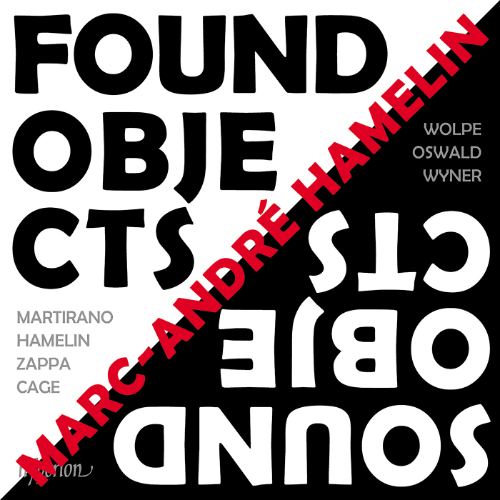
CDA68457 cover art
Once a disregarded way for the most classical labels, which mostly insisted on monographic content, this is nonetheless a very effective way to bring together some of the most well-known composers, like Frank Zappa or John Cage, with far lesser-known names. In this sense, the album is already worth our attention. The choices made are well explained by the pianist himself in the very valuable booklet, and, following his words, the music unfolds effortlessly, even if it must have been tremendously difficult to gather scores from the quite infinite ocean of existing piano music of our day. Some choices are quite logical and convincing, while others are of lower quality, and their inclusion might raise some doubt.
The two best pieces are at the beginning of this installment (Zappa) and at the very end (Hamelin).
Ruth is Sleeping, written by Frank Zappa (1940-1993) in numerous versions between 1982-83, is here played in the arrangement of Ali N Askin. The pianist captures our attention immediately with his incredible technique and capacity for shadowing the tiniest detail, all this with breathtaking speed. All would be well. But despite the effort of Hamelin, the endless repetitions of musical material with no real development or contrast after a while seem a hint too long even if lasting slightly under six minutes. This is probably due to the purely electronic origins of the score.
Far more shaded is the last piece on this CD, Hexensabbat (2023), by the pianist himself. Well, Hamelin is no stranger to writing excellent music, and he fully confirms his abilities here. From the haunting beginning to the crescendo finale played on the limit of any technical means, there is much room for rarefied material, where plenty of room is given to the pianist to demonstrate also his ability for cantabile. Written on a short theme he composed in his young years, it is certainly a magnificent contribution to the piano literature, even if not so many pianists will have the technical abilities to perform this score on the same level as Marc-Andrè Hamelin.
Just another interesting score is The Perilous Night (1944), written by John Cage (1912-1992). It has six movements with no titles, some lasting only a few seconds, some more developed. All this is played on a so-called “prepared piano” where different objects are inserted on or between the chords so that the original piano sound is practically absent. Realizing that on the tiny stage where dancer Syvilla Fort would have to dance, the original idea of the composer to use a group of percussionists was impossible to realize. But, as sometimes happens, from a limitation, a very new idea of changing the classical sound of a piano to something far more percussive was soon born. Much has been written about the composer’s personal situation; this music certainly expresses the anguish and despair perfectly. Hamelin plays this in a perfectly dry and unsentimental way (as it should be), obtaining a great effect.
The Canadian composer John Oswald (1953-) wrote his Tip in 2021, creating a sort of collage of many different musical ideas from the past, some of them recognizable, others so hidden that only a profound study of the score reveals them. While played with the usual bravura by the pianist, this is nonetheless to be considered among the lesser lucky choices of this installment.
Three other compositions are present on this CD: some of a considerable length, nearly 15 minutes. A Refrain (2012) by Yehudi Wyner (1929), a Passacaglia (1936, revised in 1979) by Stefan Wolpe (1902-1972) and finally a piece called Stuck on Stella (1979) by today completely forgotten composer Salvatore Martirano (1927-1995), a personality who would deserve much more than a brief mention in this review.
Now, what speaks of the great value of this proposal is the simple fact that those works were chosen and played by the gifted hands of Marc-André Hamelin.
He is giving them the right dignity which should be given to any piece of art, but is alas so rare nowadays.
This is the great force of this quite wild potpourri: mixing known and unknown in a sapient and definitely perfect way of interpretation. ■
EXTERNAL LINKS:
- Marc-André Hamelin: marcandrehamelin.com

Read more by Giorgio Koukl.




.png)