

November 29, 2025
Boston Symphony Hall
Boston, Massachusetts – USA
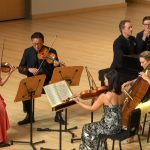
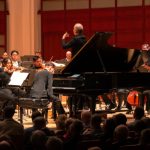
Boston Symphony Orchestra; Samy Rachid, conductor; Pablo Ferrández, violoncello.
Antonín DVOŘÁK: Cello Concerto in B minor, Op. 66
Antonín DVOŘÁK: Symphony № 8 in G, Op. 88
Karl Henning | 4 DEC 2025
A
Dvořák was sufficiently famous outside of Europe that Jeannette Thurber (a former music teacher married to a wealthy wholesale grocer) solicited the composer to come to America to serve as Director of the National Conservatory of Music, founded by Thurber in 1885 at 47-49 West 25th Street. Dvořák initially signed a two-year contract, but did sign on for a third year, and so it was that he was in New York when he composed his Cello Concerto.
While at work on the “Adagio ma non troppo” second movement, the composer learnt that a beloved sister-in-law, Josefina Kaunitzová, was seriously ill. The first of Dvořák’s Opus 82 Songs—“Leave Me Alone” (“Kéž duch můj sám”) was a favorite of his sister-in-law’s, so he incorporated a reference to the song in the middle of the second movement. Dvořák completed the third (and final) movement in New York on 9 February (his son Otáček’s birthday, dedicating the score to his close friend, cellist Hanuš Wihan. Later, after having returned to Bohemia, Dvořák revised the score, inserting 60 measures of quiet music before the close of the Finale third movement, including another recollection of “Kéž duch můj sám,” so that the Concerto is in effect a kind of memorial to his sister-in-law.
Soloist Pablo Ferrández played brilliantly, warmly, and expressively. The Concerto is a personal favorite of mine since playing in a college orchestra performance. Dvořák’s scoring is masterly (second to none in the nineteenth century, in my view). I have literally 40 favorite moments in the piece, including passages of delicate trios, when the soloist interacts with paired clarinets, or horns, say. Ferrández, BSO Assistant conductor Samy Rachid (himself a cellist) and the members of the Boston Symphony Orchestra made sonic jewels of all these passages. One of my favorite moments of Saturday’s concert was a passage late in the “Finale,” a violin/cello duet, in effect, between Ferrández and first associate concertmaster Alexander Velinzon, towards the end of Dvořák’s “quiet insertion.”
Of Dvořák’s symphonies, easily the most popular is the Ninth, the “New World.” As one who does indeed love the E minor Symphony, I’ll go ahead and say it: the “New World” Symphony is overplayed. I will stipulate that (like Beethoven’s Ninth) it certainly deserves its popularity. Still, my point is that it almost seems that when any Dvořák symphony other than the Ninth is programmed, an angel earns their wings.
Dvořák composed his Eighth between 26 August and 8 November 1889. The composer conducted the première in Prague on 2 February 1890. Arthur Nikisch led the BSO in the American première on 27 February 1892. The first movement begins in earnest character, but tonally coyly in the parallel minor (G minor). When we do ease into G Major, the principal theme is ebullient and cheerful. Over the course of the movement, it may become fanfarish. Almost like a Tchaikovskyan “Fate” motif, the minor music of the intro barges in periodically, but it is always foiled by the good humor of the principal theme.
The second movement, “Adagio,” like so many of Dvořák’s slow movements, flows with tireless invention and seemingly effortless lyricism. Over the course of the movement, there are passages which return (almost never simply literally), but overall, the “design” has a refreshingly impromptu feeling. In our lifetime, there is a compositional method which Frank Zappa christened AAAFNRAA (Anything Anywhere Anytime For No Reason At All). And this “Adagio” is one of a number of slow movements in which I am close to feeling that Dvořák was this method’s forebear.
The third movement, “Allegretto grazioso,” is a minor-mode Valse rather than a Scherzo, the minor mode perhaps reflecting the first movement’s “fateful” intrusions. Here, too, the nostalgic dolor of the Valse is ultimately dispelled by a bumptious G Major coda. This movement is one of Dvořák’s most exquisite creations. After an introductory fanfare, the last movement is a theme with structurally increasing liberal variations.
Samy Rachid did a superb job throughout. He was energetic (indeed, he practically danced at times), and between him and the orchestra, there was always musical comfort, never complacency. It was a great way to close out the regular season at Symphony Hall. ■
EXTERNAL LINKS:
- Boston Symphony Orchestra: bso.org
- Samy Rachid: samyrachid.com
- Pablo Ferrández: pabloferrandez.com

Read more by Karl Henning.



.png)