
March 11, 2026
Spivey Hall
Morrow, Georgia – USA
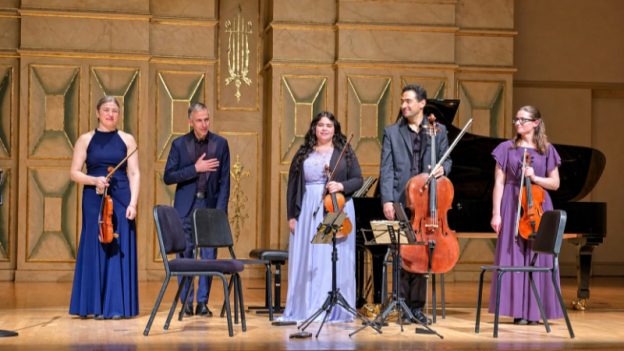
Amy Schwartz Moretti, violin; Benjamin Hochman, piano; Raman Ramakrishnan, cello; Holly Parker, violin; Anna Stein, viola.
Ludwig van BEETHOVEN: Piano Trio No. 7 in B-flat major, Op. 97 “Archduke”
César FRANCK: Piano Quintet in F minor, Op. 14
William Ford | 25 APR 2026
The Fabian Concert Series at the Mercer University Townsend School of Music continues to serve as a bridge between professional artistry and student development, placing emerging musicians alongside established performers in shared repertoire.
Last evening’s concert at Spivey Hall, Morrow, GA, carried an added sense of transition. Violinist Amy Schwartz Moretti opened the program by noting that this would be her final appearance on the Fabian series, as she prepares to return more fully to the concert stage after twenty years leading the Robert McDuffie Center for Strings. Her tenure has been central to the identity and success of the program.
She was joined by the noted pianist Benjamin Hochman and renowned cellist Raman Ramakrishnan of the Daedalus Quartet. They were joined in the second half by two McDuffie young artists.
Attendance was notably sparse, with no more than twenty-five patrons in the hall, a surprising circumstance given the stature of the performers and the ambition of the program. Moretti hinted that this series at Spivey might also be coming to an end.
The repertoire itself offered a clear throughline: two large-scale chamber works that approach musical coherence from different directions—Ludwig van Beethoven through proportion and architectural balance, and César Franck through cyclical return and cumulative intensity.
Beethoven: Piano Trio No. 7 in B-flat major, Op. 97 “Archduke” (1810-11)
Beethoven’s “Archduke” Trio stands as one of the defining works of the piano trio repertoire, expanding the genre into a fully integrated three-part discourse of symphonic breadth. The violin, cello, and piano operate as equal partners, and the work depends on long-range structural control rather than local contrast.
The opening movement unfolds in broad spans, requiring sustained line and careful proportional balance. The Scherzo shifts the focus to rhythmic clarity and articulation, while the “Andante cantabile,” built as a set of variations, forms the expressive and structural core of the work. The finale emerges as a natural release, continuing rather than breaking the musical argument.
This was a nearly ideal performance. The ensemble operated with a unity of purpose that was immediately apparent, reflected in both balance and tempo. Nothing felt imposed or negotiated in the moment; rather, the performance suggested a shared conception of the work from the outset.
Moretti’s tone was silky and golden, and the similarity of timbre between violin and cello was striking, at times creating the impression of a single, blended instrument. Ramakrishnan matched this with equal refinement, while Hochman integrated seamlessly into the texture, avoiding dominance while maintaining clarity of line. The technical command of all three players was evident, but more importantly, the performance conveyed a sense that this was music approached as a labor of commitment rather than display.
Franck: Piano Quintet in F minor, Op. 14 (1879)
César Franck is perhaps best known for his Symphony in D minor (1888), a work that enjoyed considerable popularity in the mid-twentieth century, though it is heard less frequently today. That symphony is often characterized by density, melodic profile, and a degree of restraint within its expressive language.
The Piano Quintet, composed in 1879, presents a marked contrast. It is a work of sustained intensity, driven by cyclical form and harmonic accumulation. Its thematic material recurs insistently, binding the movements together while generating continuous pressure. The quintet’s unusually charged character has often invited biographical speculation, with some writers linking its intensity to personal emotional strain in Franck’s life. Whether or not that connection can be sustained, the music itself projects a level of sustained pressure that stands apart from his more restrained works.
I first encountered the quintet several years ago and was struck by its florid, almost overwrought character, which seemed at odds with what one might expect from a church organist.
The Fabian performance fully embraced the work’s intensity. What emerged in the acoustics of Spivey Hall was a kind of supercharged romanticism, characterized by repeated cycles of gradual crescendo followed by brief returns to lower dynamic levels, only for the process to begin again, i.e., repeated episodes of building tension then release. This pattern was especially pronounced in the first movement, where the accumulation of intensity became a defining feature.
Even the relative calm of the second movement retained a sense of agitation, with dynamic levels that rarely settled. By the time the third movement arrived, the trajectory was clear: it unfolded in a sustained state of heightened intensity, consistently loud and pressing forward.
The result, at least from this listener’s perspective, was exhausting. The unrelieved loudness and density made the work feel wearisome, with little sense of contrast or respite. One became aware less of structural development than of continuous pressure, and by the final pages, the desire for resolution extended beyond the music itself.
It is perhaps not surprising that later composers would seek alternatives to this kind of sustained intensity. Claude Debussy turned toward color and harmonic ambiguity, allowing sound to exist without constant forward drive, while Igor Stravinsky reoriented musical structure around rhythm and contrast rather than accumulation. Heard in that light, Franck’s quintet can seem less an endpoint than a limit case—one that helps explain why the next generation moved in a different direction.
Moretti, Hochman, and Ramakrishnan were joined in the Franck by two McDuffie students, violinist Holly Parker and violist Anna Stein, and the performance was executed with evident skill and commitment. However, the burnished quality of Moretti’s tone, so striking in the Beethoven, was largely subsumed in the Franck. At higher dynamic levels, it occasionally took on a harder edge, a byproduct perhaps of the demands the piece places on sheer volume and projection.
Program Perspective
Taken together, these works present two distinct approaches to large-scale musical construction. Beethoven’s trio articulates its argument through proportion, balance, and long-range planning. Franck’s quintet builds coherence through recurrence, harmonic density, and cumulative force.
The contrast could not have been more clearly drawn in performance. This was a bold programming choice that benefited from the musicians’ world-class skills. Moretti demonstrated that her planned return to the concert stage is not only understandable but a natural extension of the musical authority and refinement she brought to this performance. ■
EXTERNAL LINKS:
- McDuffie Center for Strings: mcduffie.mercer.edu
- Spivey Hall: spiveyhall.org

Read more by William Ford.



.png)