
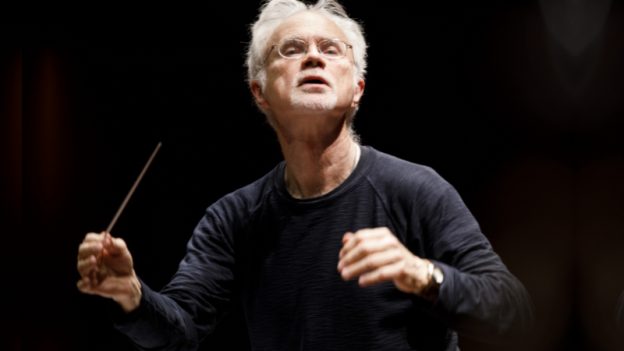
Pianist Orli Shaham steps in with poise and rhythmic command in Adams’ ‘Must the Devil Have All the Good Tunes?’
April 18, 2026
Jones Hall
Houston, Texas – USA
Houston Symphony, John Coolidge Adams, conductor; Orli Shaham, piano.
Charles IVES: The Unanswered Question (1935)
John ADAMS: Must the Devil Have All the Good Tunes? (2018) (Houston Symphony premiere)
John ADAMS: The Rock You Stand On (2024) (Houston Symphony premiere)
Aaron COPLAND: Suite from Appalachian Spring (1944)
Astor PIAZZOLLA: Three Tangos (1974–1994), arr. Adams 2026 (Houston Symphony premiere)
Lawrence Wheeler | 20 APR 2026
Saturday’s Houston Symphony concert at Jones Hall carried a sense of occasion with the appearance of composer-conductor John Adams. Widely regarded as the most celebrated living American composer, Adams framed his program with works by Charles Ives and Aaron Copland—two formative influences. Pianist Orli Shaham stepped in as a last-minute replacement for an ailing Víkingur Ólafsson in Adams’ piano concerto Must the Devil Have All the Good Tunes? The program also included Adams’ arrangements of three tangos by Astor Piazzolla.
The concert opened with Ives’s The Unanswered Question. Composed in 1908 and revised in 1935, the work has become a repertory staple. Against a backdrop of muted strings, an offstage trumpet poses the existential query, “Why am I living?” A quartet of flutes attempts a response, growing increasingly agitated and atonal before dissolving into impatience and mockery. The trumpet’s final question lingers unanswered as the strings fade to nothingness.
Trumpeter Mark Hughes delivered the offstage part with poise. Associate conductor Gonzalo Farias adeptly coordinated the independent flute quartet from a crouched position behind the podium. Ives said the muted strings should be “off stage,” or away from the trumpet and flutes, and remain ppp throughout, embodying “The Silences of the Druids—who Know, See and Hear Nothing.” Here, placed onstage, the strings projected too prominently, with noticeable dynamic creep and an inconsistent approach to vibrato. The result diluted the work’s intended stillness and mystery.
Adams’ Must the Devil Have All the Good Tunes?, commissioned and premiered by the Los Angeles Philharmonic with Yuja Wang and Gustavo Dudamel, received a committed performance under challenging circumstances. With just ten days’ notice, Shaham brought technical assurance and a finely honed chamber sensibility, shaping a persuasive account.
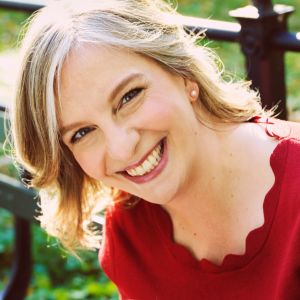
Orli Shaham (credit: Karjaka Studios)
Adams launched the opening movement at a tempo slightly brisker than his own marking and recorded benchmark. Shaham met the challenge with incisive articulation and rhythmic drive. The “gritty, funky, but in strict tempo” opening suggests a clear kinship with Henry Mancini’s “Peter Gunn” theme—one of the few moments resembling a conventional tune. Adams’ language prioritizes rhythm and texture; at this tempo, however, density outweighed clarity. Cross-rhythms blurred, inner pulsations receded, and the groove struggled to settle. Ensemble cohesion depended largely on Shaham’s constant visual coordination with the podium.
The second movement offered a measure of repose but little melodic cohesion. Adams favors wide, angular intervals over stepwise motion, producing a jagged, elusive line that resists memorability. Shaham nevertheless sustained a beautifully controlled legato, lending the music as much continuity as possible.
The finale, marked “Obsession/Swing,” proved the most compelling. Built on a propulsive, quasi-tarantella compound meter, it cycles through deconstruction and renewal. The swing is enhanced by a honky-tonk piano and a bass guitar playing a motif straight out of Nixon In China (for which I played the world premiere 39 years ago). Here, the performance finally locked into place: Shaham embodied the rhythmic vitality, and Adams drew a cohesive, energized response from the orchestra.
Composed in 2024, The Rock You Stand On, written for Marin Alsop, reflects Adams’ recent style with clarity. The Houston Symphony premiere unfolded with strong rhythmic definition and a clear architectural arc, culminating in a deftly handled offbeat close. Adams’ direct, energetic conducting elicited a confident orchestral response.
Copland’s Appalachian Spring, heard in its full-orchestra version, closed the main program. The faster sections pushed ahead at tempos that compromised clarity and ensemble precision, while the slower passages revealed the orchestra at its best—finely balanced, well tuned, and shaped with expressive nuance. The Shaker tune “Simple Gifts” emerged with warmth and dignity, leading to a satisfying conclusion.
Adams’ arrangements of three Piazzolla tangos provided a vibrant finale. Orchestrally, this was the evening’s highlight, vividly evoking the atmosphere of a Buenos Aires dance hall. La Mufa opened with a sensuous cello solo from Brinton Smith; Oblivion featured a hauntingly beautiful soprano saxophone solo by Nathan Nabb, played with exquisite phrasing and sound, joined by a tonally splendid French horn solo by Nathan Cloeter; and Libertango surged forward with crisp bass section pizzicatos, followed by ravishing solos by flutist Matthew Roitstein and Mark Nuccio on clarinet. Adams’ arrangements proved both idiomatic and imaginatively scored—an exhilarating close to the program.
Many composers have taken the podium to conduct their own works—Copland, Stravinsky, Bernstein, and Beethoven among them—with mixed results. John Adams’ legacy as a composer is secure; his contributions continue to enrich the musical landscape. ■
The program was repeated Sunday afternoon.
EXTERNAL LINKS:
- Houston Symphony: houstonsymphony.org
- John Coolidge Adams: hearbox.com
- Orli Shaham: orlishaham.com

Read more by Lawrence Wheeler.
.png)