
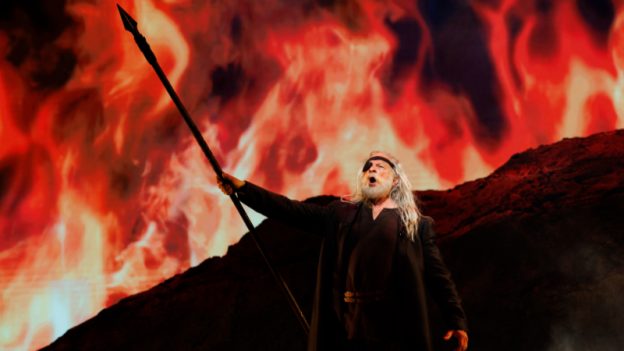
The Ring cycle’s conclusion marks both an artistic culmination and a visible signal of the company’s institutional transformation.
Mark Gresham | 27 MAY 2026
For more than a decade, The Atlanta Opera has been steadily redefining what kind of company it wants to be.
Not through a single grand gesture, but through a sequence of increasingly ambitious inflection points — each one building institutional confidence, artistic credibility, and public visibility. Under general and artistic director Tomer Zvulun, the company expanded its repertoire, experimented with alternative venues, survived the pandemic through audacious outdoor productions that drew national attention, launched a film studio, and climbed into the upper tier of American opera companies by budget and profile.
Now, this Saturday, May 30, that evolution arrives at its most consequential milestone yet: the opening of Richard Wagner’s Twilight of the Gods (‘Götterdämmerung’), the final chapter of the monumental Ring cycle that The Atlanta Opera has spent four seasons bringing to life.
The achievement is larger than a single production.
When the curtain rises at Cobb Energy Performing Arts Centre, The Atlanta Opera will complete what company leaders describe as the first fully staged Ring cycle ever mounted in the Southeast — and, according to Zvulun, the first new American staging of the complete cycle to reach completion since the pandemic.
That matters because Wagner’s Ring remains one of opera’s defining institutional tests: a sprawling, four-opera epic requiring enormous financial resources, orchestral and vocal stamina, technical sophistication, and years of sustained organizational commitment. Many companies aspire to mount a Ring. Far fewer finish one.
For Atlanta, completing the cycle signals something broader about the city itself and the cultural ambitions of the contemporary South.
Historically, Rings have been associated with the legacy capitals of American opera: New York, San Francisco, Chicago, and Seattle. Atlanta was not traditionally part of that conversation. But over the past decade, the city’s flagship opera company has steadily expanded both its reach and its sense of possibility.
The groundwork began soon after Zvulun arrived in 2013. The company broadened its artistic scope and began moving beyond a conventional regional company model. Alternative-space programming through the “Discoveries” series helped cultivate new audiences while allowing Atlanta Opera to experiment outside standard repertory expectations.
Then came the pandemic.
While many American companies went dark during COVID-19 shutdowns, Atlanta Opera drew national and international attention by constructing an outdoor circus-tent venue and continuing to stage live performances. The move was risky, expensive, and logistically daunting, but it transformed the company’s national profile almost overnight. The productions generated coverage from major national media outlets and established Atlanta Opera as one of the country’s most inventive organizations during a moment of existential crisis for the performing arts.
Rather than retrenching after the pandemic, the company accelerated.
The Atlanta Opera Film Studio emerged from that period. The company’s budget and visibility grew. Productions began circulating more widely through co-productions and streaming initiatives. Industry observers increasingly spoke of Atlanta Opera not merely as a strong regional company, but as an emerging national player.
The Ring cycle became the clearest expression of that new ambition.
When Atlanta Opera launched Das Rheingold in 2023, the undertaking was already being described as the most ambitious project in company history. Over the next several seasons came ‘Die Walküre,’ ‘Siegfried’ and now ‘Twilight of the Gods,’ the cataclysmic conclusion in which Wagner brings gods, heroes and civilizations crashing into ruin.
The signs of transformation are no longer only artistic. As The Atlanta Opera completes Wagner’s vast mythic cycle onstage, cranes and construction crews are reshaping the company’s future offstage through the new Molly Blank Center for Opera, a permanent institutional home that would have been difficult to imagine a decade ago.
The opera itself unfolds on a mythic scale.
Deception, corrupted power, revenge, and sacrifice drive the drama toward its apocalyptic finale, as the cursed ring at the center of Wagner’s vast saga ultimately destroys the world built around it. By the end, fire consumes Valhalla, the Rhine overflows its banks, and Wagner’s monumental score surges toward one of the most overwhelming conclusions in all of music drama.
The Atlanta Opera has assembled a formidable cast for the occasion.
German heldentenor Stefan Vinke stars as Siegfried, the fearless hero whose innocence and arrogance propel the tragedy toward disaster. Vinke is among the leading Wagner tenors of his generation, having appeared in major Ring productions at Bayreuth, the Metropolitan Opera, and other major international houses.
Opposite him, dramatic soprano Lise Lindstrom sings Brünnhilde, the Valkyrie whose final act of sacrifice and transcendence gives the opera its emotional and philosophical center. Lindstrom is internationally renowned for Wagner and Strauss heroines and brings both vocal power and psychological intensity to the role.
The supporting cast includes bass David Leigh as the sinister Hagen, baritone Le Bu as Gunther, mezzo-soprano Tamara Mumford as Waltraute, and bass-baritone Aleksey Bogdanov as Alberich.
In the pit, conductor Roberto Kalb leads the Atlanta Opera Orchestra through Wagner’s massive score, a musical architecture of enormous scale and complexity that demands extraordinary endurance from musicians and singers alike.
Zvulun directs the production, working alongside longtime collaborators including set designer Erhard Rom, lighting designer Robert Wierzel, and costume designer Mattie Ullrich.
The creative team faces unusual challenges in Twilight of the Gods. Wagner demands spectacle on an elemental scale: towering halls, supernatural apparitions, massed choruses, epic journeys, and finally the destruction of an entire world. Yet contemporary productions increasingly seek psychological intimacy alongside visual grandeur. The balance between mythic scale and human vulnerability often determines whether a Ring succeeds artistically.
Atlanta Opera’s production appears to aim for precisely that balance — neither rigidly traditional nor aggressively revisionist, but focused on storytelling clarity, theatrical momentum, and visual atmosphere.
The event surrounding the production reflects the company’s understanding that this is more than another repertory presentation.
A free Wagner symposium on the morning of opening day will bring together Zvulun, Rom, Wierzel, and Ullrich for a public discussion moderated by opera scholar Walter Frisch. Meanwhile, audience members can also reserve a themed “Hero’s Feast” buffet — a first-intermission dining experience inspired by Norse and Germanic cuisine.
Even those peripheral events underscore the scale of what The Atlanta Opera is attempting: not simply staging an opera, but building a cultural occasion around it.
That distinction may ultimately define why this production matters.
In opera, institutional transformations are rarely sudden. They emerge gradually through accumulated risks, successful experiments, and expanding artistic confidence. Each inflection point creates the conditions for the next one.
Without the adventurous programming initiatives of the past decade, perhaps the audience for Wagner would not exist. Without the pandemic-era innovations, perhaps the company would not have developed the institutional resilience or national profile necessary to sustain a Ring. Without the steady expansion of ambition under Zvulun, perhaps Atlanta would never have entered the conversation at all.
Now it has.
When Twilight of the Gods opens May 30 at Cobb Energy Performing Arts Centre, the performance will conclude Wagner’s epic cycle. But for The Atlanta Opera, it may also mark the end of one chapter of institutional evolution and the beginning of another. ■
EXTERNAL LINKS:
- The Atlanta Opera: atlantaopera.org

Read more by Mark Gresham.


.png)