
July 4, 2026
Dana Auditorium, Guilford College
Greensboro, North Carolina — USA
Eastern Festival Orchestra; Gerard Schwarz, music director/conductor; Julian Schwarz, cello.
Aaron COPLAND: Suite from Appalachian Spring (orchestral version, 1945)
Ellen Taaffe ZWILICH: Remembrance for Cello and Orchestra (2026; world premiere)
Arthur FOOTE: Cello Concerto in G Minor, Op. 33 (1887–93)
Ellen Taaffe ZWILICH: Jubilation for Orchestra (1996)
George GERSHWIN: An American in Paris (1928)
Christopher Hill | 7 JUL 2026
Greensboro, North Carolina, in 2026 strikes your reviewer not as a snazzy city but as one of the remaining American urban areas where one can drive around more or less randomly and get the impression that the local middle class is doing okay. Greensboro is dotted with pleasant and largish parks where the likes of you and me can approach some version of serenity. Its downtown feels vibrant. It’s an area where, perhaps because of its overall economic health, working parents can unburden themselves of discretionary income at a variety of creative and attractive local restaurants and businesses. Your reviewer always enjoys his time in Greensboro. What brings me here most often is music.
Guilford College has been along for the Greensboro ride since 1837. Over sixty years ago, back in 1961, Guilford began a summer music camp along the lines of Interlochen, and with it the Eastern Music Festival concert series. It was the very end of an era when classical and popular music overlapped in America. Duke Ellington was recording Grieg and Tchaikovsky. Van Cliburn was a hero. Leonard Bernstein’s name was familiar to millions. But as you know, by 1961 Little Richard and Elvis and much else had come to pass, and for the men controlling the purse strings of U.S. entertainment, youth culture and rural culture seemed where the easy money lay, and thus the direction entertainment should go. Fast-forward sixty-some years to 2025, and adult culture, including classical music and literature, now plays a largely peripheral role in our nation’s economy.
No surprise then that in 2025 Guilford College, succumbing to general conditions, found itself unable to continue the summer festival when their hard-working professional musicians, the ones teaching and playing music for the festival, went on strike for higher wages. Result: for the first time in sixty-four years, summer classical music concerts were canceled. What could they do? Times change—we all know that; but Mozart’s music doesn’t.
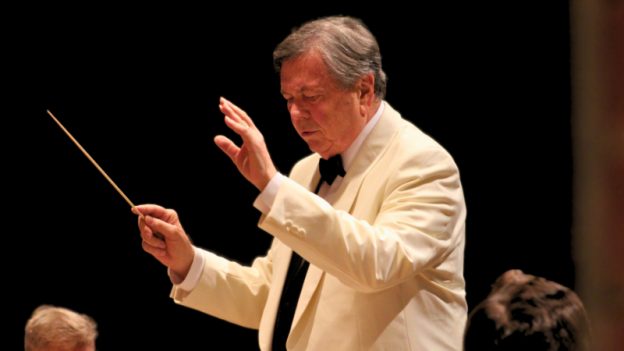
Well, what the college did, in fact, was take its hard times to heart and appoint a new president. The new president then took the college’s hard times to heart and acquired new donors from among her contacts within the one percent. New result: the Eastern Music Festival was reinvented this year as the Eastern Festival of Music. The business model, including ticket prices, has changed. But the festival has retained as many as it could of its former major players, including the most prominent among them, music director Gerard Schwarz. Schwarz was the maestro who brought the Seattle Symphony Orchestra to international prominence in the 1980s, 1990s, and 2000s. He remains today, along with Leonard Slatkin, one of the most respected (and recorded) American conductors of his generation. Under Schwarz’s knowing direction, the festival’s professional orchestra sounds as if the musicians have been playing together for years. A few summers back they played, under Schwarz’s baton, one of the best Mahler Fifths your reviewer has heard.
There was a time when Gerard Schwarz was known as an acclaimed trumpeter. Since transitioning to conducting, he has often chosen repertory based on its musical excellence rather than its popularity. His overall choices are broad and pragmatic, but they have included the Howard Hanson symphony cycle, the William Schuman symphony cycle, orchestral music by Arthur Foote, and many similar pieces that most conductors ignore. In choosing repertoire for this concert, played on the exact 250th anniversary of the signing of the Declaration of Independence, Schwarz has stayed true to form. The program, broad and pragmatic, was framed by the 1945 orchestral version of Aaron Copland’s Suite from Appalachian Spring and George Gershwin’s 1928 orchestral tone poem, An American in Paris. The centerpiece of the program was Arthur Foote’s Cello Concerto in G Minor, performed by Schwarz’s son, cellist Julian Schwarz. Finally, this concerto was sandwiched between two short pieces by contemporary composer Ellen Taaffe Zwilich, the first female to be awarded the Pulitzer Prize for music.
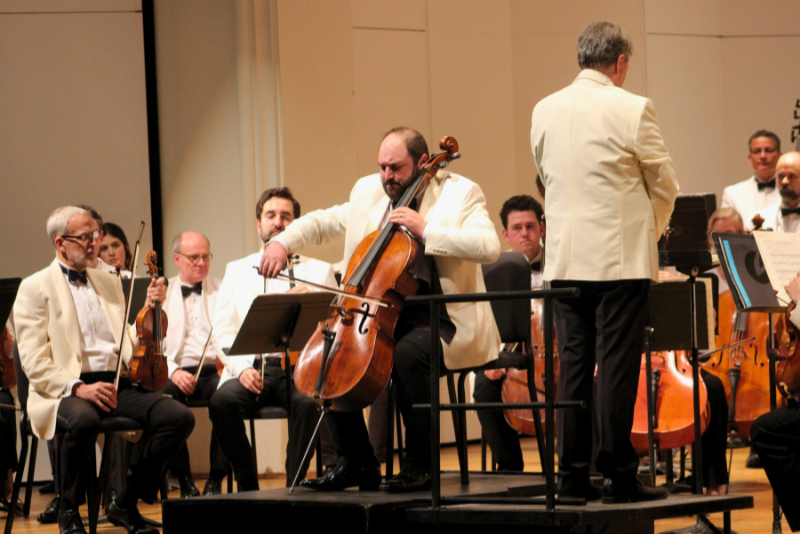
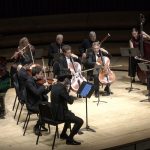
Cellist Julian Schwarz solos with the Eastern Festival of Music Orchestra, with his father, conductor Gerard Schwarz on the podium, July 4, 2026. (credit: Sarah Lucas-Page)
The two framing pieces in the program came across as life-affirming and touching (Copland) and as life-affirming and rousing (Gershwin). Schwarz has no doubt led both many times. His familiarity and interpretive preferences produced in both pieces a balanced tension between things nuanced and inward and things motoric and energetic. Your reviewer heard more New York rivets than Parisian taxis in the Gershwin, and the result sounded exceptionally cogent. The challenge of finding instrumental balances in both the Copland and Gershwin works is considerable because the two are almost totally different. Copland’s instrumentation is sometimes forceful but usually taciturn; Gershwin’s is lush and gabby. Schwarz knew how to handle both manners effectively, meaning that Copland’s sound was attractively saturated and Gershwin’s sound agleam with harmonic highlights, never muddy. Both Copland and Gershwin provided their scores with oodles of tempo changes, too. Copland’s frequent changes were balletic, offering opportunities for varied body gestures; Schwarz paced the changes in a way that would work were dancers present. Gershwin’s frequent tempo changes were nothing if not cinematic. Schwarz’s reading of An American in Paris seemed to associate these different tempos as juxtapositions tied to different characters or camera angles, like sounds coordinated with edits in a silent film score.
Now to the in-between pieces. Ellen Taffe Zwilich is an East Coast Floridian; so is (these days) Gerard Schwarz. Zwilich came to wide attention when awarded the Pulitzer Prize for her First Symphony. Like many classical composers of her generation, early works employed atonal or dodecaphonic procedures, just like the contemporaneous works of influential older composers such as Stravinsky, Copland, Sessions, Riegger, Carter, and others, pieces now dutifully played perhaps once or twice a decade. Zwilich was among the first American composers, and was perhaps the first female American composer, to abandon (as opposed to avoid or ignore) Viennese, top-down, systemic music for bottom-up, motivic music. This took courage, for in academia at that time, writing bottom-up, socially conscious, or “downtown” music could damage one’s academic career.
As mentioned, the festival concert included not one but two works by Zwilich. The earlier written work was Jubilation for Orchestra, composed in 1996, when the composer was in her fifties. Jubilation for Orchestra packs into its six minutes many of the techniques found in Appalachian Spring, yet its joyous rhythms, semi-independent tempo layers, and polytonal harmonies sound nothing like Copland or like any other composer from the 1940s. Zwilich truly found something to say all her own. This is no small feat.
The later written work, Remembrance for Cello and Orchestra, was billed as a first performance, so perhaps the piece was completed in 2026, when the composer is in her late eighties. Remembrance for Cello and Orchestra seems effectively written for the cello. It lasts perhaps half as long as Jubilation for Orchestra, and those few minutes pass as a collage of different sound worlds, music recollected but not argued.
Between the two Zwilich works came Foote’s concerto. Few, I expect, recognize this composer by name. But everyone should. Arthur Foote (1853–1937) was one of the great American melodists, like Stephen Foster or George Gershwin. Foote wrote many songs in many styles. From the beginning, they included (two decades or more before “Danny Boy”) deeply emotional tunes in the Irish manner, and at the end of his career they included equally emotional but also starker settings of such verses as “In Flanders Fields” by John McCrae, a poet who served in the trenches during the Great War of 1914–18. In between, Foote created a significant corpus of chamber, choral, and orchestral music, including the great cello sonata, Op. 78 (1912–18), and the superb cello concerto, Op. 33 (1887–92; premiered 1894), which was played at this festival.
When Dvořák wrote his cello concerto (also in the U.S.; premiered 1896), he was frank in attributing his inspiration to Victor Herbert’s second cello concerto (written in the U.S.; premiered 1894). As you can see, the Foote concerto was the earliest of these three American-made concertos, and having heard the revelatory performance by Julian Schwarz, your reviewer believes it is in a league with the other two works. When Foote wrote his cello concerto, inspiration would likely have come from concerted cello works by Saint-Saëns (1872), Lalo (1874), and Tchaikovsky (1877). Tchaikovsky himself acknowledged Lalo’s violin concerto (Symphonie espagnole) as an inspiration for his violin concerto.
It is hard not to hear Foote’s cello concerto as an attempt to create for the cello a work similar in expressive ambition to Tchaikovsky’s violin concerto, with perhaps a slight admixture of Fauré and Massenet in the middle movement. But, to repeat, Foote had his own melodic gift, and it comes through loud and clear and also tenderly in this cello concerto. The result is a stunningly beautiful and also powerful work written in the international musical language of its era. Based on the audience’s impassioned response this weekend, it’s an easy piece to like.
The soloist, Julian Schwarz, recently created a performing edition of the Foote concerto, having previously edited Ernest Bloch’s music for Carl Fischer Editions. Now in his early thirties, Mr. Schwarz teaches at Shenandoah University in Winchester, Virginia. In April of this year, he gave the premiere of Jennifer Higdon’s new cello concerto with the Rochester Philharmonic. His is a big technique, with rich tone, fleet fingers, impeccable intonation, and powerful projection. Altogether, he brings to the platform a commanding presence. Witnessing Schwarz’s performance, one could hardly deny that the soloist’s immersion in this music goes way beyond scholarly. Julian Schwarz played Foote’s concerto as if he believes in it. And as he has the chops to carry this off with flair, he made the concerto sound powerful in ways we expect of great music.
The two Schwarzes convinced your reviewer that Foote’s concerto succeeds beyond all expectations. If indeed it was inspired by the Tchaikovsky violin concerto, it differs in so many details that it comes across as its own work, as different from Tchaikovsky as Bruch is from Mendelssohn. Given half a chance, someday it will enter the standard repertory. To that end, the revived Delos recording label is releasing its first commercial recording this month.
As mentioned, at the conclusion of the concert performance, numerous bravos were shouted over sustained applause. Indeed, the audience members made it clear after every piece, from Copland to Gershwin, that they enjoyed what they heard. But the Foote concerto brought out something special. It was the only time they rose to their feet, and was clearly the big hit of the program, a great way to celebrate the country that produced Walt Whitman and Mark Twain and Emily Dickinson as well as George Washington and Robert E. Lee and Dwight D. Eisenhower. ■
EXTERNAL LINKS:
- Eastern Festival of Music: easternfestivalofmusic.org

Read more by Christopher Hill.

.png)