
Mark Gresham | 1 JUL 2026
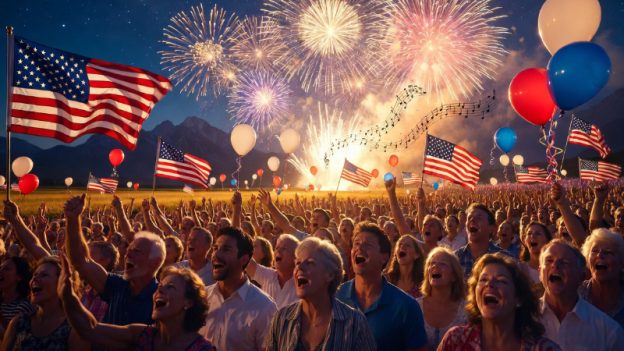
As the United States celebrates its 250th anniversary this Fourth of July, Americans will sing far more than the official national anthem. Fireworks will light up skies from sea to shining sea, but alongside the official “The Star-Spangled Banner” (adopted in 1931), a chorus of unofficial anthems will rise. These songs capture the American spirit more viscerally for many: hopeful prayers, sweeping tributes to natural beauty, raw working-class pride, and pointed critiques wrapped in sing-along choruses.
America’s unofficial soundtrack stretches back to the Revolutionary era. “Yankee Doodle,” originally intended as a British insult, became a patriotic favorite. During the 19th century, songs such as “Hail, Columbia,” “My Country, ’Tis of Thee,” and “Battle Hymn of the Republic” reflected changing ideas of nationhood long before 20th-century standards joined the repertoire. Unlike a rigidly defined national anthem, these tunes evolve with the culture, getting repurposed at ballgames, protests, inaugurations, and backyard barbecues. They become ours because we claim them.
America the Beautiful: A Poet’s Vision from the Peaks
Katharine Lee Bates, an English professor at Wellesley College, penned the poem that became “America the Beautiful” after an 1893 trip to the summit of Pikes Peak in Colorado. Overwhelmed by the “alabaster cities” and “fruited plain,” she published it in 1895. Samuel A. Ward’s melody, composed earlier for a hymn, paired perfectly with the poem in 1910, though the two never met.
Bates revised the lyrics in 1904 to emphasize brotherhood and selflessness. The song celebrates America’s natural splendor and moral aspiration (“God shed His grace on thee / And crown thy good with brotherhood”). It is aspirational rather than declarative—less about conquest, more about living up to an ideal. It has often been proposed as an alternative national anthem and frequently complements the official one at public events.
If “America the Beautiful” expressed the nation’s highest aspirations, the next great unofficial anthem came from an immigrant songwriter who thanked America for the opportunities it had given him.
God Bless America: The Immigrant’s Prayer
Irving Berlin, born Israel Beilin in Russia and arriving in America as a child, wrote the first version of “God Bless America” in 1918 while serving in the U.S. Army. He shelved it, feeling it didn’t fit his revue. Two decades later, amid rising global fascism, he revived and revised it as a “peace song” for Kate Smith to premiere on Armistice Day 1938.
Berlin changed lines such as “Make her victorious on land and foam” to something less militaristic, swapping politically charged phrasing for a more unifying tone. He famously assigned all royalties to the Boy and Girl Scouts, forgoing personal profit. It soared during World War II and beyond, becoming a staple at public events.
Yet the song has never been without critics. Some viewed it as overly patriotic, while others questioned its idealized portrait of the nation. Woody Guthrie, in particular, found it too rosy and saccharine.
The song endures as an expression of gratitude for the opportunities America offered newcomers—a heartfelt thanks rather than blind flag-waving.
This Land Is Your Land: Guthrie’s Response
Woody Guthrie wrote “This Land Is Your Land” in February 1940 in a New York hotel room, explicitly as a response to the omnipresent Kate Smith version of “God Bless America.” Originally titled something like “God Blessed America for Me,” it included sharper verses about hungry people in relief lines and a “No Trespassing” sign that challenged private property.
Publishers and performers generally omitted the more confrontational verses, allowing the song to become a schoolroom and folk standard. Its power lies in the irony: a protest song turned inclusive anthem that still carries subversive undertones. It reminds us that “this land was made for you and me” includes the right to question who exactly benefits.
Born in the U.S.A.: The Misunderstood Anthem
Bruce Springsteen’s 1984 hit “Born in the U.S.A.” stands as a masterclass in lyrical irony versus musical bombast. The anthemic chorus and driving beat made it sound like a chest-thumping celebration. Ronald Reagan famously invoked it during the 1984 campaign, despite its critical message. The verses tell a darker story: a Vietnam veteran returning to economic despair, joblessness, and alienation.
Springsteen has called it a demand for “critical patriotism.” Its misinterpretation proves why unofficial anthems thrive—they allow listeners to project their own America onto them. The fist-pumping pride coexists with the pain.
Other Voices in the Chorus
Not every unofficial anthem fits neatly into a single narrative. Lee Greenwood’s “God Bless the U.S.A.” became especially prominent during the Gulf War and again after the Sept. 11 attacks. John Philip Sousa’s “The Stars and Stripes Forever” remains America’s signature concert march, while “Lift Every Voice and Sing” has become an enduring expression of African American history, resilience, and patriotism.
Written as a poem by James Weldon Johnson in 1900 with music by his brother John Rosamond Johnson, “Lift Every Voice and Sing” began as a tribute for a Lincoln birthday celebration at a Jacksonville school. Quickly embraced far beyond its origins, the hymn blends soaring gospel roots with lyrics of bitter hardship overcome by unyielding hope and forward-looking patriotism. In recent decades it has also become a regular part of major sporting events and civic observances, further cementing its place in the nation’s musical identity.
Why These Songs Endure
Unofficial anthems resonate because they belong to the people. Anyone can sing them. They capture specific moments—immigrant hope, frontier awe, Depression-era grit, post-Vietnam disillusionment—but transcend them through melody and adaptability. In a vast, diverse nation, they let us argue about what America means while still joining voices. They’re flawed mirrors: sometimes overly sentimental, sometimes uncomfortably honest, always revealing.
This 250th year offers a chance to sing them all—with full verses where possible. Listen closely. The unofficial anthems don’t just celebrate America; they challenge us to make it better.
As the country looks ahead, one wonders what new voices will emerge to capture today’s fractures and hopes—perhaps songs born from climate-vulnerable coasts, tech-driven heartlands, or renewed immigrant dreams that future generations will claim as their own. From redwood forests to Gulf Stream waters, this land—and its songs—belong to all of us. Happy Semiquincentennial. God bless America, and may she continue to inspire the anthems still waiting to be written. ■

Read more by Mark Gresham.





.png)