

Jackie Leung, piano; Ryan Scott, vibraphone; Erica Murase, piano.
Alvin SINGLETON: Changing Faces
Alvin SINGLETON: Cinque
Alvin SINGLETON: Greed Machine for Vibraphone and Piano
Alvin SINGLETON: Baked in the Cake
Alvin SINGLETON: Argoru I
Alvin SINGLETON: Mutations
Alvin SINGLETON: In My Own Skin
Alvin SINGLETON: Inside-Out for Piano Four-Hands
Albany Records
Catalog No. TROY2025
Formats: CD, digital
Release Date: September 4, 2026
Total Duration: 59:43
Giorgio Koukl | 13 AUG 2026
Some intriguing piano music is featured on this Albany CD; it represents a big stage for the Canadian pianist Jackie Leung with a few guests: vibraphonist Ryan Scott, who joins in to play the delicious Greed Machine, and pianist Erica Murase, playing four hands in the longest score on this installment, which gives the name to the whole album: Inside-Out.
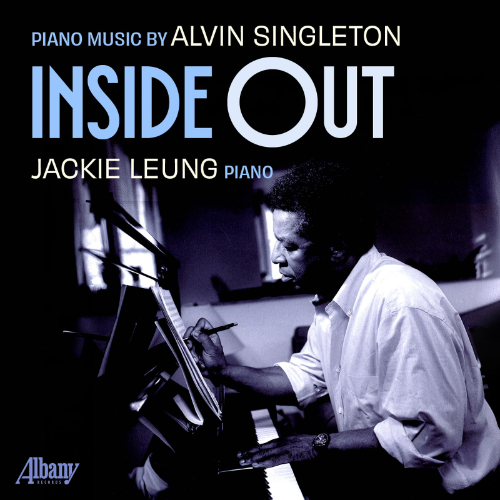
TROY2025 (cover art) click to enlarge
We can follow many decades of compositional work and some representative music by Alvin Singleton, certainly not an easy composer to interpret.
Much has been said about this composer’s ability to blend disparate sonic worlds. His influences stretch from Mahler and Bach to Thelonious Monk, Santana, and many others. His scores favor sparse, transparent textures. Unexpected pauses and silence are used deliberately to build theatrical tension. But the major obstacle for any interpreter is his way of asking for repeated passages in a perfectly identical manner, a thing which every pianist will instinctively try to modify somehow. Not so Jackie Leung; she manages to do this requested minimalist feature in a quasi-mechanical, superhuman way. Not to speak about the required non-romantic view she imprints on her playing, much aided by the metallic sound of her piano, certainly a good choice.

Alvin Singleton (alvinsingleton.com)
The short piece Changing Faces, written in 1986, opens the disc. Already, in this less-than-two-minute score, we can follow all the techniques the composer uses in a free and non-dogmatic way. His scores favor sparse, transparent textures. Unexpected pauses and silence are used deliberately to build theatrical tension.
A short set of five pieces, justly called Cinque, follows. This score is much older, written in 1969, and uses the aleatory technique extensively, giving the interpreter considerable liberty. It must be said that Jackie Leung makes wonderful use of this space, creating subtle atmospheres that sometimes recall a jazz session.
The highest point of this disc is certainly the Greed Machine for vibraphone and piano, where Ryan Scott enters the stage. This combination and similar ones were long an absolute taboo: whole generations of composers were told in conservatories that the use of the piano, harp, or vibraphone is better avoided. Luckily, composers in the past tried these subtle but dangerous duos, only to discover that they add much to their array of expressive possibilities. So in this instance. The two instruments, carefully calibrated in dynamics, deliver a nice dialogue and obtain a meditative yet robust flow of sound.
Baked in the Cake from 2012 is a birthday present for the 75th anniversary of the Schott publishing house founder Peter Hanser-Strecker.
It is built on sharp contrasts and puts high pressure on the pianist’s technical capacities. Once more, we can admire Singleton and his ability to blend disparate sonic worlds, even if it must be said that the influence of his teacher, Goffredo Petrassi, is clearly audible, at least in the more lyrical passages.
Argoru I, from 1970, a word from the Ghana Twi language meaning simply “to play,” is the first production in a series by the composer that has lasted over half a century. It is worth comparing the latest, Argoru X for trumpet, with those before it, offering a nice opportunity to follow the stylistic development of a creative author.
The use of dissonant clusters here is maybe more accentuated than elsewhere on this album.
The piece called Mutations from 1966, a series of variations, is somehow lacking the usual playful compositional style of Singleton; maybe the length of about eight minutes is a hint too much for the listener.
Even longer is In My Own Skin, but here the enormous fantasy of the composer luckily returns in full force. Probably the fortunate example of Jackie Leung’s pianistic capacities, who seems the ideal interpreter for such complex music.
The last score is a four-hands piece called Inside-Out. It was written in 2010 and features a singular technique in which nothing seems to have direct consequences from the previous musical material. We certainly cannot assist to something like a theme and its development. Instead, a completely free fantasy of the brightest imaginable array of genres can be admired.
Certainly a good example of what Alvin Singleton represents in the world.
This, at 18 minutes, is the longest work. We can admire the perfect interplay of Jackie Leung with her colleague Erica Murase. They are in a hellishly difficult score of synchronous shifting, sometimes perfectly together, sometimes willingly shifting one against the other. One can only imagine the enormous preparatory work necessary for such perfection.
This album, while surely not music for everybody, is nevertheless a wonderful way to discover the capacities of this composer. ■
EXTERNAL LINKS:
- Alvin Singleton: alvinsingleton.com
- Jackie Leung: jackieleung.com
- Ryan Scott: ryanscottpercussion.com
- Erica Murase: stonybrook.edu/commcms/music/community/_faculty/erica_murase.php

Read more by Giorgio Koukl.





.png)