
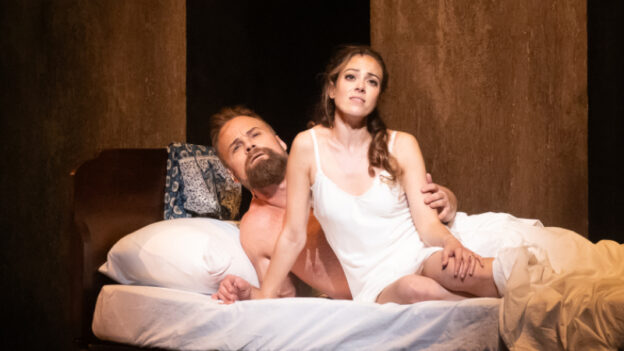
Houston Grand Opera. Missy Mazzoli, composer; Royce Vavrek, librettist; Patrick Summers, conductor. Cast: Lauren Snouffer (Bess McNeill), Ryan McKinny (Jan Nyman), Michelle Bradley (Mother), Maire Therese Carmack (Dodo McNeill), David Portillo (Dr. Richardson), Michael Mayes (Councilman), Sam Dhobhany (Terry), Johnny Salvesen (Sadistic Sailor), Andrew Surrena (Young Sailor), Jon Janacek (Tenor Solo); Houston Grand Opera Orchestra; Houston Grand Opera Chorus. Creative: Tom Morris, original director; Sara Brodie, revival director and movement director; Soutra Gilmour, scenic and costume designer; Richard Howell, lighting designer; Will Duke, projection designer; Jon Nicholls, sound designer; David Butler, video programmer and system designer; John A. Costa, associate video programmer and system designer; Samantha Kaufman, intimacy director; Adam Noble, fight director; Richard Bado, chorus director; Kathryn LaBouff, diction coach; Jenny Choo, Kyle Naig, Teddy Poll, and William Woodard, musical preparation; Annie Wheeler, stage manager; Colter Schoenfish, assistant director.
Missy MAZZOLI: Breaking the Waves
Houston Grand Opera Records HGO0003
Formats: 2-CD set; Digital
Release Date: August 7, 2026
Total Duration: 2:06:18
Giorgio Koukl | 21 JUL 2026
In the operatic world, a simple formula has persisted now for more than two centuries.
A “he” and a “she” meet, live a romance, and usually then go towards a horrible destiny. The settings may change, but this dramatic formula simply attracts the public and is a winner.
That said, there is a huge difference between, let´s say, Verdi or Puccini and the work of Missy Mazzoli in terms of where the story unfolds and how it is handled.
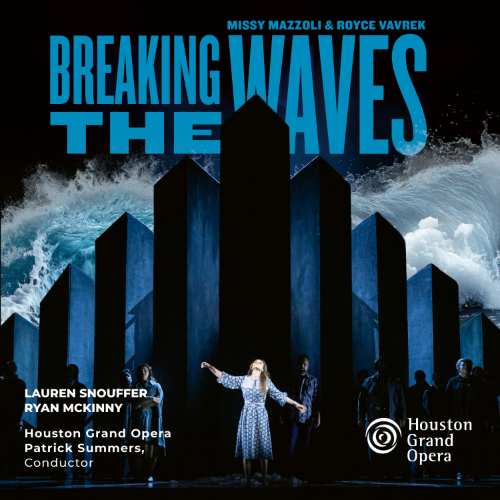
HGO0003 cover art (click to enlarge)
Mazzoli and her librettist Royce Vavrek have adapted their story from Danish filmmaker Lars von Trier’s film, Breaking the Waves, a dark and intense plot taking place in Scotland, on the Isle of Skye.
“I very clearly heard how the opera was supposed to begin. It was the violence of the landscape that led me there,” says Mazzoli of a visit to Scotland.
The score is powerful, with less melodic musical language and no beautiful melodies the audience will remember, but its recurring motifs are more reminiscent of a film soundtrack. Overlapping, dissonant glissandi in the strings are more likely to remain in the memory, creating the impression that the looming disaster is inevitable.
Before entering into the details of the story, a general fact must be said: Mazzoli is a real master of dramatic construction and creates immediate atmosphere with very tiny means. Her musical construction is mostly quite traditional, using polytonality frequently but not disdaining unusual instruments like electric guitar, and often goes to very dense harmonic friction when the situation demands.
To understand the tragic story of Bess McNeill, a deeply religious and naive young woman, let us examine the main story. Against the wishes of her strict Calvinist church, Bess marries Jan Nyman, an oil rig worker. When Jan is paralyzed in a horrific offshore accident, he is left bedridden and near death. Desperate and mentally unstable, Jan convinces Bess that the only way to keep him alive is for her to seek sexual encounters with other men and describe them to him, claiming their shared passion will heal his body.
Believing this painful sacrifice is a direct command from God to save her husband, Bess submits to increasingly dangerous and degrading acts. As a result, she is cast out and condemned by her community. Ultimately, Bess sacrifices everything—including her own life—in a brutal act of devotion that leads to an ambiguous, miraculous redemption.
As mentioned before, the oil rig worker, Jan Nyman, is very well sung by the baritone Ryan McKinny, but the true matador of the opera is Bess McNeill, magisterially sung by the soprano Lauren Snouffer. She has to endure the ordeal of the whole humiliation by her rigid community on the island, the cruel fate of the incident of her partner in the second act, and the death at the end of the story, being buried in the sea. She has to endure very harsh treatment as a soprano, too. Mazzoli throws her at the highest notes constantly without pity, and this for the whole duration of the opera. A real tour de force.
In other hands such a story could really become dangerous, but Mazzoli never slips into obvious handling of this score with restraint and elegance. Besides the two main singers, she has all the secondary figures well chosen, a wonderful all-male chorus, working in multiple roles, as church assembly, rig workers, and even as the voice of God. This solution is not new, as Arnold Schönberg has done something similar in Moses und Aron, using six solo voices blended with a spoken chorus, far more effective than the standard solution of a deep bass voice. This score has such delicious details in many other parts, like producing the bell sounds, which play a major role in the symbolism of the story, reduced to tiny piano or harp sounds. Even the choice of male hero not to be the standard tenor voice is a daring but very interesting solution.
Mazzoli’s powerful musical language can create potent, desperate chords as well as intimate scenes, where only a few instruments depict the needs of the narration. If something could be regarded as not perfectly coherent, it is the use of violent transitions from rather traditional harmonic texture to very dissonant and disturbing clusters of musical material.
Conductor Patrick Summers leads the Houston Grand Opera Orchestra with discipline and well-chosen dynamics and tempi.
The composer states that her main influences are Benjamin Britten, a logical choice clearly difficult to avoid when writing in English, but this influence is only partly audible.
Her other influence is Giacomo Puccini, clearly in a sense of dramatic feeling with the main female character, which both composers bring to the verge of a catastrophe. Breaking the Waves doesn’t promise an experience of lightheartedness; rather, the audience’s capacity for suffering is severely tested. Nevertheless, it has a very interesting angle of observation, which is the primary force of this opera. ■
EXTERNAL LINKS:
- Houston Grand Opera: houstongrandopera.org
- Patrick Summers: patricksummers.com
- Missy Mazzoli: missymazzoli.com
- Royce Vavrek: roycevavrek.com
- Lauren Snouffer: laurensnouffer.com
- Ryan McKinny: ryanmckinny.com

Read more by Giorgio Koukl.
RECENT POSTS
 Raven Chacon’s “Voiceless Mass” anchors an immersive evening with ensemble vim and Bent Frequency • 19 Oct 2026
 New Jersey Symphony names Gaetan Le Divelec vice president of artistic planning and operations • 17 Oct 2026

.png)