October 12, 2026
Voiceless Mass
St. Luke’s Episcopal Church
Atlanta, Georgia – USA
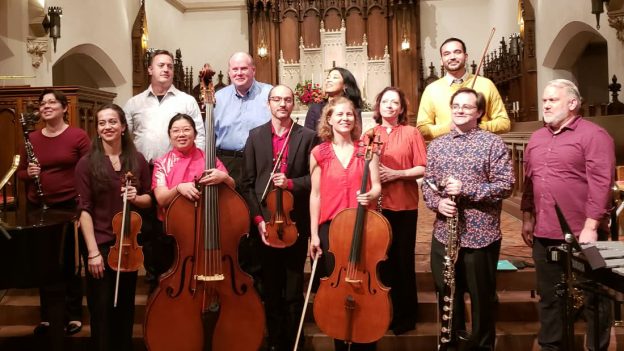
ensemble vim in collaboration with Bent Frequency (Bob Anemone & Lauren Roth-Gómez, violin; Josiah Coe, viola; Laura Usiskin, cello; Emily Koh, double bass; Christina Smith, flute; Bixby Kennedy & Iván Valbuena Páez, clarinets; Jan Berry Baker, saxophones; Stuart Gerber & Jeremy Muller, percussion; Matthew Brown, organ; Choo Choo Hu, piano.).
Viet Cuong: Electric Aroma (2017)
Marc Mellits: Dust (2025)
Emily Koh: hyd(e)r0sion (2022)
David Heyes: Memento Mori (2018)
Raven Chacon: Voiceless Mass (2021)
Howard Wershil | 19 OCT 2026
Now entering its eighth season, women-run ensemble vim has well established itself as one of the premier destinations for new music experiences. Over the past several years, the ensemble has offered exciting, engaging, and innovative concerts that explore a multitude of styles, instrumental combinations, and collaborative efforts. Expectations for this group can be high, and tonight’s season-opener certainly did fulfill them. The evening’s performances were the result of a partnership with Bent Frequency, another established, 25-year-old local performance ensemble gem. The selections chosen by ensemble vim continued to break new ground, with music ranging from somber and familiar to progressive and rhythmic, peppered with a wry sense of play and abandon, but always with completely serious intent. Spectacular!
“…and if the weather is clear listen to the crack when in my chest breaks the perfume of the stick the arrow painted on the fan tossed on the bed the luminous alarmed panther sheen of her regard with an electric aroma a most disagreeable noise spreading a dreadful odor of stars crushed underfoot.”
It is this intriguing phrase from Pablo Picasso, especially “an electric aroma a most disagreeable noise,” that inspired the first featured composer of the evening, Viet Cuong, to think to himself (as derived from his program notes), “Well then, let’s make disagreeable noises, shall we?”
Viet Cuong’s Electric Aroma (2017) received an extremely spirited performance by Jan Berry Baker on saxophone and Stuart Gerber on percussion, founding members of Bent Frequency, along with Bixby Kennedy and Choo Choo Hu of ensemble vim on clarinet and piano, respectively. The music began with a bit of sonic confusion but rapidly introduced a rhythm to the brew that endowed the piece with an unanticipated sense of fun and sass. Disagreeable noises were indeed employed – tin foil in the vibraphone, metals buzzing on an upside-down snare drum, out-of-tune pitches on the clarinet and multiphonics on both the clarinet and saxophone, sporadic repetitive bursts from the piano – but all ably crafted together to yield an alternating on-and-off series of variably reiterated, bouncing, almost humorous passages that confounded, intrigued and fully entertained.
Again, per his program notes: “Viet likes having fun. All of us are doing things the rules say we’re not supposed to do.”
I can’t speak for all of us, but as evidenced by this raucous, deliberately perplexing piece, it certainly must be true for this composer, without a doubt.
The second piece of the program proved quite a surprise, especially compared with the Viet Cuong work we just heard. Marc Mellit’s Dust is a gorgeous work, completely grounded in traditional tonality, clearly demonstrating that there is still a great deal of splendor to be unearthed from such a familiar musical language. Scored for flute, clarinet, saxophone, violin, cello, percussion (particularly vibraphone), and piano, Dust is broken into six movements… Ash, Dust, Sleep, Earth, Dream, Return. Each movement expresses its own special sonorous beauty and richness. And each movement has its own particular way of deeply, successfully communicating. One could argue – unsuccessfully these days, I think – that such populist-sounding music has no place on a concert of “new” music. And yet, the heart often knows what the mind continues to protest. Dust is an amazingly loving work, full of color, lyricism, balance and harmony. A truly gorgeous, well-composed sonic experience, given a most sensitive and confident performance by the combined members of ensemble vim and Bent Frequency.
From the composer’s program notes: “Dust was composed in 2025 as a personal response to the deaths of my mother and both of my in-laws, who passed away within a few months of one another… losing these three remaining parental figures—as well as the only surviving grandparents of my children—was devastating for our family. … Ultimately, composing Dust became a way for me to process these losses—to remember, to grieve, and, in time, to begin to heal and grow. The music is my personal tribute to three extraordinary people whose influence continues to resonate in my life and in the lives of my family.”
hyd(e)r0sion (2022) by Emily Koh again provided a stark contrast to the performance just heard. Ms. Koh, an indispensable member of the illustrious ensemble vim, describes herself as “a Singaporean composer and recovering bassist living in Atlanta, Georgia.” I’d certainly like to explore the “recovering” reference in greater depth sometime. In addition to her participation in ensemble vim, Emily is Associate Professor of Composition and Area Chair of Music Composition and Theory at the University of Georgia. Her credentials as a bassist are certainly enjoyed by anyone who attends an ensemble vim concert. But here, with hyd(e)r0sion, her abilities as a composer, and as a very innovative and somewhat irreverent composer at that, truly shine. Deftly performed by Jan Berry Baker on saxophone and Stuart Gerber on percussion, the piece began by exploring a variety of percussive, staccato, interruptive sonic materials at various attenuations and densities, ultimately creating a viable dialogue between the two performers. Interspersed with the dialogue were somewhat slower, more solo-oriented passages, providing good contrast between those passages and the relative chaos preceding. The chaos and percussiveness do return, with the conclusion approaching an unexpected and stark apotheosis.
According to the composer’s program notes, hyd(e)r0sion “is inspired by the lines and shapes formed in soil and clay formed by the detachment and removal of soil by water. … Water erosion wears away the earth’s surface, and this removal of topsoil—the layer of soil with the greatest amount of organic matter, biological activity, and nutrients—restricts its ability to sustain future uses.”
Music by Emily Koh has been featured on at least one previous concert by ensemble vim. At the time I stated the desire to hear more from her. Now that I have, I find, once again, that her compositional technique, her artistic prowess, and her stylistic range are indeed impressive.
Memento Mori (2018) by David Heyes proved to be quite a solemn piece, reverently performed by organist Matthew Brown and double bassist Emily Koh. The piece was brief and darkly lyrical, pairing a simple organ background with a simple bass accompaniment. The bass part itself seemed particularly foreboding, utilizing only a few pitches that seemed sometimes in tune, and sometimes a bit not. I would assume that this was an effect chosen by the composer deliberately, to create the sense of profundity elicited by the realities of life and death referenced in the verbal introduction given to the piece earlier.
This performance, as well as the subsequent concluding work, gave Matthew Brown, the music director of St. Luke’s Episcopal Church, an enthusiastic supporter of ensemble vim, to finally join ensemble vim as a performer. It also gave us an opportunity to appreciate the beauty and power of this organ, which Matthew Brown also plays in the final selection of the evening.
Per David Heyes’ program notes, “Memento Mori… is slow and reflective, expressing an atmospheric and evocative sound world. The solo line is simple and sustained, with a gently moving accompaniment which reflects the mood of the piece.”
The final piece of the program, and the namesake of the concert, was Raven Chacon’s Voiceless Mass, winner of the 2022 Pulitzer Prize in Music. I knew he’d received this prize, but I hadn’t had the chance to hear the piece, not on recording, and certainly not live. For some reason, I had expected something more agitating and biting. Instead, I was met with an incredible composition that raises the concept of “solemn” to an entirely new level, but in a truly beautiful way. For this piece, all the attentive and devoted performers – Christina Smith on flute, Bixby Kennedy on clarinet, Luz Sarmiento on clarinet, Jan Berry Baker on saxophone, Robert Anemone on violin, Lauren Roth-Gomez on violin, Josiah Coe on viola, Laura Usiskin on cello, Emily Koh on double bass, Stuart Gerber on percussion, Jeremy Muller on percussion, Matthew Brown on organ, and Choo Choo Hu on piano (also serving as conductor) – were spread throughout the sanctuary, well-prepared to provide the audience with an intensely immersive experience, with duo percussionists stationed on far opposite sides of the area in front of the pews, and other performers equidistantly positioned opposite each other throughout. In fact, the composer states that he intended this piece for exactly this kind of space… “any space of worship with high ceilings and pipe organ.”
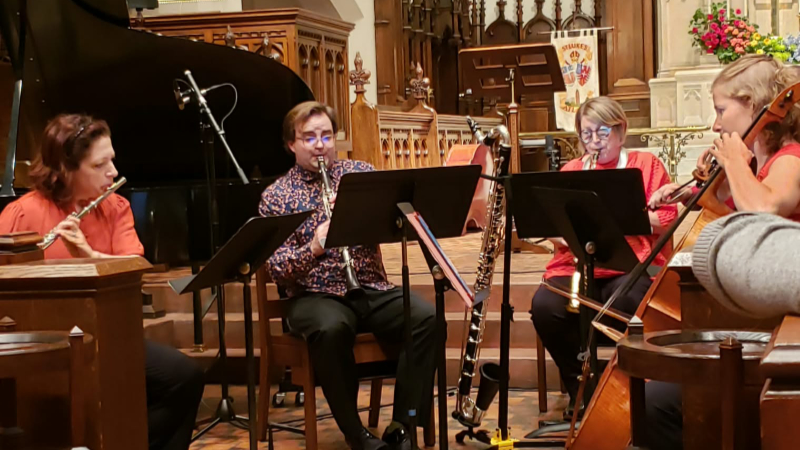
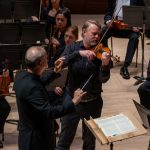
Christina Smith, Bixby Kennedy, Jan Berry Baker, and Laura Usiskin. (credit: Davida Cohen)
The piece begins with a very low note on the organ, followed by a single strike on an antique cymbal. The piece unfolds, ever so slowly, ever so cautiously, with simple, sparse materials, providing relatively sustained harmonies from various combinations of instruments. Throughout the piece, we hear various percussive commentary and occasional drumbeats punctuating the progressing sonic darkness and imposing gloom. At odd times, we could hear strands of almost classical lyricism that were as quickly erased gently by sounds seeming more dire in nature. At one point, we hear the slow, continuous beating of a drum as an almost too obvious Native American reference, but the beating slows, and softens, and vanishes, superseded by high, ominous, pianissimo screams, which also vanish into the sonic vapor, thus concluding this highly compelling work.
The ceiling height of the space, the distribution of the performers, the power of the facility’s organ, and the music itself, especially the music, all contributed to creating a sense of ambiance that arrested you, engaged you, and encouraged within a listener a golden opportunity to pause, and think, and reflect.
According to Raven Chacon’s program notes, “This work considers the spaces in which we gather, the history of access of these spaces, and the land upon which these buildings sit. Though ‘mass’ is referenced in the title, the piece contains no audible singing voices, instead using the openness of the large space to intone the constricted intervals of the wind and string instruments. In exploiting the architecture of the cathedral, Voiceless Mass considers the futility of giving voice to the voiceless, when ceding space is never an option for those in power.”
That final thought bears repeating:
“The futility of giving voice to the voiceless, when ceding space is never an option for those in power.”
Powerful words indeed, and profoundly expressed by the sonic and emotional atmosphere Chacon’s Voiceless Mass provides.
This evening’s concert by ensemble vim was merely the first of an exciting set to come. On November 22, 2026, at 3 p.m. (venue TBA), ensemble vim offers a free hip-hop class with FyreNation Crew, as part of their Spark2 program outreach. On February 9, 2027, at 7:30 p.m. at MOCA GA, we have the Sparkweek2 grand finale, featuring three world-premiere interdisciplinary compositions connecting music and dance. On March 23, 2027, at 7:30 p.m., also at MOCA GA, we can enjoy an International Women’s Month concert, featuring soprano Marnie Breckenridge. Then finally, on May 4, 2027, at 7:30 p.m. at MOCA GA, ensemble vim presents a Michael Ellison retrospective, connecting new music with the visual art of Michael Ellison.
And let’s not ignore activities on the docket from tonight’s ensemble vim collaborator Bent Frequency. On November 21, 2026, at 8 p.m. at Emerson Hall, Emory University, Bent Frequency presents Nina Shekhar’s Double Concerto: Tāla in partnership with The Emory University Symphony Orchestra. On December 10, 2026, at 7 p.m. at Plaza Theater, we can marvel at a performance with Javelinas accompanying The Phantom Carriage, providing a live soundtrack to Victor Sjöström’s 1921 silent horror classic. And finally, on December 11, 2026, at 6 p.m. at First Existentialist Congregation, Candler Park is our yearly Unsilent Night, Phil Kline’s beloved holiday tradition.
Tonight’s marvelous concert by ensemble vim, in collaboration with Bent Frequency, demonstrates how amazingly rich a collection of resources for contemporary music performance and enjoyment Atlanta has to offer. I hope readers of my reviews, and of reviews by other featured EarRelevant authors, are encouraged to explore these resources, and benefit from their wonders. Despite any concepts of voicelessness in the world one may have, Atlanta’s new music community truly does have a voice, a very musical, artistic and innovative voice, a voice that can speak to any of us, if we only give it the chance to do so. ■
EXTERNAL LINKS:
- ensemble vim: ensemblevim.org
- Bent Frequency: bentfrequency.com

Read more by Howard Wershil.