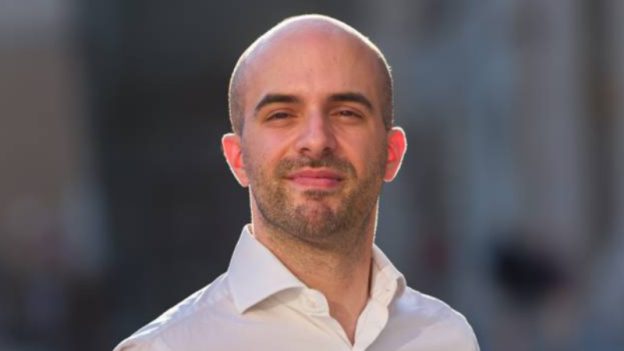
Matteo Cardelli, piano.
Paul de SCHLÖZER: 2 Études de concert, Op. 1 (1872)
Alexander SCRIABIN: Fugue in F minor, WoO 12 (1888); Fugue in E minor, WoO 20 (1892); Fantaisie in A minor, WoO 18 (1889); Symphonic Allegro (1896; transcribed for piano by Leonid Sabaneyev)
Julian SCRIABIN: Preludes, Op. 2 and Op. 3 (1918); Prelude, WoO (1919)
Daniel LAZARUS: Six pièces (1923)
Marina SCRIABINE: Thème et variations (1940s)
Robert CORNMAN: Sonata brevis (1957)
Julian CORNMAN: Rondeau (2022)
Pascale LAZARUS: Traces (2022)
PIANO CLASSICS
Catalog No. PCL10334
EAN: 5063758103343
Format: CD, digital
Release Date: September 4, 2026 (digital); September 11, 2026 (CD)
Total Duration: 85:32
Giorgio Koukl | 25 NOV 2026
The core concept of this album focuses exclusively on piano works written by musicians related to Alexander Scriabin by blood or marriage. Right at the beginning of the excellent booklet, the fundamental question is raised: Is musical talent hereditary? We certainly know the Bach family or the Scarlattis; there are lesser-known dynasties like the Bendas or the Strauss family. But can music really pass by DNA to the next generation?
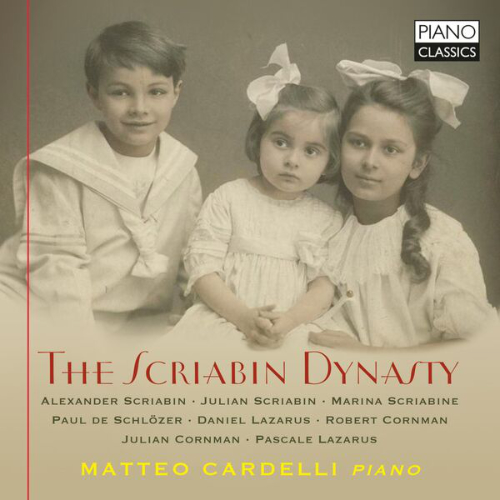
PCL10334 cover art (click to enlarge)
Italian pianist Matteo Cardelli decides to explore the Scriabin line, a strong idea for his CD debut. He graduated from the Conservatory of Ferrara in Italy and the Musik-Akademie Basel in Switzerland, and has earned top prizes at several international competitions, including the Julian Cochran Piano Competition, the Concours International du Piano Antoine de Saint-Exupéry, the Euregio Piano Award, and the Concorso Internazionale “Città di Albenga.” It is uncommon to move with ease between such different worlds, from the quasi-Liszt style of the opening of the 20 tracks on this CD to the modernist world of Marina Scriabin (1911–1998). Mr. Cardelli shows his capacities in each and every world he explores.
This CD was released in September 2026 under the Piano Classics label. It offers a unique musical journey through the artistic and familial history of Alexander Scriabin, one of Russia’s most visionary composers.
- The album spans a generous 85 minutes, covering a century and a half of piano literature from 1872 to 2022.
- The tracks were recorded at Don Bosco Hall in Basel, Switzerland; the sound engineers deserve the highest praise for achieving a natural, genuine piano sound. The musicological consultation and the booklet are by Mauro Piccinini, certainly a major contribution to this release.
Cardelli’s selection traces an evolution of styles, moving from Lisztian late Romanticism to mid-20th-century atonality and neoclassicism.
Let us look at the composers in detail.
- Alexander Scriabin (1872–1915): Featured through rare pieces from his teenage years, including two fugues and the Fantaisie in A minor. The album also includes the rarely heard Symphonic Allegro (1896), originally intended as a symphonic movement and transcribed for piano by Leonid Sabaneyev. Choosing to record this rarely played music instead of the better-known “typical” Scriabin is noteworthy and adds a lot to the album’s value.
- Paul de Schlözer (1841–1898): Scriabin’s second wife’s uncle, Tatyana de Schlözer. The album opens with his highly virtuosic 2 Études de concert, Op. 1 (1872). This is a strong choice, as from the start it is clear the pianist is more than capable of delivering even the most difficult technical challenges.
- Julian Scriabin (1908–1919): Alexander’s prodigiously talented son, who tragically drowned at the age of 11. Cardelli performs three of the four existing mature, hypnotic late-Symbolist Preludes. The listener can really admire the incredible maturity of an eleven-year-old boy. Who knows what he would have become without his premature death in the Dnieper River.
- Marina Scriabine (1911–1998): Scriabin’s youngest daughter, who, besides music, had a series of interests in her rich life, from Egyptology to theology, is intellectually very interesting, while her music somehow tends to be dry. A major contribution is her rigorous atonal cycle of Themes and Variations, composed in the 1940s. The pianist plays them in a suitable anti-romantic style, which serves the score well.
- Daniel Lazarus (1898–1964): Scriabin’s nephew, whose Six pièces reflect French influences and the style of Prokofiev. This music may be a hint less easy to understand, but it’s certainly informative.
- Robert and Julian Cornman: Scriabin’s son-in-law and great-grandson, respectively, represent the last part of this dynasty so far. Their works conclude the album’s chronology, showing stylistic nods to Copland and neoclassicism. The Sonata brevis and Traces are defined as “postmodern.”
This album is an easy recommendation for more than one reason: its rare repertoire and the otherwise difficult-to-obtain opportunity to follow 150 years of musical history through a single family’s history. ■
EXTERNAL LINKS:
- Matteo Cardelli: orfeomusicfestival.com

Read more by Giorgio Koukl.