November 21, 2026
James Turrell Skyspace at Live Oak Friends Meeting
Houston, Texas – USA
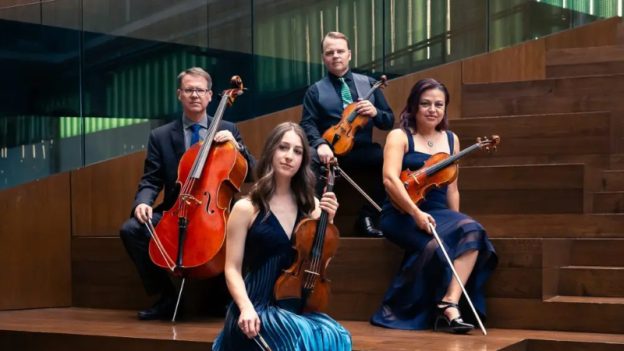
Matthew J. Detrick and Anabel Ramirez, violins; Aria Cheregosha, viola; Matthew Dudzik, cello.
Philip GLASS: String Quartet No. 3, “Mishima” (1985)
Joey ROUKENS: Forgotten Dutch Melodies (2024)
Claude DEBUSSY: String Quartet in G minor, Op. 10 (1893)
Tian QIN: Side Entrance: Sandstrasse 9 (2026) (Apollo commission, world premiere)
Marty REGAN: Splash of Indigo (2014) (Apollo commission)
Lawrence Wheeler | 23 NOV 2026
Apollo Chamber Players presented their second concert of the season at the James Turrell Skyspace at Live Oak Friends Meeting in Houston. Titled “Flow,” it was timed to coincide with James Turrell’s Twilight Epiphany, where the open Skyspace allows viewing the sky as it changes from bright blue to dark. The concert was favored with perfect weather and a full house of 110 people in the intimate space. The quartet stood facing each other in the middle of the square room. The concert continued Apollo’s imaginative and musically relevant programming.
As creator and curator Matthew Detrick describes it, “Flow explores the elusive state where creativity, attention, and meaning converge. The program combines music, conversation, and communal reflection in a unique journey toward presence and deep listening.” The goals were generally, if not entirely, achieved.
American contemporary composer Philip Glass (born 1937) has written at least nine string quartets. The Third Quartet, titled Mishima, was written in 1985 and consists of six named movements. He originally composed these movements as part of the soundtrack to the film Mishima: A Life in Four Chapters, based on a biopic of Mishima’s life and interspersed with dramatizations from three of his works.
Glass’s works can be classed (some would say incorrectly) as Minimalism, which often places little or no emphasis on melody. Its pulsing rhythms and minute harmonic changes create a hypnotic effect, making it an ideal choice to open a program titled “Flow.” The piece is a longstanding part of Apollo’s repertoire, and they gave an idiomatic performance that was nicely balanced and well-tuned. Detrick asked the audience to hold applause until the first three selections were completed.
The second selection was a version of the Armenian folk song Groung (Crane), arranged by Mary Kouyoumdjian. Inspired by a 1916 recording of Zabelle Panosian, the song features the singer calling out to a crane, a common character in Armenian folklore and poetry, pleading for news from her homeland. At the time Panosian recorded this piece, the Armenians were experiencing genocide—the systematic destruction of the Armenian people and identity in the Ottoman Empire during World War I. The timing of her recording gives the music even greater meaning.
While the performance was beautifully played, the context of this tragically expressive work was not explored, and it was not afforded a verbal introduction. The printed program says simply that this piece and the Joey Roukens work “represent a through line across generations.” While it may not fit with the “Flow” theme of “serenity and lasting reflection,” this was a missed opportunity to relate the song to current events that many consider to constitute genocide.
Joey Roukens writes eclectic music that intentionally withstands definition. From a 17th-Century Songbook is the first movement of his String Quartet No. 5, Forgotten Dutch Melodies. Written to sound like a consort of viols, it combines ancient music with a contemporary vernacular. A muted viola solo was particularly beautiful.
Next was “Artist & Audience Conversation: What Creates Flow?,” led by conversation facilitators Leila Scott Price and Kenneth Gayle. Price led some breathing exercises and asked the Apollo musicians how they achieve flow. Their answers were illuminating. While I expected time for audience questions for the musicians and composers, we were instead told to talk among ourselves. This reminded me of “passing the peace” in church, but here it was “passing the piece.”
After the break, Apollo performed the “Andantino, doucement expressif,” the second movement from Claude Debussy’s String Quartet in G minor. First violinist Anabel Ramirez played with expression and a silky tone. Violist Aria Cheregosha had an extended solo and later joined Ramirez in octaves. With cellist Matthew Dudzik providing a firm foundation, tone and tuning were exceptional. Cheregosha has proved to be a valuable addition to the group.
Splash of Indigo by Marty Regan was commissioned by Apollo Chamber Players a dozen years ago and has received widespread exposure. Drawing inspiration from a Japanese shakuhachi flute (which he demonstrated) and Debussy’s string quartet, he has written an engaging, even compelling, cross-cultural work. Musical quotations from the Debussy were given novel treatment. With this work, Apollo gave its best performance of the evening.
Tian Qin’s Side Entrance: Sandstrasse 9 was an Apollo commission and world premiere. It drew inspiration from an evening service in the crypt of a German cathedral. While that space must have been quite dark and perhaps a bit creepy, the music’s static lines and disjointed textures did little to illustrate or promote a feeling of spirituality. By then, the open Skyspace had changed to darkness, providing a fitting metaphor for the piece. ■
EXTERNAL LINKS:
- Apollo Chamber Players: apollochamberplayers.org
- Live Oak Friends Meeting: liveoakfriends.org
- James Turrell Skyspace (Twilight Epiphany): rice.edu

Read more by Lawrence Wheeler.