November 14, 2026
“Fellow Travelers”
The Ismaili Center
Houston, Texas – USA
ROCO; Rei Hotoda, guest conductor.
Arvo PäRT: Fratres (1977)
Marcus MARONEY: Concerto for Chamber Orchestra (2015) (ROCO commission; world premiere in 2016)
Jessica MEYER: As Within, So Without (2026) (ROCO commission; world premiere)
Ludwig van BEETHOVEN: Symphony No. 2 in D Major, Op. 36 (1802)
Lawrence Wheeler | 17 NOV 2026
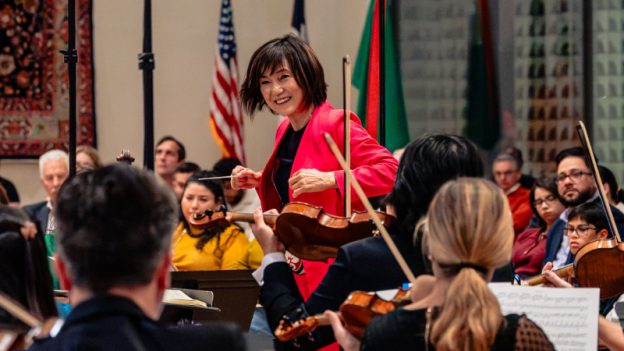
ROCO, a 40-piece chamber orchestra in Houston, continued its Season 22 Odyssey with a world premiere, a recycled premiere, a twentieth-century work, and a Beethoven symphony. Titled Fellow Travelers, the concert was the first of two led by guest conductor Rei Hotoda at The Ismaili Center, Houston—one of fifteen Houston venues where ROCO groups will perform this year. One year old, it is the first Ismaili Center in the United States and the seventh in the world. The building and adjoining grounds are quite striking and beautiful.
This is the first classical music concert given at the Center. The room where the concert was given is three times as wide as it is deep. Two pairs of Persian rugs were recently hung on the side walls, perhaps to improve acoustics. The orchestra sat beneath a stepped overhang, with the strings and timpani on the floor and the winds on risers. The setup presented a few tonal and balance issues. Visually, the strings’ sightlines were somewhat compromised compared to the group’s standard location at The Church of St. John the Divine. The lighting was uniformly bright throughout the room. Dimming the banks of lights not directly over the orchestra would have provided a more intimate feel. The air-conditioning system contributed ambient noise throughout the concert.
The program opened with Fratres by Arvo Pärt, as originally written for strings with woodblock and bass drum. It is written in Tintinnabuli style, a minimalist compositional technique Pärt created that was influenced by chant music. Fratres is a mesmerizing set of variations on a six-bar theme. Deeply meditative, it begins softly with the violins over a drone in the basses. Violas, then cellos join them. All parts move in rhythmic unison while playing notes restricted to either a D harmonic minor scale or the A minor triad. Soft percussion separates each of the nine sequences, which follow a dynamic arc from soft to full and back to soft. While sensitively conducted and played, the absence of sonic bloom limited the piece’s ethereal effect. Also, the ending lost the feeling of timeless serenity given some players’ use of vibrato.
ROCO commissioned Marcus Maroney’s Concerto for Chamber Orchestra, which premiered ten years ago. He was asked to write a piece modeled on Béla Bartók’s Concerto for Orchestra. The first movement, “Epigraph,” shows similarities to Bartók’s second movement, featuring pairs of woodwinds. Nicely played, the movement ran its course with minimal emotional impact. The second movement, “Variations,” begins with a charming minuet-styled theme in the woodwinds. A variation with solo cello was expressively played by Alexis Gerlach. A spirited, faster section provides energy before winding down to a soft piccolo solo. The third movement, “Ostinato,” begins with a quintuple-meter rhythmic figure in the violas. This provides an undercurrent that travels throughout the movement. Solo woodwinds trade off short melodies and some of the piece’s most virtuosic passages. The cellos provide a tonally rich, lyrical line, and the high French horns add dynamic thrust. The bass clarinet’s ostinato motif set up a clarinet cadenza before three chords ended the piece. The movement had a fine kinetic feel that maintained interest. Taken as a whole, this is much more successful than the composer’s Concerto for Flute and Viola d’Amore, a ROCO commission that appears relegated to obscurity.
Next, the concert featured a world-premiere ROCO commission from Season 22 Composer-in-Residence Jessica Meyer. Very active as a composer, violist, and educator, Meyer spoke to the audience about what inspires her: text (what people write), places, moments in time, and the emotions felt in those moments. She said we create our own reality, so if we want to change our reality, we have to change our insides and our habits of thinking and being. Speaking with clarity and ease, Meyer held the audience’s attention. That level of communication continued with her new work. As Within, So Without explores how melody, harmony, and sound interact with both external physical environments and internal human experience. Even absent a verbal explanation, the music is easy to follow on both an intellectual and emotional level.
The piece begins quietly with a muted trumpet solo, followed by vibraphone and solo oboe. The music becomes more directional as it gains momentum—the trumpet returns, now unmuted. The French horns express destiny. A downward harmonic shift settles into a viola solo, expertly played by Tanner Menees. A calm string episode leads to solo bassoon, clarinet, oboe, and flutes as the pitches rise along with the intensity. At the dynamic peak, the music cuts to a clarinet cadenza. Slowly, the music grows in an expression of awakening self-affirmation, culminating in timpani beats and clarion French horns. It ends abruptly on the dominant chord, leaving harmonic completion to the listener. As Within, So Without was afforded inspired playing from the ROCO musicians, and Hotoda delivered some of her best work of the evening. It proved to be the highlight of the concert.
Beethoven’s Symphony No. 2 in D Major is on the cusp of the composer’s early and middle periods. He was still under the influence of Joseph Haydn and Mozart but was developing his own compositional voice. It was written at a time when he contemplated suicide because of his impending deafness. The symphony drew on his elevated sense of formal structure, astute understanding of functional harmony, and innate feel for rhythmic and harmonic pulse. He was compulsive about accuracy when it comes to dynamics and articulation. In this regard, I found tonight’s performance a qualified success. Hotoda’s conducting style is perfect for the two newer works on the program. Large, energetic gestures are not equally fitting for a Beethoven symphony. Piano and forte dynamics require a clear distinction, but they tended to look the same. Not all quarter notes are created equal–those with dots (or carets) are shorter than those without. Urtext editions show that clearly, whereas less precise editions (like Kalmus) do not. Gradations of dynamics—ff, f, p, pp—are crucial. Stepped and surprise dynamics are integral to Beethoven. While the musicians played them, they were not always indicated in the conducting and were therefore less convincing. It was a fine performance, but not at the level of what I heard 21 months ago. That was the finest live performance of Beethoven’s Seventh Symphony I have ever heard. ■
The program repeated Sunday afternoon at the Ismaili Center in Houston
EXTERNAL LINKS:
- ROCO: roco.org
- Rei Hotoda: reihotoda.com
- Jessica Meyer: jessicameyermusic.com
- Marcus Maroney: mkmaroney.com

Read more by Lawrence Wheeler.