
October 11, 2026
Spivey Hall, Clayton State University
Morrow, Georgia – USA
Joyce DiDonato, mezzo-soprano; Time for Three (Ranaan Meyer, double bass and vocals; Nick Kendall, violin, viola, and vocals; Charles Yang, violin and vocals); Joyce DiDonato, director; Ryan J. O’Gara, production designer.
Kevin PUTS: Emily – No Prisoner Be (text by Emily Dickinson; 24 poems)
Mark Gresham | 16 OCT 2026
a poet sits alone with her words. They accumulate on the page, some tentative, others defiant, as the world outside presses against the limits of the room.
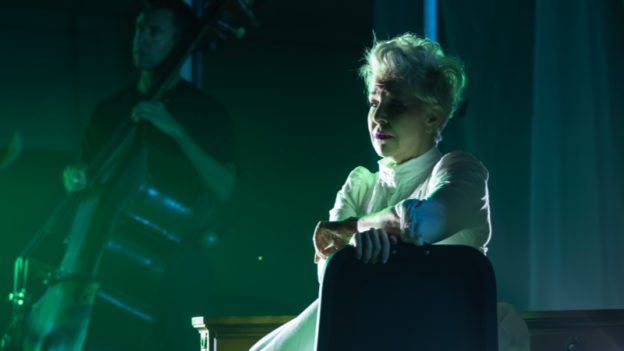
In Emily – No Prisoner Be, composer Kevin Puts and mezzo-soprano Joyce DiDonato brought that solitary act of creation to Spivey Hall on Oct. 11, using Dickinson’s poetry as the basis for a staged work that occupies the space between song recital and theater. The production pairs DiDonato with string trio Time for Three — violinists Charles Yang and Nicolas Kendall and double bassist Ranaan Meyer — whose members also contribute vocals, expanding the conventional relationship between solo singer and instrumental ensemble.
Puts draws on 24 poems by Emily Dickinson, the 19th-century American writer whose compressed language, unconventional punctuation, and shifting perspectives have invited generations of readers to debate their meanings and composers to set them to music. Rather than arrange the poems chronologically, Puts grouped them according to the musical and dramatic possibilities he discovered as he worked, shaping a cycle that moves through changing states of mind without becoming a linear biography. Puts’ music gives the poems distinct musical identities without reducing them to a single emotional register.
Instrumental interludes known as “bee scherzos” punctuate the sequence, connecting groups of songs while giving the string players opportunities to display their individual and collective virtuosity. Inspired by Dickinson’s recurring interest in bees, these passages introduce a more playful, kinetic dimension to a work otherwise preoccupied with the intricacies of the inner life.
The opening songs establish a speaker confined by others yet fiercely protective of her inner life. “They Shut Me Up” and “The Soul Selects Her Own Society” make withdrawal both an imposed condition and an assertion of choice, while “I Dwell in Possibility” transforms the idea of a house into a metaphor for the expansive freedom of imagination.
The sequence then turns toward mortality and mental disorientation. “Because I Could Not Stop for Death” presents death as a strangely courteous companion, while “I Felt a Funeral, in My Brain” makes the collapse of reason an interior catastrophe. The poems that follow seek firmer ground through reflection, domestic routine, and hope, but the cycle avoids a simple progression from despair to consolation. Later songs turn toward solitude, longing and desire, culminating in the direct passion of “Wild Nights!” before returning to the image of exclusion in “’Tis True – They Shut Me in the Cold.”
The theatrical staging gives the poetry physical dimension without relying on a literal reconstruction of Dickinson’s life. The production uses a desk and chair only for Dickinson’s private room, with striking contrasts of stage lighting, and a half-dozen “chase light” columns, to establish a relationship between not only the songs but also the poet’s private world and the audience watching it unfold.
DiDonato’s interpretation combines vocal flexibility and finely shaded expression with a physically engaged portrayal of Dickinson’s restless inner life. Her performance moves beyond conventional song recital, giving the poems dramatic presence while preserving the precision of their language. At times, her sustained treatment of a single word becomes a dramatic event, letting it enlarge Dickinson’s image without diminishing its simplicity.
Time for Three contributes more than instrumental accompaniment. Its members’ voices also become part of the musical fabric, giving the work a sound world that moves between chamber music and textures associated with contemporary popular music. The composer has described envisioning the trio’s singing as having a role resembling that of a gospel choir, responding to and supporting DiDonato’s solo lines.
Near the end, Puts sets “If I Can Stop One Heart from Breaking” against the familiar German chorale melody of “Lo, How a Rose E’er Blooming.” Dickinson’s poem measures a meaningful life by an act of compassion—easing another’s pain or helping a fallen bird return to its nest. The chorale introduces a musical tradition shared across generations into a cycle largely concerned with the independence of an individual mind. Time for Three’s singing makes this passage especially significant: the trio moves beyond accompaniment to participate directly in the vocal expression of the text.
The final song, “No Prisoner Be,” brings the cycle’s concern with freedom to its concluding statement. After repeated encounters with confinement, solitude, mortality, and longing, the assertion of independence carries the weight of what has preceded it. Yet the growing importance of shared voices complicates the idea of freedom as solitude. Dickinson’s insistence on the sovereignty of the inner life reaches its conclusion through music made collectively.
Ultimately, this Spivey Hall performance of Emily – No Prisoner Be by DiDonato and Time for Three derived its power from giving theatrical form to something essentially private: the movement of a mind that refuses to be fully known or confined. Puts does not resolve Dickinson’s contradictions so much as give them room to coexist, allowing defiance, vulnerability, longing and hope to remain in tension. What emerges is not a portrait that explains the poet, but one that invites the audience to inhabit, however briefly, the freedom of her imagination. ■
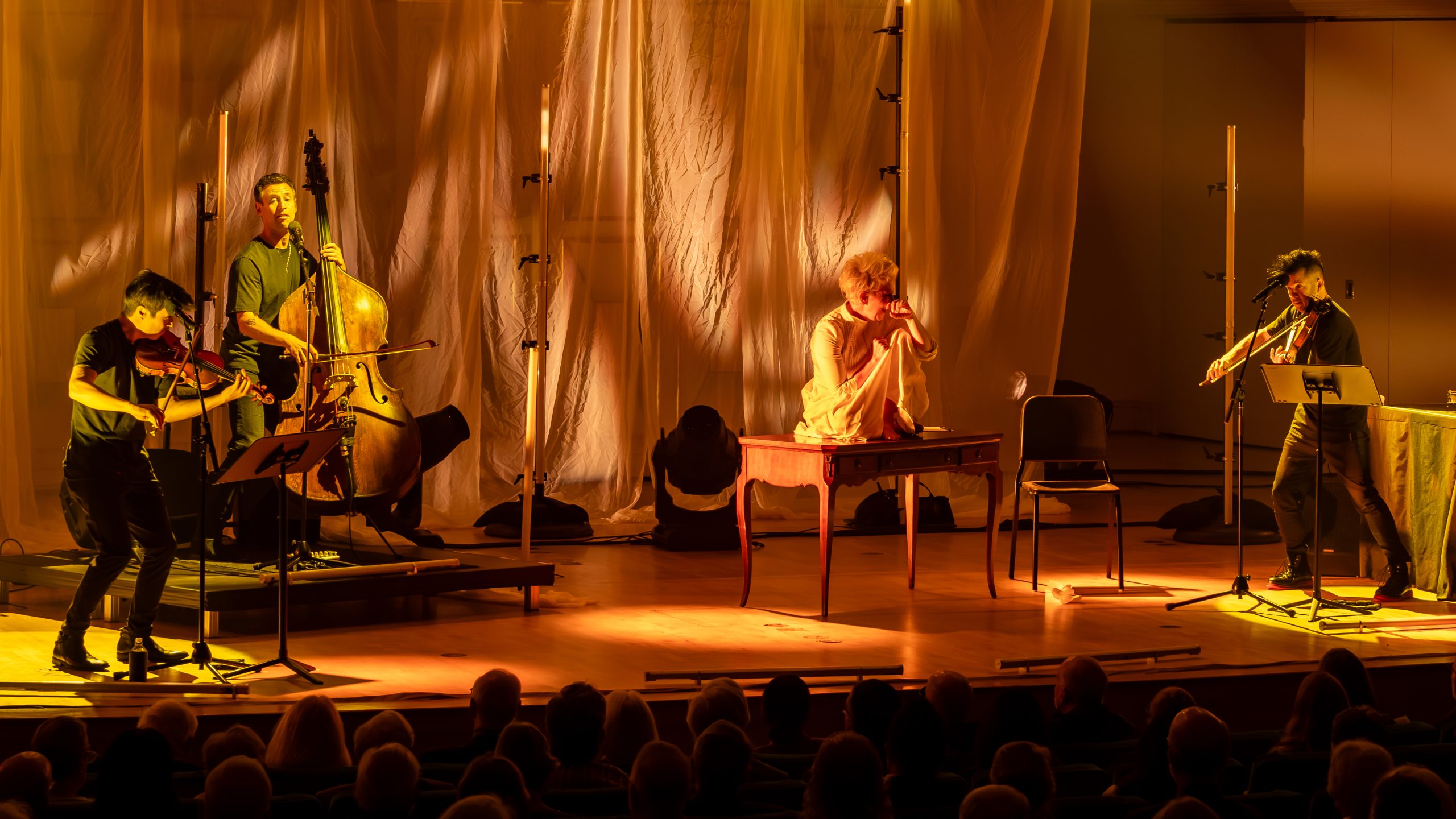
Joyce DiDonato and Time for Three in Kevin Puts’ “Emily – No Prisoner Be” at Spivey Hall. (courtesy of Spivey Hall)
EXTERNAL LINKS:
- Joyce DiDonato: joycedidonato.com
- Time for Three: tf3.com
- Spivey Hall: spiveyhall.org

Read more by Mark Gresham.


.png)