

Igor Levit, piano; Dörte Lyssewski, reciter; Kammerakademie Potsdam, Antonello Manacorda, conductor.
Arnold SCHOENBERG: Ode to Napoleon Buonaparte, Op. 41 (for strings, piano and reciter; text by Lord Byron)
Ludwig van BEETHOVEN: Symphony No. 3 in E-flat major, “Eroica,” Op. 55 (piano transcription by Franz Liszt, S 464/3)
NO SILENCE RECORDS / Sony Classical
Catalog No. 19958454642
EAN: 0199584546421
Formats: CD, digital
Release Date: October 23, 2026
Total Duration: 70 minutes
Giorgio Koukl | 9 OCT 2026
when releasing the first CD of a new label, the artist usually tends to indicate a direction, a sort of program that should be considered binding for the future.
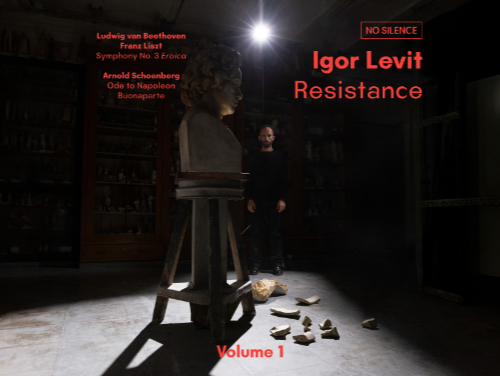
“Resistance” cover art
(click to enlarge)
Now, when pianist Igor Levit, already a well-known and respected member of the world’s elite circle of pianists, launches his own label, NO SILENCE, and calls its first installment Resistance, the direction is clear. In the CD indicated as volume 1, an intriguing mixture of Arnold Schönberg and Ludwig van Beethoven, a mixture which would have been immediately rejected only a few decades ago by any major company, today in the capable hands of Mr. Levit assumes a new light and unfolds its full potential.
“Kings of yesteryear, heroes of today and the world of tomorrow.” Under this title, and with the help of beautiful artwork depicting a statue of a hero, some broken pieces of clay on the floor, and the pianist standing under sharp light, a real program is shown, and a real intention is unveiled.
Art de-masks dictators at any time in history. Beethoven angrily erased Napoleon’s name from his “Eroica” Symphony score. So did Schönberg with his sarcastic melodrama Ode to Napoleon Bonaparte, in which Hitler was the modern reincarnation of Napoleon’s megalomania. It is quite clear who Mr. Levine had in mind when thinking of our recent time and its dictators.
Composed in 1942 during his exile in Los Angeles, the Op. 41 of Arnold Schönberg is one of his most explicitly political and biting works. It is set to Lord Byron’s 1814 poem and uses his usual dodecaphonic technique, but heavily adapted to the needs of this score, allowing the use of consonant triads, a rare feature in his overall output. This softened atonality paves the way for the surprising finale in E-flat major, linking this composition to Beethoven’s “Eroica” Symphony that follows. Originally scored for a string quartet, piano and a narrator, we can listen here to the enlarged version for full string orchestra, a task elegantly fulfilled by the Kammerakademie Potsdam and conductor Antonello Manacorda. The piano has here an important but not solistic role of a “piano obbligato,” and the full dramatic power is given to the voice of Dörte Lyssewski, a leading member of Vienna’s “Burgtheater.”
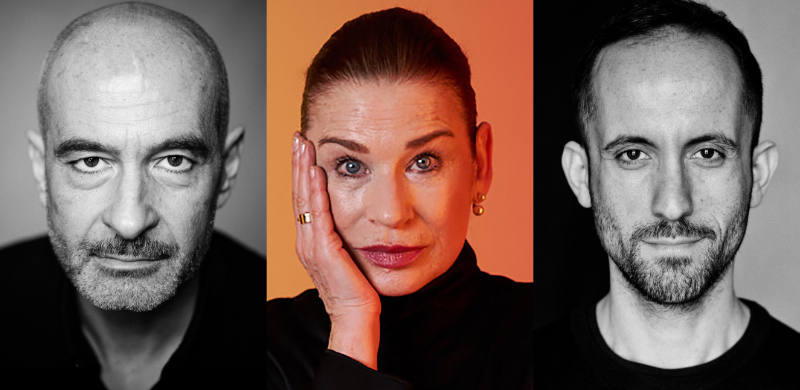
L-R: Antonello Manacorda, Dörte Lyssewski, and Igor Levit. (No SILENCE/Sony)
The apparently simple score is full of “hidden” quotes, such as the “fate” motif of Beethoven, used by the BBC during war as a Morse code signal for V… victory. In some places, you can even hear a distorted citation of Marseillaise. The use of “Sprechstimme,” as known from Pierrot lunaire, is completely different here: Schönberg uses a single line with fixed rhythmical patterns but no indicated pitch, creating realistic speech filled with sarcasm and irony.
Specialists can dwell here on refined research into hexachords, clearly visible in the printed score but not as easily heard in the audio version, maybe only as a very effective, almost cinematic effect. All artists are perfectly committed and obtain a spectacular result.
Franz Liszt’s transcription of Beethoven’s “Eroica” Symphony follows.
Now usually, transcriptions of any kind can be very, very divisive among musicians. Some simply consider them material to avoid, while others are increasingly discovering their value.
While the first opinion may still hold for most transcriptions from a large, impressionistic orchestra, where color is impossible to translate into the “black and white” world of a piano, in other cases the added value depends on who does the job.
Franz Liszt has transcribed all nine symphonies of Beethoven between 1837 and 1865. The idea behind this work was to enlarge the piano’s timbral variety, not simply reduce it for domestic use. In this sense, he was very successful, but the score still depends heavily on the interpreter to achieve this effect.
Now here Igor Levitt achieves a miracle few pianists can.
With his millimetric precision, a phrasing of supernatural beauty, and, when necessary, breathtaking cascades of double octaves, he lets the listener forget that an orchestra is not there. He is also one of the few pianists for whom the slow tempi are as meaningful and perfectly balanced as the quick ones. The second movement, “Marcia funebre-Allegro assai,” has many critical places where rarefaction of the sound can easily transform this task into a nightmare. Not so under the hands of Igor Levit.
Not to speak of tremendous technical difficulties in the last two movements. The pianist deserves the greatest admiration, as he, on every occasion, avoids the triumphalist, far-too-easy, noisy “tambureggiamento” many other pianists would apply in such cases. It is a joy that all Liszt transcriptions of the symphonies will be recorded in the future.
Igor Levit is a great artist who plays the piano, not merely a pianist who relies on artistic allure. To fully understand his complexity, let us finish with his own words:
“Remaining vague when one man (…) starts a war (…) is unacceptable. And never, never bring up music and your being a musician as an excuse. Do not insult art.” ■
EXTERNAL LINKS:
- Igor Levit: igor-levit.com
- Dörte Lyssewski: berliner-ensemble.de
- Kammerakademie Potsdam: kammerakademie-potsdam.de
- Antonello Manacorda: antonello-manacorda.com

Read more by Giorgio Koukl.
.png)