
October 9, 2026
Jones Hall
Houston, Texas – USA
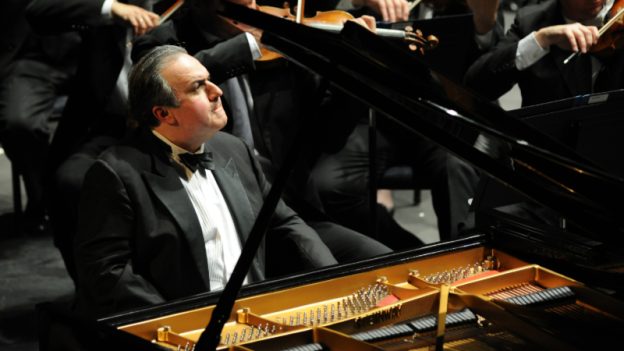
Houston Symphony, Juraj Valčuha, conductor; Yefim Bronfman, piano.
Sergei RACMANINOFF: Piano Concerto No. 3 in D minor, Op. 30 (1909)
Sergei RACMANINOFF: Symphony No. 3 in A minor, Op. 44 (1936)
Lawrence Wheeler | 11 OCT 2026
Friday evening, Houston Symphony Music Director Juraj Valčuha led the second and final program in a series at Jones Hall featuring the works of Russian composer Sergei Rachmaninoff. The program included a pair of threes—the Third Symphony and the Third Piano Concerto—two outstanding works representative of two chronological and stylistic periods in the composer’s life. The Third Symphony returned after a 14-year hiatus. The Third Piano Concerto was last performed three years ago, with Yefim Bronfman and Valčuha.
Rachmaninoff wrote the Third Piano Concerto (lovingly known as Rach 3) in 1909. It followed closely on the heels of the Second Symphony, Piano Sonata No. 1, and Isle of the Dead—works representative of his richly lyrical Romantic style. In his day, Rachmaninoff was regarded as the world’s best pianist, so when he wrote a concerto he would perform himself, he imposed virtually no technical limitations. This concerto tests stamina as well as technique.
Bronfman is one of a handful of pianists today who can meet the immense challenges of this famously difficult concerto. He did so without the excess motion some pianists use for show. While his hair flew a bit in loud passages, it was the result of energy being directed through his body to his hands. In quiet passages, his sensitive touch revealed multiple colors and subtle phrasing. Power and poetry permeated the performance.
The first movement offers many examples of interplay between soloist and orchestra. Subtle and abrupt changes in tempo and dynamics placed responsibility on Valčuha to maintain balance and ensemble, which he did exceptionally well. The Houston Symphony responded attentively to his directions, providing excellent accompaniment. Seated on the left side of the podium, the cellos and basses projected warmly, and French horn player Nathan Cloeter contributed several tonally lustrous solos. Bronfman began the formidable ossia cadenza softly, then arched through increasingly powerful passages with virtuosic ease, followed by delicate reminders of the first theme, passed beautifully from flute to oboe, clarinet and French horn. After returning to the first theme, now pianissimo, the movement ended softly.
The second movement, a theme and variations, begins with the orchestra playing the theme and two variations sans piano. The piano then alternates between playing alone and with the orchestra, sometimes joining in and other times interjecting. The emotional high point is the interplay between piano and orchestra—which sounds like an exchange of love vows—executed passionately by Bronfman et al. with synergistic effect. Affirmation comes in a melody played richly by the viola section on the C string. Beginning attacca from the second movement, the finale contains variations on themes from the first movement. Dynamic surges and chromatic progressions lead to the conclusion. Assisted by well-balanced brasses, Valčuha took charge of the passionate second-theme melody, with Bronfman’s eyes glued to his baton. The concerto came to a triumphant conclusion, musically signed by the composer: Rach-man-in-off. A standing ovation followed immediately.
On his fourth curtain call, Bronfman sat down and played Franz Liszt’s transcription of Paganini’s Caprice No. 17. An extraordinarily difficult piece, it was performed with charm and flying octaves. Simply fabulous.
The Third Symphony was written in 1936, almost three decades after the Second Symphony. It came two years after the Rhapsody on a Theme of Paganini and marked Rachmaninoff’s desire to “cast out the old way of writing” and “acquire the new.” Despite his “intense effort to feel the manner of today,” he admitted, “it will not come.” Initial reactions were negative. Critics found it insufficiently innovative, while audiences felt it lacked the lush richness of his earlier works. Characterized by textural clarity and rhythmic incision, Rachmaninoff nevertheless considered the symphony one of his best works.
The symphony begins quietly with four instruments—two clarinets, muted French horn and muted solo cello—playing a three-note motto theme pianissimo. This makes reference to the first movement of the Second Symphony, with Rachmaninoff looking back. Then the music explodes in a full-orchestra outburst that ends abruptly. The second violins continue alone, accompanying pairs of oboes and bassoons in a very typical Rachmaninoff melody, redolent of the Russian sound. This may explain why Valčuha chose to have the violins spread across the front of the stage. Throughout the symphony, the two violin sections imitate each other, a feature highlighted by the split seating. It is worth mentioning that, with 16 first violins and 14 second violins facing inward, there was no loss of tone in these exchanges. The cellos presented the lyrical second theme before being joined by the violas in a suave unison. The movement developed motivically as well as melodically, ending softly with an echo of the motto theme.
The second movement begins with a solo French horn playing the motto theme. Accompanied by harpist Allegra Lilly, William VerMeulen became the lonely minstrel. This was followed by a cantabile solo violin, with concertmaster Yoonshin Song as the sweet damsel. The entire violin section joined in unison, producing a collective sound remarkable for its tonal beauty and ensemble. A fleet-footed central scherzo section serves as a de facto third movement of a four-movement symphony. It grows into a forceful march at its peak before softening as the French horn and oboe play the second theme. The movement ends softly, with the motto theme played pizzicato.
The finale features brilliant string writing and jazzy syncopations. One melody even has a Gershwinesque flavor. As in the Second Symphony, this movement includes a fugue, played with precision by the first violins, then the seconds, followed by the violas, and finally the cellos and basses. The coda brings in the full brass section and percussion for a rousing ending.
This past week, the Houston Symphony and the Musicians Union reached an agreement on a four-year contract. Negotiations were marked by a collaborative spirit, with the agreement seen as an investment in the future of the Houston Symphony. ■
This concert was repeated Saturday evening and Sunday afternoon.
EXTERNAL LINKS:
- Houston Symphony: houstonsymphony.org
- Juraj Valčuha: jurajvalcuha.com
- Yefim Bronfman: yefim-bronfman.com

Read more by Lawrence Wheeler.

.png)