
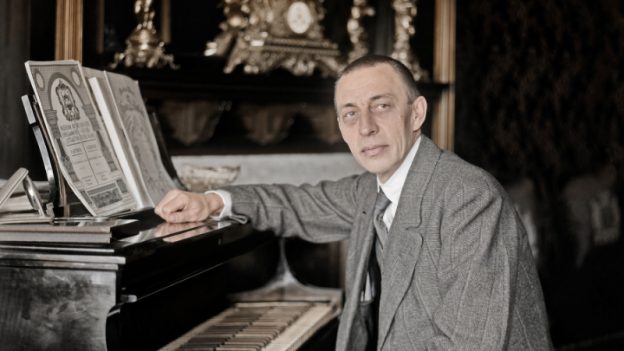
October 2, 2026
Jones Hall
Houston, Texas – USA
Houston Symphony, Juraj Valčuha, conductor; Aleksey Bogdanov, baritone; Houston Symphony Chorus, Anthony J. Maglione, director; Houston Chamber Choir, Betsy Cook Weber, artistic director.
Sergei RACHMANINOFF: The Isle of the Dead, Op. 29 (1909)
Sergei RACHMANINOFF: Spring, Op. 20 (1902)
Sergei RACHMANINOFF: Symphony No. 2 in E minor, Op. 27 (1907)
Lawrence Wheeler | 4 OCT 2026
Friday evening, Houston Symphony Music Director Juraj Valčuha led the first in a series of concerts at Jones Hall featuring the works of Russian composer Sergei Rachmaninoff. Valčuha likes to begin each season with the combined forces of the Houston Symphony and Houston Symphony Chorus. This program also included the Houston Chamber Choir. Ukrainian-American baritone Aleksey Bogdanov made his Houston debut.
A program consisting entirely of the works of Rachmaninoff risks sounding like too much of a good thing—much like eating too many Belgian chocolates. Some conductors rely on the richly colored orchestration and sensuous melodies to carry the performance, often with a cloying effect. Not so with Valčuha, whose emotional intensity and rapt attention to detail wrapped the listener in the warm embrace of sonic splendor. This performance took the highly successful season-ending performances of last May to another level and reminded me how much I had missed hearing the Houston Symphony with Valčuha.
Rachmaninoff’s composition The Isle of the Dead was inspired by a painting of the same name by the 19th-century Swiss Symbolist painter Arnold Böcklin. The painting depicts a desolate small island with towering rocks dominated by cypress trees and surrounded by a dark, still sea. A solitary rowboat, carrying a shrouded figure and a coffin, approaches the island, evoking themes of death, mourning, and the afterlife. Böcklin was influenced by the late-Romantic musical compositions that often wove themes of mortality and nature, making Rachmaninoff’s composition a work influenced by art that was affected by music. A marvel of orchestration, it features a wealth of orchestral color that mirrors the painting’s melancholic and contemplative tone—remarkable, given that Rachmaninoff only saw a black-and-white reproduction of the painting before he wrote it.
Writing in quintuple meter that alternates between 2+3 and 3+2, Rachmaninoff sets the scene of gently lapping waves with low strings, harp, and soft timpani. Cellos intone the main subject, joined by violas and second violins. A lone French horn interjects mournfully, setting the atmosphere. A musical arc from cellos through flute and shimmering violins leads to a thrilling climax that includes the Dies Irae from the Latin Mass for the Dead.
The subtle building of textured dynamics was artfully managed by Valčuha while giving the pulse a hypnotic effect. His adroit control of the overall structure gave the performance a sense of inevitability. The musicians were inspired by his output and, in turn, inspired the audience.
Rachmaninoff’s < em>Spring is a secular cantata for baritone solo, mixed chorus, and orchestra. Based on Nikolai Nekrasov’s 1863 poem “Zelyony shum” (“The Green Noise”), it evokes the awakening of spring through vivid orchestral depictions of nature’s renewal, intertwined with a narrative of human emotion involving betrayal, storm, and ultimate forgiveness.
The performance of < em>Spring was finer than any of the commercially available recordings I have heard. Each element was first-rate—orchestra, chorus, soloist, and conductor. The difference is the level of commitment to the emotional content and execution.
Taken individually, the Houston Symphony is playing at an ever-higher level. Ensemble, intonation, and tonal beauty are at an exceptionally high level. Execution is purposeful, with a foundation of expressive intent.
The combined Houston Symphony Chorus and Houston Chamber Choir have performed together before, but never better than this evening. Tonally rich and expressive, internal balance was exceptional, and dynamic contrasts were stunning. Special attention was given to accurate pronunciation of the Russian text—not an easy task.
Making an impressive Houston debut was the outstanding baritone, Aleksey Bogdanov. Entering shortly before singing, he immediately commanded the stage with his presence. His part in the cantata involves discovering his wife’s infidelity, with thoughts of killing both her and her lover. He represented this with a snarling countenance that was ultimately transformed by thoughts of spring and forgiveness. Bogdanov’s voice filled the hall with richly colored and expressive projection. His articulation was especially fine, bringing to mind the great Feodor Chaliapin, who sang early performances of Spring. Bogdanov’s operatic approach was perfectly suited to the work, which is a cantata in name only.
Making all of the above successful was Juraj Valčuha, who brought his knowledge and insight to the performance. Not one second was spent coasting or being indecisive. It was a masterclass in maintaining control of large forces while still allowing freedom.
Rachmaninoff’s Second Symphony is an orchestral tour de force. From a technical and musical level, as well as in terms of endurance, it is a challenge for the best orchestras and conductors. By any measure, tonight those challenges were met, if not exceeded. Valčuha led an artistically expressive account, showing musical growth and maturity.
The first movement unfolded splendidly. Contrasts of dynamics and tempo flowed seamlessly, with high-pitched violas leading legato lines and first violins playing with exceptional unity and sensitivity. Concertmaster Yoonshin Song’s solos projected warmly. Adam Dinitz contributed beautiful English horn solos, Kayla Burggraf delivered lyrical, well-tuned flute solos, and the violas and timpani provided precise, emphatic punctuations. Combined brass sections showed cohesive power in the climaxes and the coda.
The second movement has an energetic theme introduced by the French horns, led by William VerMeulen. The strings played the difficult central fugue section with energy and uncompromising virtuosity. The woodwinds joined them, led by the bassoons. Valčuha maintained a steady but directional tempo, allowing for precision.
The third movement, “Adagio,” features melodies that have inspired popular songs and movie scores. The heart of the symphony, expressions of love inhabit every phrase. The first violins introduced the lovely opening theme. The clarinet presents the main melody, which Mark Nuccio played with exquisite control. Bassoonist Rian Craypo answered empathetically. While existing as a creative moment, the nuanced, flexible phrasing will likely change tomorrow night.
The music inexorably builds to a climax, culminating in a passionate declaration of love, then quickly fades to a fermata on the dominant chord. What follows is a restatement of the love themes, but now in a state of repose. Quintessential romantic music.
The “Allegro vivace” finale is an exuberant celebration in compound meter that takes the symphony to a triumphant conclusion. Valčuha began a bit too fast but quickly settled into his intended tempo after a dozen bars. Being a virtuoso orchestra, the Houston Symphony brilliantly executed the complicated counterpoint and syncopated rhythms that populate the movement. Valčuha led with precision and mindfulness. The playing was thrilling.
The Jones Hall audience applauded between each movement—not out of ignorance, but because they were keenly aware that what they were hearing was exceptional. Indeed, it was.
Those who regard Rachmaninoff’s music as passé forget that his music came first and was imitated later. That was the judgment a few decades ago, but there has been a resurgence of this composer’s music, even Rachmanomania. Perhaps the world needs the heart-on-a-sleeve emotional expression this music can provide. When we see the violence and corruption that seem to pervade everyday life, finding sanctuary in a concert hall filled with beautiful and caring sounds becomes a necessity. And a gift worth preserving. ■
This concert was repeated on Saturday evening and will be performed again on Sunday afternoon
EXTERNAL LINKS:
- Houston Symphony: houstonsymphony.org
- Juraj Valčuha: jurajvalcuha.com
- Aleksey Bogdanov: alekseybogdanov.com
- Houston Symphony Chorus: houstonsymphony.org
- Houston Chamber Choir: houstonchamberchoir.org

Read more by Lawrence Wheeler.

.png)