
October 3, 2026
Zilkha Hall, Hobby Center for the Performing Arts
Houston, Texas – USA
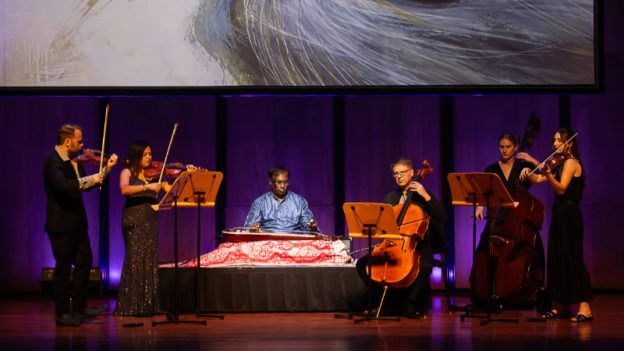
Apollo Chamber Players; Matthew Detrick, artistic director and violin; Chitravina N. Ravikiran, chitravina and voice; Matthew Dudzik, cello; Aria Cheregosha, viola; Ella Sharpe, double bass.
Anthony BRANDT: Resting States for string quartet
Chitravina N. RAVIKIRAN: Illusion to Resolution for string quintet and chitravina
Chitravina N. RAVIKIRAN: excerpt from The Cosmic Knowledge
Sherry Cheng | 6 OCT 2026
In recent seasons, Houston’s Apollo Chamber Players has been tackling major social, cultural, and civic issues that speak to the heart of America’s foundational democratic aspirations. Through wide-ranging musical explorations and collaborations, the ensemble has created programs that boldly confront the topics of racism, immigration, genocide, censorship, the refugee crisis, and more. Apollo garnered Chamber Music America’s Ensemble of the Year award in 2025 for its groundbreaking impact on America’s chamber music landscape. So what is next?
Founder and Artist Director Matthew Detrick found the answer while hiking in Washington’s Cascades. He experienced “a kind of awe that inspires stillness and contemplation.” From that moment of reflection came Apollo’s 19th season, entitled Bold Serenity. Through four concerts this season, Apollo will attempt to “slow the snarl of the attention economy,” and ask how we can live more thoughtfully and find calm and connection in this ever more cacophonous and chaotic world.
Apollo opened its new season this Saturday (Oct. 3) in Zilkha Hall at the Hobby Center for the Performing Arts with Tranquility, in which Eastern and Western musical traditions came together in two world premiere commissions, Resting States for string quartet by Anthony Brandt and Illusion to Resolution for string quintet and chitravina by Chitravina N. Ravikiran. Both composers have diverse and expansive experiences that go beyond the traditional. Brandt is not only an acclaimed composer, a revered professor of composition at Rice University’s Shepherd School, and co-founder and Artistic Director of the contemporary music collective Musiqa, but also a writer and pioneering researcher in music cognition and the creative brain. Ravikiran, known widely as “the Mozart of Indian Classical Music,” is a world-renowned Carnatic musician and composer, a virtuoso on the 21-string chitravina, and an innovator whose groundbreaking concept of Melharmony bridges Eastern (melody-centric) and Western (harmony-centric) traditions by creating harmonies and counterpoints derived directly from the melodic rules and scale integrity of Indian ragas. Apollo first collaborated with Ravikiran in 2017 on its Melharmony program.
An excerpt from Ravikiran’s The Cosmic Knowledge, commissioned by Apollo in 2017, sits at the center of this conceptually unusual concert. The works of Brandt and Ravikiran are literally interwoven and performed without pause: nine alternating movements that take the listener on a journey from chaos to tranquility in the space of an hour. It was an hour of complete engagement, deep listening, and genuine discovery. The interaction between the two works often yielded unexpected synchronicity and happy coincidences. At other times, the differences became points of sharp juxtaposition and wild contrast, making for dynamic dialogue and an adventurous listening experience throughout.
The opening movement, Darkness and Delusion, begins with Ravikiran on the chitravina (a 21-stringed, fretless slide lute used in Carnatic music) playing a captivating melody based on a unique raga he discovered called Andhakāriṇi, used specifically to represent complete darkness. By leaving out the stabilizing 5th note of its parent scale, the mood darkens, creating a sense of profound mystery. The Apollo strings, with the addition of bassist Ella Sharpe, improvised fluidly around the dark raga, creating thin layers of intricate texture that formed a cocoon around the mystery at the center.
An upward bending note on the chitravina, almost whistle-like, leads to Brandt’s Resting States (I): Too much conflict. We are immediately thrown into chaos—disjointed descending and ascending figures in thirds, furious tremolos, punctuating sforzando chords. Unrelenting agitation characterizes much of the movement, gradually slowing to a somewhat peaceful resolution. Before the concert, Brandt spoke about how he considered the composition as working through a series of problems. Each movement comes to a rest, but not until the final movement does he meet the challenge of finding calm.
Illusions and Celebrations features an open and expansive melody shaped beautifully by the entire ensemble. The resonant vibrations of the chitravina underpin the soundscape, giving the whole a warm glow. The unison passages felt comfortable on the ears, a real pleasure. This movement goes through several riveting variations, interspersed with improvisatory solos on the chitravina. Rhythmic vitality and joyous energy are abundant.
That joyous energy turns into frenetic energy in Resting States (II): Too much rushing around. I was reminded of being in rush-hour traffic—crazy drivers, beeping horns, cars swerving to switch lanes, road rage. Propulsive triplets drive the entire movement, building in intensity with little relief. The quartet delivers a brilliantly virtuosic performance, finding precision and clarity amidst the chaos. The lower strings (Matthew Dudzik on cello and Aria Cheregosha on viola) provided much-needed breathing room with rich, well-tuned chords toward the movement’s resolution.
The center of the story arc, for indeed one feels there is an arc taking shape as the music progresses, is an excerpt from Ravikiran’s 2017 Apollo commission, The Cosmic Knowledge.
An extended, soulful chitravina solo leads to a grooving, energetic section that sees traditional Western string instruments occasionally bending it like the chitravina. This is music one can dance to. The chitravina returns with an incredibly expressive solo. It was pure pleasure to watch Ravikiran sliding and plucking with a masterful flourish, producing otherworldly sounds that feel like cosmic voices floating in space, calling to earth. At one point, Ravikiran sings, part of the Carnatic tradition living on in this extraordinary music, music that demonstrates his concept of Melharmony in such an accessible way.
The transition from the ending of The Cosmic Knowledge to the beginning of Resting States (III): Too many distractions is one of the most remarkable moments in the music. There is a sense of serendipity as one long-held note seamlessly progressed to another, as if these two pieces were meant to meld together at this point. This movement begins calmly enough, but soon interruptions occur from every direction. The musical material gets lost in the confusion. The viola picks up the calming figuration with which the movement began, a series of undulating slurred seconds that lets the brain come to a rest. Pulsing discordant chords mark Resting States (IV): Too much stress. Played tenuto with a sense of heaviness, the movement gives one a feeling of persistent, grinding stress.
Illumination to Resolution immediately feels light and buoyant, the distinctly joyous raga, first played in unison, goes through playful variations. The repetition of small cells of melodic material brings to mind the Minimalist music of Philip Glass, grooving, rhythmically interesting, and fun. The ensemble executed the melodic lines with precision and nuance, shaping the phrases with expressive energy.
In the finale, Resting States (V): None of the above, Brandt uses the same musical material from Resting States (III) as a refrain, but centers it without any distractions pulling the audience’s attention away. Fully focused on the melody, beautifully played by Matthew Detrick on first violin, the musical line can now soar above a tranquil landscape. We are listening to a strong inner voice, a sustained melodic line that is quiet but completely present. Perhaps finding tranquility is simply listening deeply to the voice within.
As a listening experience, Apollo’s Tranquility program was thought-provoking and completely satisfying. It was an adventure, a journey from darkness to light, from chaos to calm. Yet it was neither a linear nor predictable journey. One could sense the commonalities and differences between two very different musical traditions. It was a successful blending of these two systems, as both contemplated the same questions. One did not need to understand the complexity of Carnatic music, one of the oldest and most sophisticated musical systems in the world, to appreciate its inventiveness and expressive range. The two works were in conversation with each other and with the audience. And while both could have stood alone, together they told an even more interesting story. This is exactly the kind of programming, from conception to performance, that makes Apollo one of the most innovative and exciting ensembles to watch. ■
EXTERNAL LINKS:
- Apollo Chamber Players: apollochamberplayers.org
- Anthony Brandt: anthonybrandt.net
- Chitravina N. Ravikiran: ravikiranmusic.com

Read more by Sherry Cheng.



.png)