
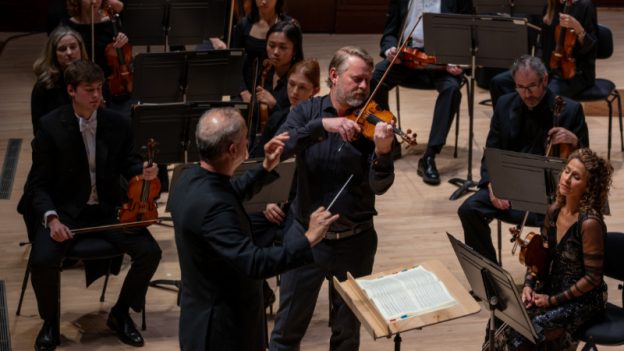
Concertmaster Justin Bruns brings expressive depth to Mendelssohn’s Violin Concerto
October 9 & 10, 2026
Meymandi Concert Hall
Raleigh, North Carolina — USA
North Carolina Symphony; Carlos Miguel Prieto, music director; Justin Bruns, violin
Franz Joseph HAYDN: Symphony No. 49 in G minor, “The Passion” (1768)
Felix MENDELSSOHN: Violin Concerto in E minor, Op. 64 (1838–44)
Robert SCHUMANN: Symphony No. 2 in C major, Op. 61 (1845–46)
Christopher Hill | 12 OCT 2026
Carlos Miguel Prieto and the North Carolina Symphony gave central North Carolinians a chance this weekend to hear their eponymous band perform important Classical and early Romantic repertoire. The three pieces (symphonies by Haydn and Schumann, a concerto by Mendelssohn) are undeniable masterpieces. But then virtually all pieces chosen for the North Carolina Symphony subscription series are masterpieces; this weekend’s program contrasts with many recent concerts in that all three works lean heavily on strings and woodwinds for narrative, reserving brass and percussion for emphasis and punctuation. In contrast, earlier seasons have frequently featured works from the late nineteenth and early twentieth centuries, works with much broader, more coruscating, more virtuosic instrumental palettes. The satisfactions of music like the pieces played this weekend lie more in musical argument than in sensory surfaces.
The first piece, Haydn’s Symphony No. 49 in F minor, cannot truly be called a warhorse, even if it deserves to be one. It is a piece deeply marked by one of music history’s most influential revolutionaries, Carl Philipp Emmanuel Bach. Bach’s compositions and treatise on music, published in the 1750s, when Haydn was at the very beginning of his career, invented Romantic music. It’s the job of music, Bach argued, to arouse the listener’s own emotions, to astonish him, even terrify him, but one way or another to move him, not just entertain him. The young Haydn was enormously impressed by C. P. E. Bach, as was his close contemporary Johann Schobert (whose music showed the young Mozart how to write with feeling).
Haydn was also enormously ambitious, and soon after he landed a plum position with Prince Esterhazy, in 1761, he wrote for his new employer not a symphony but a trilogy of symphonies (Morning, Noon, and Night), and not a Missa Brevis but a 45-minute-long, C. P. E. Bach–style Stabat Mater. Thus, fifteen years before the Sturm und Drang literary movement got started, Haydn was already committed to writing as many big pieces about inner feelings as he could get away with. No wonder he later took the young Beethoven under his wing and helped him get a toehold in Vienna.
But let’s face it: when you work for a prince you are, at best, a favored courtier, at worst, a despised lackey, and most likely something in between. When your world is the world of the court, manners are essential, but wit counts for something, too, and Haydn’s high intelligence allowed him to write well-mannered music with more pointed wit than anyone anywhere had ever heard. His prince was impressed and over four years or so came to trust his musical servant. At that point, Haydn started writing the occasional symphony that was less well-mannered and more like C. P. E. Bach.
His first such was Symphony No. 39 in G minor, which the North Carolina Symphony played last month. Two or three years later, Haydn wrote Symphony No. 49 in F minor, which the ensemble played this weekend. Notice that both these works are in minor keys. At the time Haydn wrote them, minor keys were associated with sacred rather than secular music. There were, in fact, two different kinds of sonata forms associated with this sacred/secular dichotomy. The sacred form was known as a “church sonata,” and in Symphony No. 49 Haydn — for the very last time — “behaved himself” by writing a minor-key work in church sonata form.
In practice that means the symphony’s slow movement comes first, before the fast movement. Some later person decided this church-sonata symphony reminded them of Christ’s crucifixion and nicknamed it “La passione.” Haydn didn’t know about that. But eighteen years after Symphony 49, Haydn actually did write an ambitious, seven-movement work about the crucifixion. And back in 1768, under the last bar of Symphony 49, as with his other symphonies, Haydn wrote Laus Deo, “praise be to God.”
Haydn scores the symphony for strings, two oboes, two horns, and continuo. The horns get a two-bar solo in the third movement. The oboes get a two-bar solo in the last movement. The rest of the time, oboes and horns either double the strings or play long sustained notes, which the strings often embroider with motivic utterances that incorporate lots of spaces (silences), just like pithy human speech. Prieto and his strings made the most of this opportunity. Theirs was a pithy and truly eloquent rendition of the score.
A minor point, perhaps: Haydn would have led this symphony from the keyboard. In Raleigh, the continuo, by contrast, sat behind the other players, and no matter how hard your reviewer strained his ears, he was unable to detect its characteristic arpeggiations. Still, this was a most satisfying performance, save for the moment when the high horn flubbed every note but the last of its two-bar solo.
For seventy-five years or so, Mendelssohn’s Violin Concerto [No. 2] in E minor was the one soloists most often performed in concert. Then the Nazis banned it, so Western Europeans didn’t hear it for a while. The concerto recovered and is still among the top five, along with Beethoven, Brahms, Tchaikovsky, and Sibelius. It may not be the most extroverted concerto or even the most profound, but no musician who ever lived was more deeply musical than Mendelssohn, and if one drops one’s intellectual baggage (negative or positive) and just engages with the notes as they pass, an astonishing array of emotional realities opens up. C. P. E. Bach would be proud.
In a pre-concert talk, Prieto mentioned that the first performance of the score was conducted by Mendelssohn and played by his concertmaster, Ferdinand David. This weekend’s soloist was Justin Bruns, the North Carolina Symphony’s concertmaster. Bruns is no stranger to the proscenium, having made his solo debut with an orchestra at age nine. Standing before the North Carolina Symphony, he appeared entirely natural in his role as soloist, playing with great panache, sensitivity, and complete mastery of the technical requirements.
As concertmaster, Bruns and Prieto share an uncommonly collegial relationship, as evidenced during orchestral rehearsals. Your reviewer was thus surprised that this, their sixth joint performance of the Mendelssohn, projected not one singular voice but two competing voices. The interpretive gap was especially apparent in the first movement, where Bruns displayed a markedly original and insightful conception of the solo part, playing much of it in an unexaggerated but distinctively parlando manner. This manner was ignored by the band in a performance that kept chugging along, though naturally respecting ritardandos at conventional junctures where virtually everyone slows down. Was the metronomic inflexibility intentional?
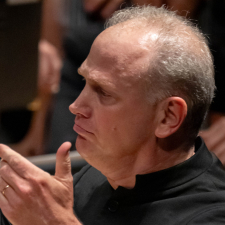
Carlos Miguel Prieto (credit: John Hansen)
Prieto is a master of balance, but for some reason in this first movement, horns and trumpets were often too loud, and even the woodwinds (bassoons, for instance) were heard playing interior phrases a bit too loudly, with little or no nuance. It occurred to your reviewer (entirely speculatively) that the musicians might be too exhausted to listen to their soloist the way chamber-music players do.
The middle movement was taken as a slow waltz rather than as a heartfelt utterance, sweet and nicely coiffed, but scrubbed clean of all its misterioso. Curiously, in this movement the soloist eschewed parlando. Overall, the performance brought to mind how Kurt Masur liked to conduct Mendelssohn, as though a composer who died of heartbreak in his mid-thirties aimed above all to capture conventional bourgeois attitudes. Trying to make sense of the way this middle movement was being played, your reviewer started leaning toward intention rather than exhaustion. But then … in the rondo’s opening theme the flutes lagged so precisely behind the soloist for so long that it sounded like computer latency at work. All was well by the mid-movement recurrence, though, and Bruns’s virtuosic playing carried the day despite so-so support. The audience made it clear that they had had a good time and that Bruns is impressive.
Bruns maintained his high interpretive and technical level in his encore: the beautiful but difficult “Giga” from J. S. Bach’s Partita No. 2 in D minor. After concluding, Bruns thanked the orchestra and subscription audience for an unforgettable experience.
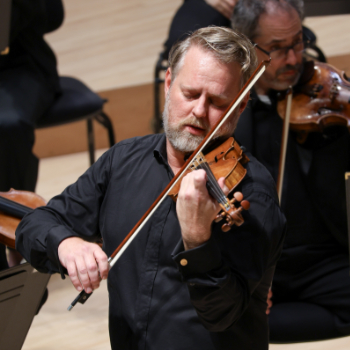
NCS concertmaster Justin Bruns. (courtesy of NCS)
If you were Robert Schumann creating your oeuvre in real time, here’s how things would have appeared in 1845. You wrote a Big Serious symphony in G minor on Hamlet when you were 22, and it’s been performed a couple of times, but you don’t really think the whole thing is ready for prime time. You wrote a Big Happy symphony in B-flat major that includes a “non-serious” instrument (a triangle), and it’s been a big hit. You wrote a Small Happy symphony in E major (you call it Sinfonietta) that doesn’t include a slow movement or a surprise instrument, and it has not been a big hit. You wrote a Small Serious symphony in D minor that features an unusual instrument (a guitar), but no one liked it. Time to try writing a Big Noble symphony — where Noble is a mash-up of Serious and Happy — without any unusual instruments.
It turns out Symphony No. 2 in C major wasn’t easy to write. One reason was that, starting in 1844, Schumann had determined to become a serious disciple of Bach, and one result of this devotion was that his playmates Florestan and Eusebius had to grow up and stop showing off so much. Because of Schumann’s own tragic end, it became fashionable after 1860 to attribute this change of musical manner not to a maturing view of music and life but rather to mental decline. Liszt, for one, said something to the effect that Schumann was an example of a great genius who descended into mere talent. Turn on the echo chamber, please. (A century passes.)
Well, whether you like the mature Schumann or not, there’s no doubt that the principal fulcrum for his growing pains was Symphony No. 2 in C major. Schumann struggled with it far longer than with any of his five other symphonies. It’s the main piece in which Schumann reinvented himself, certainly as a symphonist, probably also as a composer overall. For a long time, it and the E major were the least-played of Schumann’s symphonies. Over the last few decades, all his symphonies have been played more and more. Today Symphony 2 is arguably the most played among them — and why not? Movements 1 and 3 convey depth and sincerity, the scherzo scintillates, and the finale features one of the most successful formal innovations in all Romantic music. Plus, like most Schumann, it’s loaded with good tunes.
This happens to be the second account of Schumann 2 I have heard from Prieto. The first was when he conducted it with the Atlanta Symphony Orchestra in 2024. Your reviewer recalls the hushed, devout atmosphere with which the Atlanta horns opened that performance. The North Carolina horns also created an atmosphere, the kind you feel walking past practice rooms in a conservatory basement. Brass balances were seriously off during the entire first movement, which, despite its energetic rhythms and fine playing by the strings, sounded like it couldn’t wait to be over. The recently augmented cello section brought a welcome warmth and richness to Schumann’s sound.
The second movement was the occasion for more fine playing by the strings. Here the brass started warming up, and by the second trio they projected, for the first time that night, a burnished sound. Prieto’s interpretation of the slow movement, as heard in Raleigh, verges on the cool, but it must be said that he could be seen several times encouraging the violins to sing with more energy. Horns drowned out lower parts of Schumann’s melody in two exposed ruminative spots. But long woodwind solos by oboe and clarinet were played affectingly, as if they really meant something.
Which brings us to the last movement. It begins, very intentionally, in the manner of the first movement’s exposition — in other words, with energetic rhythms. But whereas the orchestra’s musicians sounded bored during the first movement, in this final movement, quite unexpectedly, they didn’t just wake up; they caught fire. Why your reviewer can only guess. Suddenly we were hearing not just the notes but Prieto’s noble conception of the symphony, embodied in sound that carried real conviction. Your reviewer has heard perhaps a dozen performances of Schumann 2, including the aforementioned Atlanta one. This weekend’s performance had the most powerful finale I have yet heard. Balances were well nigh perfect. Phrases were attractively sculpted in all layers of the instrumentation. The pacing was like a great storyteller in his element. Execution in every section was alert and impassioned. Combined with Schumann’s large, intricate, and compelling structure, the resulting musical drama lifted its audience to some kind of sphere where one feels both connected with, yet transcends, the travails of daily life.
From the response at the end, I think just about everybody in the audience shared some version of this experience. I can’t imagine a better example to explain why people still want to hear music conceived centuries ago. Skillfully recreated by one’s talented contemporaries, there’s nothing else like it. ■
EXTERNAL LINKS:
- North Carolina Symphony: ncsymphony.org
- Carlos Miguel Prieto: carlosmiguelprieto.com
- Justin Bruns: ncsymphony.org/people/justin-bruns

Read more by Christopher Hill.

.png)