
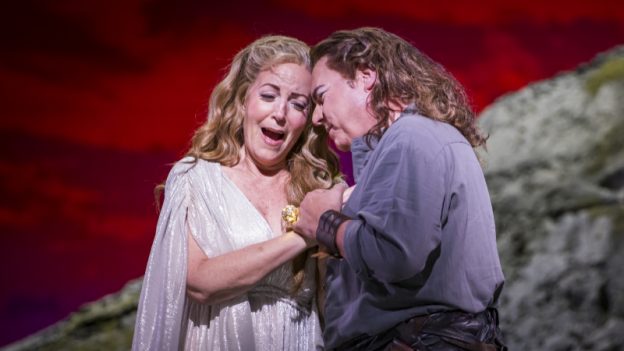
May 30; June 2, 5 & 7, 2026
Cobb Energy Performing Arts Centre
Atlanta, Georgia – USA
Richard WAGNER: Twilight of the Gods (Götterdämmerung)
Roberto Kalb, conductor; Tomer Zvulun, stage director; Richard Wagner, composer & librettist. Cast: Stefan Vinke (Siegfried), Lise Lindstrom (Brünnhilde), David Leigh (Hagen), Le Bu (Gunther), Sylvia D’Eramo (Gutrune), Tamara Mumford (Waltraute / First Norn), Olivia Vote (Second Norn), Caitlin Lynch (Third Norn), Aleksey Bogdanov (Alberich), Cadie J. Bryan (Woglinde), Alexandra Razskazoff (Wellgunde), Gretchen Krupp (Flosshilde), John Arnold (First Vassal), Wayd Odle* (Second Vassal). [*Studio Artist] Creative: Erhard Rom, scenic & projection designer; Mattie Ullrich, costume designer; Robert Wierzel, lighting designer; Ran Arthur Braun, live action director; Anne Nesmith, wig & makeup designer; Walter Huff, chorus master; Gregory Luis Boyle, associate director; Emma Grimsley & Aletha Saunders, assistant directors; Erin Teachman, projection programmer.
Mark Gresham | 2 JUN 2026
“In my end is my beginning.”
—T. S. Eliot, East Coker
By any reasonable measure, Saturday night’s opening performance of Wagner’s Götterdämmerung at the Cobb Energy Performing Arts Centre was more than an opera performance. It was the culmination of an artistic undertaking that began four years ago with Das Rheingold and has now made The Atlanta Opera the first company in the Southeast ever to complete Wagner’s Der Ring des Nibelungen cycle in a fully staged production. Conducted by Roberto Kalb and directed by Tomer Zvulun, this concluding chapter carried the weight not only of Wagner’s vast mythological drama but of the company’s own ambitious journey.
That burden might have crushed a lesser enterprise. Instead, Atlanta delivered an evening of remarkable theatrical assurance, one that succeeded not because it attempted to rival Bayreuth or the Metropolitan Opera in sheer scale, but because it understood the essence of Wagner’s final drama: inevitability.
Everything in Götterdämmerung points toward collapse. The gods are already dying. Heroism has become naïveté. Love is vulnerable to manipulation. Power consumes those who seek it. By the time the curtain rises, the ending is already written.
The challenge for any production lies in making that inevitability compelling rather than merely prolonged. Zvulun’s production largely succeeds.
The visual language developed across Atlanta’s Ring reached its fullest realization here. Scenic and projection designer Erhard Rom again employed a multimedia environment in which physical scenery and projected imagery continuously interacted. Throughout the evening, projections became an active storytelling element rather than decorative enhancement, creating a cinematic sense of movement during Wagner’s extended orchestral transitions and scene changes. The technique proved especially valuable in a work whose architecture frequently requires the audience to remain immersed in the narrative during lengthy orchestral spans.
Rather than interrupting momentum, these interludes often became among the production’s most evocative moments.
One could sense the influence of film language throughout the evening. Ran Arthur Braun’s live-action direction, combined with Rom’s projections and Robert Wierzel’s lighting, created a visual world in constant transformation. Images emerged, dissolved, and reappeared like fragments of memory. Fire, water, sky, and ruin became recurring visual motifs, foreshadowing the apocalypse long before Wagner finally unleashes it.
Most impressive was the production’s refusal to become trapped in literalism.
Many contemporary Rings either bury themselves beneath concept-driven reinterpretation or attempt a quasi-medieval fantasy spectacle. Atlanta pursued neither path. Instead, the production occupied an intermediate space where myth and psychology coexisted. The visual world often felt less like a historical setting than a landscape of memory and consequence.
That proved particularly effective in the opera’s opening Norn scene.
Tamara Mumford, Olivia Vote, and Caitlin Lynch established the atmosphere immediately. Their account of the Norns’ great narrative prologue possessed both vocal solidity and dramatic tension. Wagner begins not with action but with remembrance. The world is already unraveling, and the Norns know it. The trio projected precisely the sense of cosmic instability required for the scene to function.
Mumford, returning later as Waltraute, delivered one of the evening’s most affecting performances.
Waltraute’s Act I narration remains among Wagner’s greatest monologues, a scene in which an eyewitness reports the collapse of divine authority. Mumford shaped the lengthy account with remarkable dramatic intelligence, avoiding declamation for its own sake and instead constructing a genuine psychological portrait of a woman horrified by what she has seen. Her rich mezzo-soprano carried both urgency and dread.
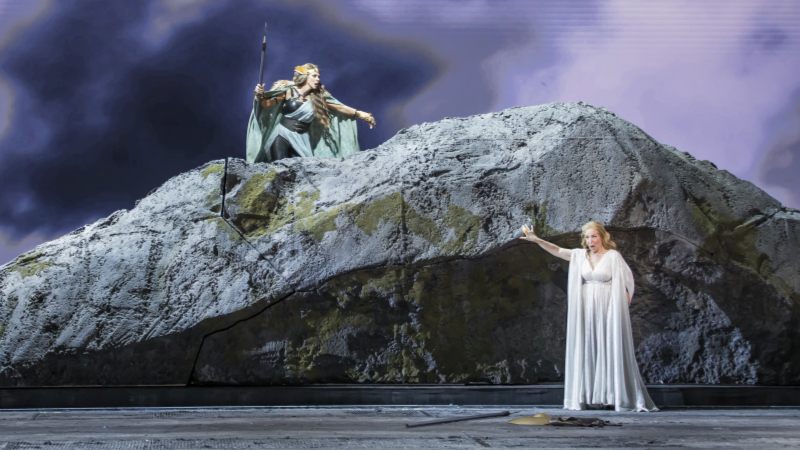
Tamara Mumford as the Valkyrie Waltraute brings a message to Brünnhilde, sung by Lise Lindstrom. (credit: Eaftermen)
If Mumford supplied the evening’s conscience, David Leigh provided its darkness.
Making his Atlanta Opera debut as Hagen, Leigh delivered a performance of formidable authority. Hagen can easily become a one-dimensional villain, but Leigh found complexity within the character’s malevolence. The bass voice possessed the necessary depth and power, yet what proved more impressive was his restraint. He understood that Hagen’s greatest weapon is not force but patience.
Throughout the evening, he seemed to wait. Watch. Calculate.
The famous Act II summons to the vassals emerged not as an explosion but as the culmination of a carefully cultivated menace.
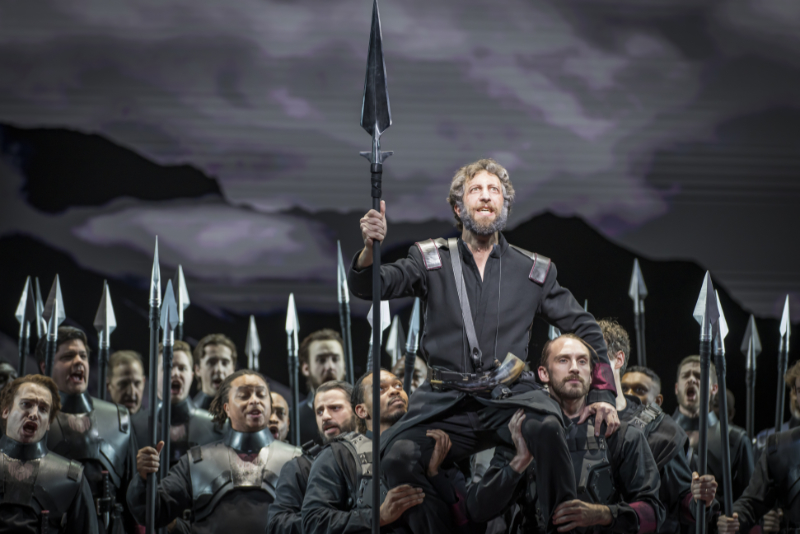
David Leigh as Hagen rides on the shoulders of his vassals. (credit: Raftermen)
Le Bu’s Gunther offered a compelling study in weakness rather than villainy. Gunther is among Wagner’s most pathetic creations, a man whose desire for prestige exceeds his capacity for leadership. Bu captured that essential fragility, making Gunther’s moral failures seem tragically human rather than merely contemptible.
Sylvia D’Eramo’s Gutrune likewise benefited from a sympathetic characterization. Too often treated as an operatic afterthought, Gutrune emerged here as another casualty of forces she scarcely understands.
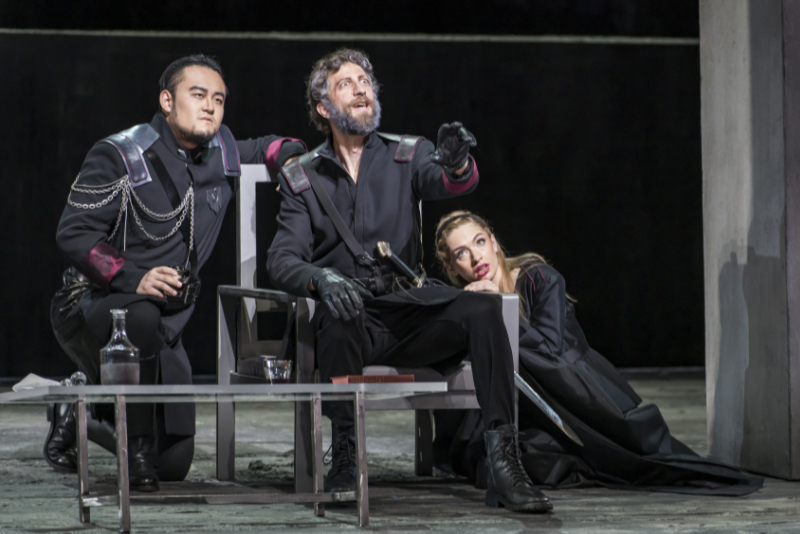
From left to right, Le Bu as Gunther, David Leigh as Hagen, and Sylvia D’Eramo as Gutrune. (credit: Raftermen)
Yet Götterdämmerung ultimately belongs to three figures: Siegfried, Brünnhilde, and the orchestra.
Stefan Vinke’s Siegfried remained astonishingly tireless. Wagner asks almost impossible things of the tenor singing this role, especially when one considers that the character has already dominated the preceding opera. Vinke’s voice retained its heroic brightness across the evening’s immense duration. More importantly, he preserved Siegfried’s defining innocence.
That innocence is crucial.
Siegfried is not a tragic hero because he possesses a fatal flaw. He is tragic because he lacks one. His openness becomes the very quality that allows manipulation to destroy him.
Vinke understood this paradox.
His account of the Rhine Journey and subsequent scenes never suggested intellectual weakness. Rather, this Siegfried seemed incapable of imagining deception because deception has never existed in his moral universe.
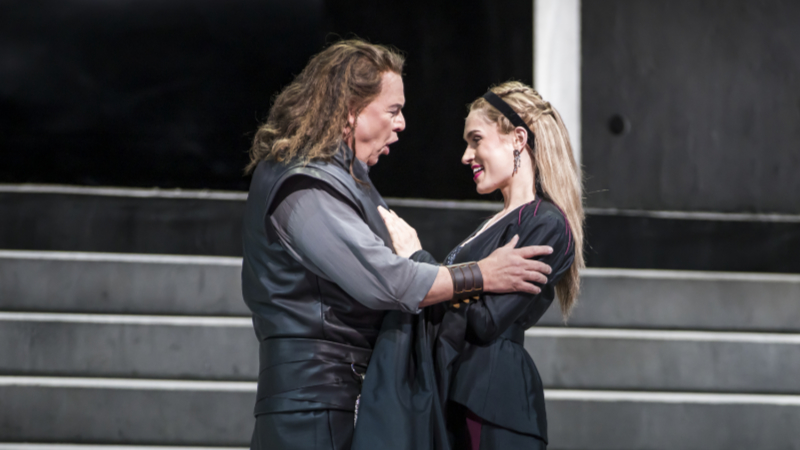
Stefan Vinke as Siegfried embraces Sylvia D’Eramo as Gutrune. (credit: ERaftermen)
Opposite him, Lise Lindstrom delivered the performance around which the evening ultimately revolved.
Brünnhilde is the emotional and philosophical center of Götterdämmerung. Every betrayal, every death, every revelation ultimately serves her journey toward understanding.
Lindstrom’s Brünnhilde possessed both vocal security and dramatic command. The great Act II oath scene carried blazing intensity, but it was in the quieter moments that her portrayal achieved its greatest impact. She allowed grief to emerge gradually, transforming outrage into comprehension and comprehension into resolve.
By the time she reached the Immolation Scene, the evening’s trajectory felt complete.
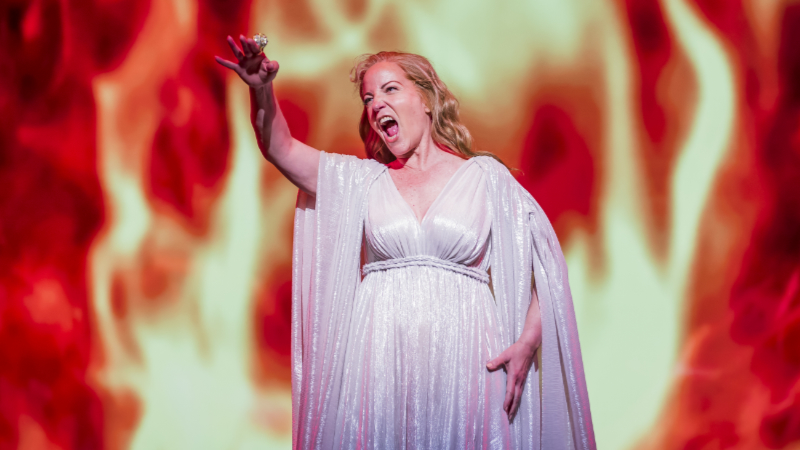
Lise Lindstrom as Brünnhilde. (credit: Raftermen)
The final twenty minutes remain among the most extraordinary passages in opera. Wagner gathers together musical ideas introduced over fifteen hours earlier in Das Rheingold. Themes associated with power, love, renunciation, heroism, and redemption return for one final reckoning.
Kalb handled these pages magnificently.
Throughout the evening, he demonstrated an acute understanding of Wagnerian architecture. Conducting Götterdämmerung requires balancing immediate dramatic needs against a structure spanning nearly six hours. Kalb consistently maintained momentum without sacrificing detail. The orchestra responded with playing of impressive concentration and stamina.
Particularly notable was the transparency of the orchestral texture. Wagner’s score can become overwhelming in a modern theater, yet instrumental details emerged with unusual clarity. Leitmotifs surfaced and receded naturally, allowing listeners to experience the drama’s vast network of musical associations without feeling lectured by them.
The Atlanta Opera Orchestra has grown noticeably over the course of this Ring cycle.
Saturday’s performance suggested an ensemble that has developed a genuine Wagnerian instinct.
As Brünnhilde finally embraced her destiny and the world of gods moved toward destruction, the production’s visual and musical elements converged with striking effectiveness. Fire and water—elements repeatedly invoked throughout the opera and highlighted in the production’s visual design—assumed their symbolic roles in the final catastrophe. Wagner’s ending can feel either overwhelming or transcendent. Here it achieved something rarer: coherence.
The closing moments brought a palpable sense that an enormous narrative had finally completed its arc.
If the evening carried the emotional satisfaction of a conclusion, it also contained the unmistakable energy of a beginning. Before the performance, The Atlanta Opera announced plans for a dedicated Ring Festival in June 2029, presenting two complete cycles of Der Ring des Nibelungen over consecutive weeks and transforming Atlanta into a destination for Wagner audiences from around the world.
Centered around the company’s future home, the Molly Blank Center for Opera and the Arts, the festival will pair the four operas with recitals, lectures, discussions, and related events. The announcement underscored how profoundly the company’s ambitions have evolved.
What began with Das Rheingold in 2023 as an audacious artistic gamble is now being positioned as a recurring cultural attraction with national and international reach. If Saturday night’s performance marked the completion of Atlanta’s first Ring, the 2029 festival announcement suggested that the company views this achievement not as a summit conquered, but as a foundation upon which to build.
That feeling extended beyond the opera itself.
For Atlanta audiences who have followed this journey since Das Rheingold in 2023, the evening represented the conclusion of a four-year relationship with Wagner’s mythic universe. One could sense that awareness in the auditorium during the final curtain calls. Applause celebrated not merely a successful performance, but the completion of a project many doubted would ever happen in the Southeast.
Wagner called the Ring a stage festival play.
The phrase suggests something larger than ordinary repertory performance.
Saturday night, Atlanta finally reached the festival’s end.
The gods perished. The ring returned to the Rhine. The world burned.
And from the ashes emerged one of the most significant achievements in The Atlanta Opera’s history. ■
EXTERNAL LINKS:
- The Atlanta Opera: atlantaopera.org
- Roberto Kalb: robertokalb.com
- Tomer Zvulun: tomerzvulun.com
- Erhard Rom: erhardrom.com
- Lise Lindstrom: liselindstrom.com
- Stefan Vinke: stefanvinke.de
- David Leigh: davidleighbass.com
- Tamara Mumford: tamaramumford.com
- Sylvia D’Eramo: sylviaderamo.com

Read more by Mark Gresham.

.png)