
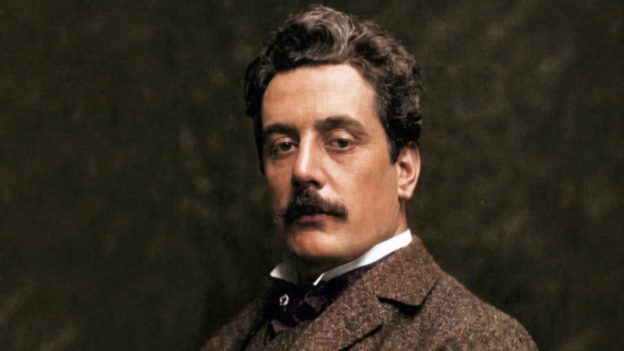
Centennial production reframes the opera’s final act by returning to Puccini’s music and reshaping its dramatic arc
Mark Gresham | 22 APR 2026
For an opera so firmly embedded in the repertory, Turandot has long carried an unresolved tension. Left incomplete at Giacomo Puccini’s death in 1924, the work has traditionally been performed with an ending assembled by Franco Alfano—a conclusion that, while functional, has rarely escaped questions of dramatic and musical coherence.
“I have known Turandot since I was 10,” recalls scenic designer Erhard Rom, describing a childhood performance that left a lasting impression but also a lingering dissatisfaction. “I saw a production of it in Seattle, and—honestly, even since that early age—I’ve never really liked the ending. After all this incredibly great music of Puccini, you get a different composer, and it’s just not as good.” He added that the issue is not merely musical: “There’s also a dramatic problem. The way the story culminates… is not particularly appealing.” The instinct stayed with him over years of listening, eventually sharpening into a more specific critique of both its musical and dramatic resolution.
That underlying discomfort—shared quietly by performers, scholars, and audiences alike—forms the starting point for The Atlanta Opera’s new staging, presented not only in the work’s centennial year but opening exactly 100 years to the day after its premiere. Rather than smoothing over the opera’s famously problematic ending, the company has chosen to confront it directly.
“We’re not saying that this is the absolute solution,” said production director Tomer Zvulun, General and Artistic Director of The Atlanta Opera since 2013. “But we are very proud, on the 100-year anniversary of the piece, to present something that has not been presented before.” He added that the company hopes to “encourage those discussions about how to end this,” describing the work as “this enigmatic, unfinished masterpiece.”
A structural shift
At the center of the rethinking is a deceptively simple idea: relocate Turandot’s Act II aria, “In questa reggia,” to the final act, after the death of Liù—the enslaved servant girl whose sacrifice marks the opera’s emotional turning point.
That shift—small on paper—fundamentally alters the opera’s dramatic trajectory. Traditionally, “In questa reggia” functions as exposition, explaining Turandot’s cruelty through ancestral trauma. In the Atlanta Opera staging, it becomes something else entirely: a response to the emotional rupture of Liù’s sacrifice.
“Liù’s death is a moment of transformation,” Rom explains. “She’s caused this death… she’s in despair. And suddenly that aria takes on a completely different emotional meaning.”
The repositioning also addresses a long-standing imbalance in the opera. Puccini’s final completed music—Liù’s death—carries such emotional weight that what follows has often struggled to match it. In this restructured version, that moment becomes the hinge of the drama rather than a peak followed by a decline.
Musical continuity, minimal intervention
Crucially, the solution is not built on replacing Puccini, but on reassembling him.
“Respecting Puccini’s score was our first idea,” says conductor Iván López-Reynoso. The revised ending draws almost entirely on existing material, with only a brief retention of five bars of Alfano’s music to bridge the final transition.
The goal, as Rom puts it, is simple: “to make Puccini the winner.”
Even at the level of harmonic detail, the restructuring seeks continuity. The close of Liù’s death scene and the opening of “In questa reggia” share a common pitch, allowing the transition to function organically despite the shift in order. From there, the conclusion incorporates familiar musical material—including themes associated with “Nessun dorma”—so that the opera’s final pages remain grounded in Puccini’s language.
Reframing Turandot
The most significant change, however, is dramatic.
In the conventional ending, Turandot’s sudden transformation—often read as coerced or insufficiently motivated—has long been a point of contention. Here, that arc is reconsidered, with choice rather than coercion becoming the turning point.
Drawing in part on Friedrich Schiller’s source play, the new structure suggests that Turandot’s capacity for change is latent rather than imposed. Liù’s act becomes the catalyst: witnessing the servant girl’s sacrifice, she confronts a form of devotion previously absent from her world.
The result is an ending in which Turandot refuses to execute Calaf—not out of submission, but as an act of choice—reframing the opera’s final turn around agency rather than coercion.
Implications for performance
The shift carries practical consequences as well. “In questa reggia,” notoriously demanding as an opening statement for the character, gains a new dramatic foundation when placed later in the opera.
As López-Reynoso noted, “It’s a very, very hard aria to just come on stage and sing as the first thing.” In its new position, the aria instead emerges from the drama itself, giving the soprano a more immediate emotional context.
At the same time, the title role retains its centrality through the final act, avoiding the sense, common in some interpretations, that Turandot recedes after Liù’s death.
A broader frame
The Atlanta Opera’s thinking about this production extends beyond structural repair. As the company frames it, Turandot becomes part of a larger exploration of power, leadership, and moral responsibility.
“I’m always influenced by what is going on in the world,” said Zvulun. “I worry greatly about leadership today.”
Across several works in the company’s current season—The Marriage of Figaro, Turandot, and Twilight of the Gods—a pattern emerges: figures of authority who fail to listen, and women who intervene to restore balance. In Turandot, that role belongs to Liù, whose sacrifice reshapes the opera’s moral landscape.
From that perspective, the restructured ending traces a movement “from power to freedom… from monarchy to life.”
The new production also sheds Turandot’s traditional patina of orientalism, opting instead for a more cosmopolitan visual language inspired by artistic currents contemporary with the latter years of Puccini’s life—including the geometric abstraction of Piet Mondrian. At the same time, the design reflects the opera’s central motif of riddles, incorporating visual elements drawn from puzzles and games, such as chess and Rubik’s Cube.
Risk and reception
The creative team is clear-eyed about the risks.
“It may not be perfect,” said Zvulun. “There will be people who won’t like it—but we welcome that discussion.”
If anything, that openness is central to the project. Rather than presenting a definitive solution, the production positions itself as a proposal—one that invites audiences to reconsider a work they may think they know.
The idea itself, fittingly, began by accident. Listening through the score, Rom mistakenly played the wrong disc—jumping from the end of Act III back to Turandot’s Act II aria. The juxtaposition sparked the realization that the opera’s emotional logic might lie not in new material, but in a different order.
From that moment, a new structure emerged—one that seeks not to complete Puccini, but to listen more closely to what he left behind.
As audiences encounter this centennial Turandot, they are asked to do much the same. ■
EXTERNAL LINKS:
- The Atlanta Opera: atlantaopera.org

Read more by Mark Gresham.


.png)