
April 25, 28; May 1 & 3, 2026
Cobb Energy Performing Arts Centre
Atlanta, Georgia – USA
Giacomo PUCCINI: Turandot
Iván López Reynoso, conductor; Tomer Zvulun, production director; Giacomo Puccini, composer; Giuseppe Adami & Renato Simoni, librettists. Cast: Angela Meade (Turandot), Jonathan Burton (Calaf), Juliana Grigoryan (Liù), Peixin Chen (Timur), Eleomar Cuello (Ping), Wayd Odle (Pang), Terrence Chin-Loy (Pong), Kyle White* (A Mandarin), Steven Cole (Emperor Altoum). Creative: Ran Arthur Braun, live action director; Gregory Luis Boyle & José Israel García*, assistant directors; Erhard Rom, scenic designer; Ana Kuzmanic, costume designer; Robert Wierzel, lighting designer. [* Studio Artist]
Mark Gresham | 29 APR 2026
“Off with his head!” —the Queen of Hearts, in Lewis Carroll’s Alice’s Adventures in Wonderland
The Atlanta Opera’s new production of Turandot, which opened Saturday, April 25, exactly 100 years to the day after the opera’s 1926 premiere, does not treat that anniversary as mere commemoration. Instead, it interrogates the work at its structural fault lines—most notably by reordering one of its central arias and radically altering the opera’s conventional ending.
That decision alone places the performance in a lineage of productions willing to confront the unfinished nature of Puccini’s final score. Here, the confrontation is not theoretical. It is built directly into the evening’s musical architecture.
The most consequential change arrives with the relocation of “In questa reggia,” traditionally, the defining moment of Act II—Turandot’s icy declaration of inherited trauma. It is moved to Act III, following Liù’s death. What is normally a manifesto of cruelty becomes, instead, a retrospective justification delivered after the human cost has already been exacted.
Dramatically, this reframing shifts the opera’s center of gravity. The riddle scene in Act II, deprived of Turandot’s psychological exposition, becomes more ritual than revelation—a public mechanism of power rather than a window into motive. The princess emerges less as a figure shaped by history and more as an emblem of impersonal authority. Whether that abstraction clarifies or diminishes the character will likely divide listeners; what is certain is that it alters the stakes of the riddles themselves, making them feel less like a personal trial and more like an institutionalized performance of dominance.
When “In questa reggia” finally arrives in Act III, the aria lands differently. Sung here by Angela Meade with formidable control and tonal amplitude, it reads less as a declaration than as an attempt (perhaps futile) to reclaim narrative authority after Liù’s sacrifice has already shifted the moral balance of the opera. The placement invites a reading of Turandot not as implacable but as belated; yet it shifts the focus back to Turandot, with Liù’s death as the moral infection point, and heightens the drama compared with Franco Alfano’s unsatisfactory completion of the opera after Puccini’s death. Only a few measures of Alfano’s music are retained; the rest is Puccini. Thus, the ending resists the familiar turn toward sudden redemption as obligation, and the apotheosis instead belongs to Turandot’s choice.
These interventions ripple backward through the performance. Under conductor Iván López Reynoso, the Atlanta Opera Orchestra delivered structural coherence, with none of the changes feeling abrupt, though die-hard fans of the traditional version will definitely notice. The score’s familiar surges of opulence are present but restrained, allowing the altered architecture to register cleanly, which aligns with the production’s visually modernist emphasis on form and ritual.
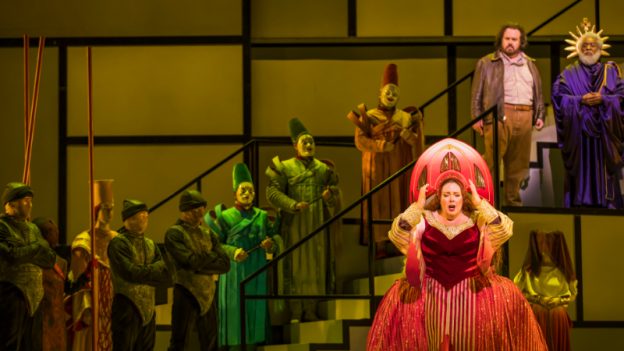
This visual world, shaped by production director Tomer Zvulun and designers Erhard Rom (scenic) and Ana Kuzmanic (costumes), supports this rethinking. A chess-inflected aesthetic—explicitly symbolic rather than literal—frames the court as a system of power defined by position and constraint. But it is not a direct emulation of a game of chess, with its symmetrical game board and pair of equal opposing forces. Instead, the symbolic forces are singular and asymmetrical.
Rom’s modernly abstract Piet Mondrian-inspired set emphasizes visual asymmetry, including the placement and movement of staircases and platforms. The “chess” figures move less as individuals than as pieces within a larger design. The asymmetry of that system, noted even within the production’s own logic, reinforces the sense that authority here is constructed rather than natural.
Much like Turandot’s court, Kuzmanic’s costumes were designed with chess pieces in mind because chess is a game of power and position. They suggest a hierarchy of roles without tying them to literal references. Ping, Pang, and Pong are costumed to imply bishops and move with a uniformity that reads as deliberate patterning. In one scene, they also play with Rubik’s Cubes. The Mandarin was marked out distinctly as a knight, replete with a horse’s head. With three bishops, one knight, one king, one queen, a number of rooks, and a host of pawns, the asymmetry of Turandot’s court (and its power) is again brought to the fore.
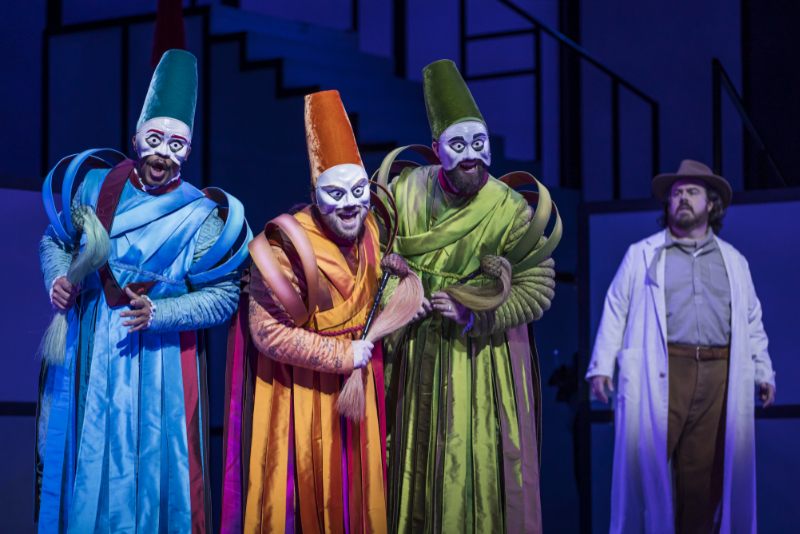
Ping, Pang, and Pong, the court ministers, warn Calaf against testing himself against the Princess’s riddles. Terrence Chin-Loy (left) as Pong; Eleomar Cuello (center) as Ping; and Wayd Odle as Pang. Jonathan Burton appears in the right background as Prince Calaf. (credit: Raftermen)
But there were also characters who were not chess pieces: Calaf, Timur, and Liù, who are outsiders, not pieces of the game’s hierarchy, but who have entered the game as players.
My first impression of Calaf, with his brimmed hat and self-possessed bearing, suggested an operatic Indiana Jones—entering not a romance but a trial system, where success depends less on passion than on reading the rules correctly. Whether intentional or not, it actually tracks in a surprisingly precise way. Like the Grail challenges in The Last Crusade, Turandot’s riddles function as public tests with private logic; the difference is that in the opera, solving them does not clarify the world so much as expose its arbitrariness.
Additional movement elements add a physical vocabulary that underscores hierarchy and control. Robert Wierzel’s lighting isolates and sculpts, reinforcing the movements of Rom’s set pieces in turning the stage into a series of shifting tableaux.
Vocally, the performance remains anchored by Angela Meade’s commanding Turandot. Her instrument meets the role’s demands with authority, but in this configuration, the character’s emotional trajectory is necessarily altered. The delayed placement of “In questa reggia” renders her less a figure introduced through ideology than one revealed through aftermath.
Juliana Grigoryan’s Liù becomes, correspondingly, even more pivotal. Her finely controlled singing and direct expressive line give the opera its clearest emotional anchor. In a version of Turandot that withholds easy resolution, Liù’s sacrifice resonates as a heightened moral turning point.
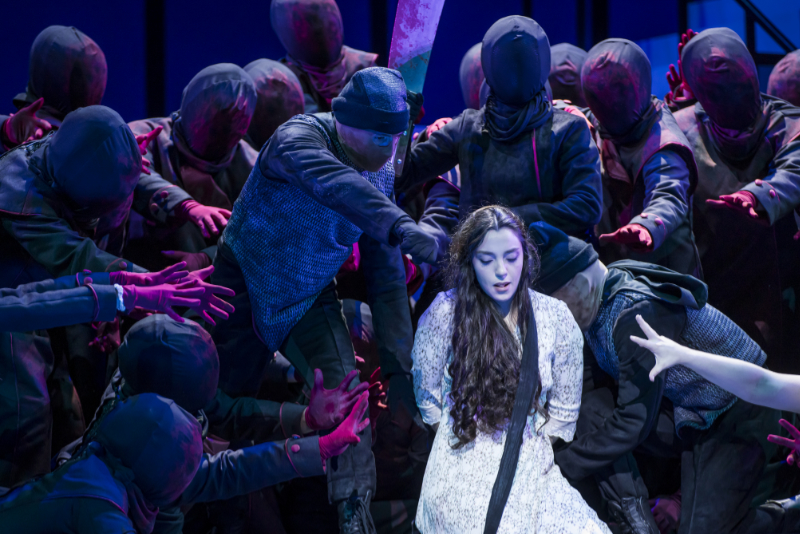
Juliana Grigoryan (center) as Liù keeps Calaf’s secret. (credit: Raftermen)
Jonathan Burton’s Calaf offers a more measured heroism, shaping “Nessun dorma” with attention to line rather than sheer force. Peixin Chen’s Timur provides a grounded, resonant presence, while the trio of ministers, Ping, Pang, and Pong (Eleomar Cuello, Wayd Odle, and Terrence Chin-Loy) navigate the production’s stylized framework with precision.
The remainder of the cast was strong and effective. The chorus, prepared by chorus master Lisa Hasson, functioned as a disciplined, often imposing collective, reinforcing the production’s focus on societal structures rather than individual psychology.
Marking the centenary of Turandot with a production that so deliberately unsettles its conventions is a calculated choice. By relocating a central aria and stripping the ending to its Puccini-writ bones, The Atlanta Opera foregrounds the opera’s unresolved tensions rather than smoothing them over.
The result is not a Turandot that answers its riddles, but one that asks whether they were ever meant to be solved. ■
EXTERNAL LINKS:
- The Atlanta Opera: atlantaopera.org
- Iván López Reynoso (conductor): ivanlopezreynoso.com
- Tomer Zvulun (production director): tomerzvulun.com
- Erhard Rom (scenic designer): erhardrom.com
- Ana Kuzmanic (costume designer): anakuzmanic.com
- Angela Meade (Turandot): angelameade.com
- Jonathan Burton (Calaf): jburtontenor.com
- Juliana Grigoryan (Liù): askonasholt.com
- Peixin Chen (Timur): imgartists.com

Read more by Mark Gresham.



.png)