
February 8, 2026
MATCH in Midtown
Houston, Texas – USA
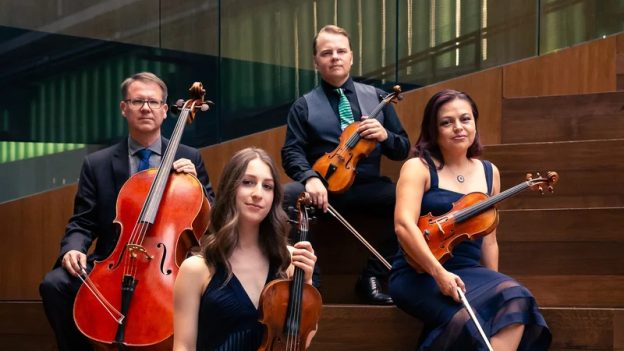
Apollo Chamber Players (Matthew J. Dietrick, violin; Anabel Ramirez, violin; Aria Cheregosha, viola; Matthew Dudzik, cello); Evergreen Quartet – Kinder HSPVA; Kenneth Morris, Jr., narrator; Mali Gatewood, speaker; Penelope Campbell, soprano; Elizabeth Tate, alto; Wayne Ashley, tenor; Keaton Brown, baritone.
Daniel Bernard ROUMAIN: And Still We Cross (2026) – (World Premiere Version for String Quartet)
Libby LARSEN: Sorrow Song & Jubilee (2014)
Felix MENDELSSOHN: String Quartet in F Minor, Op. 80 (1847)
Daniel Bernard ROUMAIN: And Still We Cross (2025) – (World Premiere version for string quartet, vocal quartet (SATB) & narrator; words by Kenneth B. MORRIS, Jr.)
Lawrence Wheeler | 9 FEB 2026
Apollo Chamber Players’ 18th season, American Story, explores the diverse cultural threads that have shaped the United States, celebrating the voices, histories, and artistic expressions that define our nation, and to remind us that the American story—though filled with triumphs—remains unfinished and ever-contested. They seek to “celebrate the nation’s greatest achievements while uplifting the voices and stories of marginalized communities that have long shaped progress, struggle, and resilience.”
For this program, Apollo stated: “We honor the life and legacy of Frederick Douglass and Booker T. Washington—brought to the present by their living descendant, Kenneth Morris, Jr.—through a collaborative commission with Emmy-winning composer Daniel Bernard Roumain. And Still We Cross is an artistic statement on migration, resilience, and the enduring struggle for freedom, from the Underground Railroad to the Rio Grande.” Kenneth B. Morris, Jr. descends from two of the most influential names in American history: Frederick Douglass—the most important leader of the movement for African American civil rights in the 19th century—and Booker T. Washington, a prominent African American educator, author, leader, and founder of the Tuskegee Institute.
This past week, Matthew Dietrick discovered there was an extraordinary connection between Morris and Roumain. Roumain’s ancestor, Ernest Roumain, was Haiti’s ambassador to the United States. He attended Abraham Lincoln’s Second Inauguration, where he met Frederick Douglas. The men ate together at the state dinner. This connection was not known to Dietrick when he invited the two men.
The program began with all 15 participants on stage while Kenneth Morris, Jr. introduced himself: “I am the great-great-great-grandson of Frederick Douglass and the great-great-grandson of Booker T. Washington. Their blood runs through my veins, and so does their purpose. I walk in their footsteps, sometimes literally…” He continued by reading the text he had written that formed the basis of And Still We Cross. He was joined by speaker Mali Gatewood, who said, “Our ancestors crossed so we could stand. Now we must stand so others can cross. Freedom is not a gift we inherit—it is a promise we renew—with every open hand—with every crossing that reminds us we are the heirs of their hope and the stewards of their unfinished work and dreams.”
Without pause, the program continued with the world premiere of an adapted version of Roumain’s work, performed by the Evergreen Quartet—a student ensemble from Kinder HSPVA. Their appearance underscores Apollo’s “education and mentorship mission and the democratization of artistic expression.” The young musicians gave an admirable performance of the piece, which included speaking some lines from Morris’s text.
The concert continued with Apollo’s early commission, Sorrow Song & Jubilee by American composer Libby Larsen. This piece “draws on the spiritual tradition where sorrow and despair give way to resolve and collective hope.” It is inspired by Antonín Dvořák’s relationship with the Black composer Henry Burleigh, who introduced Dvořák to African American spirituals and dances, deeply influencing Dvořák’s American works. Sorrow Song is based on “Swing Low Sweet Chariot.” Jubilee is modeled on a furiant dance typical of Dvořák. Having previously performed and recorded the work, Apollo provided the definitive interpretation.
Felix Mendelssohn wrote his Sixth String Quartet following the sudden death of his older sister Fanny, one of his closest confidants. Still deep in grief, he died two months later. The quartet is somewhat spare as compared to his earlier quartets, with a darker expressive palette. It may have signaled a change in his compositional style, but his ensuing death relegates that idea to conjecture. Mendelssohn’s music is characterized by consonant triadic chords, with little use of disruptive dissonances. This may have been the product of his upbringing. Mendelssohn’s grandfather was the Jewish philosopher and theologian Moses Mendelssohn, “a key figure in the Jewish Enlightenment whose ideals helped shape the values of America’s founders and moral leaders.” Felix’s father, Abraham, renounced Judaism, and his parents formally adopted the surname Mendelssohn-Bartholdy to further demonstrate the break from Moses. Felix was initially raised without religion until he was baptized at age seven. The parents were later baptized. Abraham was a businessman, and these moves were likely intended to gain acceptance in the widely anti-semitic Germany. Felix may have sought acceptance, even if subconsciously, by writing music that was pleasant and non-confrontational. He further reflected his conformist Christian upbringing by quoting Handel’s Messiah in his early String Octet and later in his Reformation Symphony.
Apollo gave a stirring account of the quartet, led with accuracy and polish by first-violinist Anabel Ramirez. The first movement swirls with turbulent accents alternating with yearning motifs, finishing with a blazing “Presto” coda. The second movement, “Scherzo,” provides little relief with syncopated rhythms and multiple sforzandi. The subdued and ominous Trio was afforded well-tuned viola and cello octaves by Aria Cheregosha and Matthew Dudzik. The third-movement “Adagio”—a deeply personal elegy—received a sensitive reading. It features harsher dissonances than his earlier works, perhaps signaling a departure from conformity. The inner voices empathetically supported Ramirez’s touching sound while Dudzik provided a firm foundation. The “Finale” returns to the fiery character of the first movement, combined with the syncopations of the “Scherzo.” The Apollo musicians drove the music to its inexorable end with passion and excitement.
The featured work of the evening, Roumain’s And Still We Cross, brought multiple forces to the stage—a vocal quartet, the four Apollo musicians, and Morris seated center stage. His text was projected on a screen. The piece begins with a powerful cello riff, soon joined by viola with second violin pizzicatos. Contrasting is a mournful first violin melody. The music includes rhythmic elements, along with expressions of anger, hurt, and hopeful prayer. Morris speaks as the music continues in a baroque style before changing to tremolos. A cello ostinato figure continues as the other three instruments play individual melodies. Touching vocal melodies complete the piece. The singers were uniformly excellent– their straightforward approach heightened the deep emotions within the words. Apollo gave an excellent and committed performance. Morris’s powerful roots provide gravitas to his speaking. Roumain’s writing is imaginative and well aligned with the text’s emotional content. The effect on the listener is moving and powerful.
February 2026 marks a century of national commemorations of Black History Month, making tonight’s world premiere of And Still We Cross both apt and timely. African Americans continue to face systemic racism and discrimination, clearly demonstrated this very week by the shameful and racially charged actions of our nation’s chief executive. Hispanic and Latino immigrants have likewise been subjected to government-sanctioned abuse. Racism is born of ignorance and has remained relevant for far too long. Artistic creations such as this can inform and enlighten until such time as they are no longer necessary.
Last year, Houston’s Apollo Chamber Players earned Chamber Music America’s Ensemble of the Year Award for their dedication to advancing contemporary music and championing underrepresented voices. Founded in 2008, Apollo has commissioned over 50 new works while addressing numerous social issues through innovative programming. As advocates for music that reflects modern challenges, they have served to expand the chamber music landscape. Established musical institutions that rely solely on the masterworks of the past are finding decreasing audiences and relevance. By including contemporary and socially aware works, Apollo provides a model for keeping the chamber music genre alive. ■
EXTERNAL LINKS:
- Apollo Chamber Players: apollochamberplayers.org

Read more by Lawrence Wheeler.


.png)