
September 28, 2026
Faculty Recital: Summit Piano Trio & Friends
Morgan Concert Hall
Kennesaw, Georgia – USA
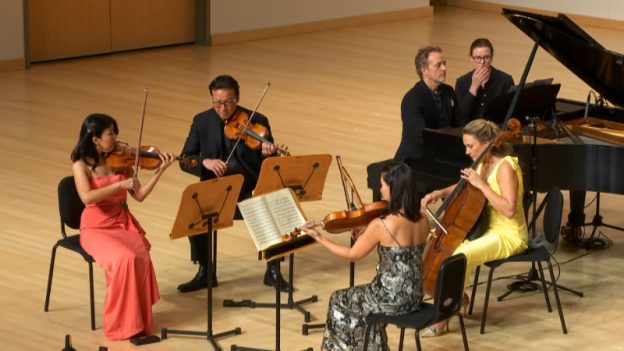
Helen Kim, violin; Charae Krueger, cello; Robert Henry, piano; Kenn Wagner, violin; Yang-Yoon Kim, viola.
Antonín DVOŘÁK: Piano Trio No. 3 in F minor, Op. 65, B. 130 — “Dumky”
Antonín DVOŘÁK: Piano Quintet in A major, Op. 81, B. 155
Mark Gresham | 30 SEP 2026
The Summit Piano Trio, the ensemble-in-residence at Kennesaw State University’s Bailey School of Music, returned to Morgan Concert Hall on September 28 for a faculty recital devoted entirely to Antonín Dvořák. The program paired the composer’s Piano Trio No. 3 in F minor, Op. 65, with his Piano Quintet in A major, Op. 81, bringing two substantial chamber works from different moments in Dvořák’s mature style into a single evening.
This review is based on the performance as presented in Kennesaw State’s live stream. The stream offered a clear picture of the performance, allowing an assessment of ensemble, balance, phrasing, and interpretation. Those observations necessarily differ from the experience of hearing the musicians in Morgan Concert Hall. Still, KSU has maintained live-streaming as a regular part of its music programming for years, and the audio quality for this broadcast was excellent.
The Summit Piano Trio (violinist Helen Hwaya Kim, cellist Charae Krueger, and pianist Robert Henry) was joined in the second half by violinist Kenn Wagner and violist Yang-Yoon Kim, both KSU string faculty members and members of the Atlanta Symphony Orchestra.
The Summit Trio has developed a national profile since forming years ago at Kennesaw State, where the three musicians began as colleagues and developed an ongoing artistic partnership. The name “Summit” refers both to Kennesaw Mountain near the university campus and to three musical paths converging into one voice. In December 2025, Kim, Krueger, and Henry made their Carnegie Hall debut at Weill Recital Hall, performing works by Joaquín Turina, Anton Arensky, and Felix Mendelssohn.
For Monday evening’s Kennesaw recital, however, the musicians turned entirely to Antonín Dvořák, whose chamber music occupies an important place between the traditions of Austro-German Romanticism and the composer’s deeply felt engagement with Czech and broader Slavic musical character.
The Piano Trio No. 3, completed in 1883, belongs to a relatively serious period in Dvořák’s development. Unlike the lighter, folk-inflected character of some of his better-known works, the F-minor Trio is concentrated and dramatic, with a large-scale conception that often pushes against the boundaries of conventional chamber music. Dvořák completed the work in March 1883 and premiered it that October, with Dvořák himself playing the piano part.
That seriousness was evident from the opening “Lento maestoso,” which establishes an atmosphere far removed from the geniality often associated with Dvořák. The music moves between agitation and lyricism, with the piano, violin and cello repeatedly passing fragments of musical argument among themselves. The three musicians brought out the movement’s architectural shape, letting its contrasting ideas accumulate rather than treating them as isolated episodes.
Rather than a conventional four-movement layout, the Trio’s six-part succession of contrasting sections also makes the work unusually fluid. The slow, reflective passages repeatedly give way to more animated music, creating a succession of changes in temperature and character. The lively final movement was especially engaging, with Kim, Krueger and Henry handling its shifting rhythms and accumulating energy with considerable precision.
The Piano Quintet in A major, written four years later, presented a markedly different side of the same composer. Dvořák composed it between August and October 1887, and it was premiered in Prague in January 1888. The work became one of his most enduring chamber compositions.
Where the Third Piano Trio can seem to wrestle with its material, the Quintet more readily embraces the tension between lyricism and dance. Its opening movement begins with a lyrical cello melody over the piano, then shifts into more animated, contrasting material. The second movement, a “Dumka,” draws on a form associated with a melancholy Slavic lament but alternates that reflective character with faster, brighter episodes. The third movement, labeled a “Scherzo” and subtitled “Furiant,” invokes a vigorous Czech dance.
That makes the two works particularly useful companions. The Trio’s emotional contrasts tend toward dramatic argument, while the Quintet repeatedly converts contrast into movement: lament becomes dance, introspection becomes exuberance, and lyrical material returns transformed by its surroundings.
The Summit players seemed especially well suited to this shifting musical vocabulary. Henry’s piano part supplied much of the harmonic and rhythmic foundation without overwhelming the strings, with all five musicians participating fully in the active musical dialogue. Dvořák continually redistributes that dialogue among the strings, from the cello’s opening lyricism through the first violin’s prominent melodic role and the viola’s darker, often important melodic contributions. The second violin helps bind those voices together.
The Quintet’s “Dumka” makes the connection especially clear. Its slow, melancholy principal material is interrupted by faster episodes, creating a structure in which opposing moods are not merely juxtaposed but depend on one another. The subsequent “Furiant” carries that transformation into rhythmic energy, and the finale continues toward an exuberant conclusion.
The performance made the relationship between those contrasting impulses audible without overplaying the folk elements. Rather than treating Dvořák’s Czech identity as decorative color, the musicians let rhythm, melodic shape, and mood changes emerge from the musical structure itself.
The result was an engaging evening of Dvořák, with the two works illuminating different aspects of a composer whose chamber music is considerably broader and deeper than the familiar postcard image of a genial Czech melodist. ■
EXTERNAL LINKS:
- Summit Piano Trio: parkerartists.com
- Bailey School of Music, Kennesaw State University: arts.kennesaw.edu

Read more by Mark Gresham.

.png)