
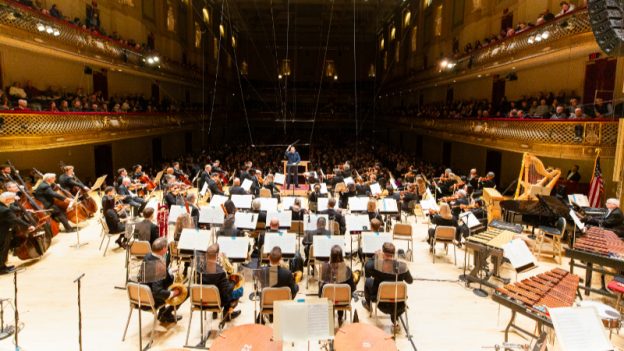
What the Boston Symphony dispute and negotiations reveal
William Ford | 7 SEP 2026
For months, the dispute surrounding Andris Nelsons and the Boston Symphony Orchestra was presented in unusually consequential terms. This was not simply a disagreement about a music director whose contract would not be renewed. Musicians described the decision as a threat to artistic quality, institutional stability, trust, and the BSO’s international standing.
Then came contract negotiations.
The musicians acquired perhaps their greatest source of leverage: the possibility of a strike. Management faced the prospect of labor disruption at one of America’s most prestigious orchestras.
A settlement was reached. Nelsons is still leaving. The musicians received substantial raises, improved pension benefits, and a greater role in selecting the next music director.
That sequence raises an uncomfortable question extending well beyond Boston:
How non-negotiable is artistic quality when defending it carries an economic price?
“The Greatest Squandering of Artistic Capital”
The musicians’ reaction to the Nelsons decision was extraordinary in its intensity.
Principal flute Lorna McGhee described it as “the greatest squandering of artistic capital I have ever witnessed.”
Principal oboe John Ferrillo made the dispute intensely personal: “This is OUR house, my family’s house, that has been violated.”
Another musician described being “devastated, heartbroken, angry, and incredulous,” characterized working with Nelsons as being “at the pinnacle of our profession,” and called the relationship “the artistic highlight of my life.”
The BSO Players Committee moved the argument from individual reaction to institutional indictment. Nelsons’s departure, it maintained, left the orchestra “without Artistic leadership or continuity” and threatened the BSO’s local and international reputation. The committee declared that President and CEO Chad Smith no longer possessed the musicians’ “trust or buy-in.”
Following a meeting with management, the musicians reported receiving “no reassurance that there is a path to rebuilding trust.” They criticized management’s “inability to articulate any artistic vision.”
These were not mild objections to a personnel decision. The musicians portrayed Nelsons’s departure as a potentially profound artistic and institutional loss.
That matters when considering what happened next.
When Principle Reached the Bargaining Table
The musicians subsequently authorized a strike, giving them substantial leverage as negotiations over a new collective bargaining agreement approached their conclusion.
The resulting agreement is financially impressive.
Musicians will receive salary increases of 4 percent in the first year, another 4 percent in the second, and 4.5 percent in the third. Compounded, that represents an increase of approximately 13.1 percent over three years. Guaranteed base compensation will reach $230,000, while the guaranteed pension will rise to $94,000.
The contract was ratified by 94 percent of the musicians.
The musicians also obtained greater influence over artistic matters. Most significantly, six musicians will sit on the 12-member committee charged with identifying the next music director. A candidate cannot advance without the support of two-thirds of those musician representatives. In practical terms, at least four of the six musicians must agree.
That is meaningful power. But it is important to understand what it is not. It is power over selection.
It does not appear to give musicians comparable authority over the subsequent dismissal or nonrenewal of the person they help select. The musicians therefore gained an important voice in choosing Nelsons’s successor without obtaining an apparent contractual mechanism that would prevent management from eventually doing to that successor essentially what it did to Nelsons.
One element of the original dispute remained unchanged: Nelsons will still leave the BSO.
From Public Protest to Collective Bargaining
This does not establish that the musicians traded Nelsons for money. And it would be irresponsible to make such an inference. Collective bargaining is more complicated than that, and a union has responsibilities to its members involving compensation, pensions, working conditions, and job security. Nelsons is not a member of their bargaining unit.
Management also may simply have made his reinstatement non-negotiable. If so, the musicians faced a rational choice: continue a potentially damaging confrontation over a decision they could not reverse or use their leverage to obtain benefits for orchestra members and greater influence over the future.
But rationality does not make the earlier rhetoric irrelevant.
The eventual settlement provides another perspective from which to consider those earlier concerns. It does not tell us how individual musicians weighed Nelsons’s departure against compensation, pensions, working conditions, or greater participation in artistic decisions, nor can a collective bargaining agreement reveal individual motives.
What it does tell us is what the negotiations ultimately produced. Nelsons remained out. Compensation increased substantially. Pension benefits improved. Musicians acquired greater influence over selecting his successor. And 94 percent of the musicians approved the agreement.
The contrast between the intensity of the earlier public statements and the terms of the eventual settlement is worth noting, even if the settlement itself cannot tell us how the musicians reconciled the two.
The Familiar Defense of “Artistic Quality”
There is a larger issue here than Nelsons.
Across American orchestras, musicians frequently respond to proposed institutional changes by invoking artistic quality. Changes in personnel, complement, scheduling, programming, rehearsal practices, touring, or working conditions are often resisted partly on the grounds that they threaten the artistic standards audiences expect.
Sometimes that argument is unquestionably legitimate. Great orchestras do not become great accidentally. Their quality depends upon exceptional musicians, adequate rehearsal, stable personnel, accomplished artistic leadership, and working conditions that permit extraordinarily demanding performances.
And “artistic quality” also has enormous rhetorical power.
Who wants to argue against it?
A board member can advocate financial sustainability. An executive can propose organizational restructuring. A consultant can recommend changes in programming. Once musicians respond that the proposal threatens artistic quality, however, the argument has moved onto very favorable terrain. Once a proposal is characterized as threatening artistic quality, financial and organizational arguments can become considerably more difficult to advance.
Boston therefore offers an unusually useful test case. The musicians’ public statements presented artistic considerations in near-absolute terms. Once those concerns entered collective bargaining, they became part of a negotiation involving salary, pensions, governance, and influence.
Artistic quality had not disappeared from the discussion. It had become one consideration within a negotiation involving several competing interests.
Management Has Its Own Contradiction
The musicians are not the only participants whose actions deserve comparison with their rhetoric.
BSO management has emphasized declining ticket revenue and the need to respond to changing institutional circumstances. That concern is supported by the orchestra’s own historical financial and attendance data.
Our earlier examination [AtlantaMusicCritic.net] of more than two decades of BSO financial records found a substantial deterioration in attendance from earlier levels. Attendance was 182,696 in 2004–05 and reached 213,790 in 2018–19. After the pandemic disruption, it stood at 142,521 in 2022–23 and recovered to 159,787 in 2023–24, still well below the pre-pandemic figure.
That decline does not prove financial distress. The BSO has an enormous endowment and multiple revenue sources beyond ticket sales. Nor does declining ticket revenue mean management should hold musician compensation flat. Maintaining an elite orchestra requires elite musicians, and elite musicians command competitive compensation.
Nevertheless, a three-year compounded salary increase of approximately 13 percent, together with enhanced pension obligations, costs real money. It has to come from somewhere.
If weakening ticket revenue helped establish the urgency for institutional change, management’s willingness to assume substantially greater labor costs deserves scrutiny as well.
The same question therefore applies to both sides:
How much of the language surrounding this dispute represented deeply held institutional principle, and how much represented negotiating posture?
Absolutes in Public, Trade-Offs in Private
That may ultimately be the most revealing lesson of the Nelsons affair.
The musicians spoke in the language of artistic principle. Management spoke in the language of institutional direction, governance, and economic reality.
Then they negotiated.
The musicians accepted Nelsons’s departure and obtained considerably more money and greater future influence. Management retained its fundamental authority over the music director while agreeing to considerably higher musician compensation and greater musician participation in artistic governance.
Both sides surrendered something. Both sides obtained something. That is what negotiations normally accomplish.
What makes Boston fascinating is the distance between the absolutism of the public dispute and the pragmatism of its resolution. The musicians’ defense of Nelsons may have been entirely sincere. Management’s concerns about ticket revenue and institutional direction may be entirely genuine. Sincerity, however, does not make a priority absolute. The settlement tells us something that months of statements, interviews, accusations, and counteraccusations could not. It tells us what each side was willing to trade.
The Price of Principle—The Difficult Questions
There is nothing inherently disreputable about musicians seeking higher compensation. These are extraordinarily skilled professionals with short audition windows, demanding careers, and specialized abilities acquired over decades. Nor is there anything inherently inconsistent about management acknowledging declining ticket revenue while concluding that competitive salaries remain essential to preserving the orchestra.
The analytical difficulty arises when institutional interests are expressed in the language of non-negotiable principle. “Artistic quality” carries particular weight because it goes directly to the purpose of an orchestra, yet the term itself is rarely defined with enough precision to determine what would constitute its preservation or decline. Boston exposes the limits of that argument unusually clearly. When the Nelsons controversy began, artistic quality appeared paramount. His departure was described as a catastrophic loss of artistic capital and a threat to the orchestra’s leadership and reputation.
When bargaining ended, Nelsons was still departing. The musicians had secured substantially improved compensation and greater participation in selecting his successor, while management retained its fundamental authority over the institution’s artistic leadership. Perhaps nobody abandoned a principle. Perhaps both sides simply discovered what their principles cost.
But the Boston settlement leaves American orchestras with a question worth remembering the next time “artistic quality” is invoked as the first line of defense against institutional change:
Artistic quality is routinely presented as the non-negotiable value of the American orchestra. How non-negotiable is it when the people defending it are finally asked to pay a price for their principle? ■
Postnote: In the few days following ratification, we have found no public statement from an identifiable current BSO musician renewing the earlier calls for Nelsons’s reinstatement or publicly denouncing his dismissal. The most explicit post-settlement insistence that the Nelsons controversy remains unresolved has instead come from a patrons’ organization.

Read more by William Ford.





.png)