

January 23, 2026
Jones Hall
Houston, Texas – USA
Houston Symphony, Ryan Bancroft, conductor; Clara-Jumi Kang, violin (Houston Symphony debut).
Gabriella SMITH: Tumblebird Contrails (2014)
Édouard LALO: Symphonie espagnole for Violin and Orchestra. Op. 21 (1874)
Hector BERLIOZ: Symphonie fantastique, Op. 14 (1830)
Lawrence Wheeler | 16 FEB 2026
After a four-year hiatus, guest conductor Ryan Bancroft returned to Jones Hall to begin the Houston Symphony’s Doomed Lovers Festival. Clara-Jumi Kang was violin soloist in Édouard Lalo’s Symphonie espagnole. The program concluded with Hector Berlioz’s Symphonie fantastique, which provided the link to the “Doomed Lovers” theme.
Before the concert, Gary Ginstling, Houston Symphony Executive Director and CEO, spoke to the audience about the recent passing of Rodica Gonzalez, a member of the first violin section for 36 years. The orchestra offered the “Air” from J.S. Bach’s Orchestral Suite No. 3 in her honor. Concertmaster Yoonshin Song led the strings in a sensitive and touching reading.
Gabriella Smith is enjoying widespread recognition and performances of her compositions. Within this week alone, two of her works are being performed by the Chicago Symphony and the Boston Symphony Orchestra. Tonight’s selection, Tumblebird Contrails, premiered in 2014 under Marin Alsop and was later performed by the Royal Stockholm Philharmonic Orchestra at the 2023 Nobel Prize Concert.
The piece was inspired by a single moment Smith experienced while backpacking in Point Reyes, California — “sitting in the sand and listening to the hallucinatory sounds of the Pacific (the keening gulls, pounding surf), ebb and flow of pitch to pitches, tune to texture, grooving to free-flowing. The title, Tumblebird Contrails, is a Kerouac-inspired nonsense phrase I invented to evoke the sound and feeling of the piece.”
Smith employs extended techniques: violin bows swishing crosswise and playing behind the bridge; basses and cellos slapping their instruments; and percussionists bowing cymbals and employing other unconventional methods. Though primarily in quadruple meter, the work seldom establishes a definable pulse or harmonic center, and it contains no sustained melody. Textures evolve rather than develop, in the manner of theta brainwaves. The result is an atmospheric tapestry suggestive of birds, waves, and distant whale calls. It is music to experience rather than analyze. Bancroft maintained fluid continuity, carefully shaping dynamic shifts. Interpretation yielded to atmosphere.
Clara-Jumi Kang, winner of several major competitions — most notably the 2010 Indianapolis International Violin Competition — is Artist-in-Residence this season with the Royal Stockholm Philharmonic Orchestra, where Bancroft serves as Chief Conductor. They will perform the Lalo together in Stockholm next month. As demonstrated here, theirs is a compelling partnership.
Written in 1874 for the Spanish virtuoso Pablo de Sarasate, Lalo’s five-movement work incorporates Spanish idioms with virtuosic brilliance. Neither strictly concerto nor symphony, it occupies a hybrid space reminiscent of the earlier sinfonia concertante, in which soloist and orchestra share prominence. Lalo described his aim as “a violin solo soaring above the rigid form of an old-fashioned symphony.” Berlioz’s Harold in Italy may well have served as a model for Lalo, who also played the viola and performed opera with Berlioz conducting.
Making her Houston Symphony debut, Kang immediately took control of the music. The proudly stated opening notes were a declaration of dramatic intent. Musically, she grabbed Lalo by the lapels and said, “Here I am—listen to this!” Bancroft followed with a broadly stated orchestral interlude. Throughout the first movement, the concertante give-and-take was finely balanced, delineating the objective orchestral voice from the subjective solo line. Bancroft’s coolly controlled direction complemented Kang’s emotionally charged playing. The dolce espressivo section provides a brief respite. With varied vibrato and a bow straight as an arrow, Kang was thoroughly invested in each note. All was framed by her gorgeous sound, some of the most beautiful heard in Jones Hall.
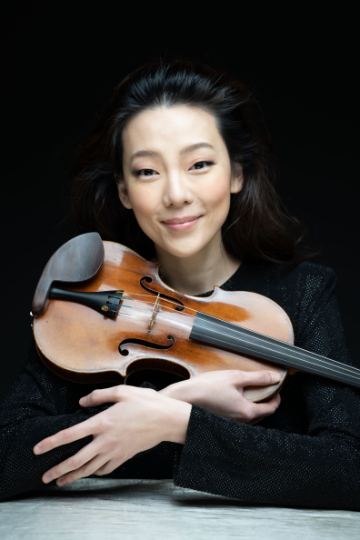
Clara-Jumo Kang (credit: Marco Borggreve)
The “Scherzando” second movement introduced a Carmen-esque dialogue in which the orchestra’s reserve is seduced by the violin’s coquettish charm. Bancroft and Kang projected this duality with finesse.
The “Intermezzo,” sometimes omitted, was thankfully retained. Built upon a 3/2 habanera rhythm, it provided Kang a vehicle for expressive storytelling. Several passages on the G string revealed the rich sonority of her 1702 Stradivarius. Appassionato E-string lines soared brilliantly without edge.
The “Andante” forms the emotional core of the work. Its principal melody sounds like Schubert with a Spanish accent. Bancroft led a cohesive and finely balanced opening, replete with rich orchestral sonorities. Kang responded with deeply expressive playing while adding a tear to her tone.
The Rondo finale is a spirited gigue/muiñeira with a memorable tune, made more so by a descending three-note figure that sounds like “Three Blind Mice.” Kang carried it off with fiery virtuosity while Bancroft stuck with her all the way. The performance was enthusiastically received, with a standing ovation and multiple curtain calls. Kang certainly earned a return engagement.
Berlioz’s Symphonie fantastique remains one of the most audacious works of the nineteenth century. A program symphony unified by the idée fixe — representing the actress Harriet Smithson, Berlioz’s obsessive love — it ventures into subjects that were shocking in 1830: obsessive passion, opium-induced hallucinations, murder, execution by guillotine, witches’ sabbaths, and the “Dies irae” from the Mass for the Dead. Audiences were startled; Berlioz was delighted.
The combination of Bancroft and the Houston Symphony produced sonic splendor, from the tenderest of soft dynamics to teeth-rattling fortissimos. Conducting sans baton, Bancroft used highly expressive hands to elicit a rainbow of colors. From the back, he looks like a young Leonard Slatkin—certainly an excellent model for a young conductor. From the front, he seldom used facial expressions, yet drew expressive playing from the musicians.
Bancroft opened the first movement, “Reveries, Passions,” with a mysterious air, taking full time in the fermatas. This is Berlioz’s depiction of waking from a dream (or stupor). The following Più mosso, a place of caution from Berlioz himself, was perfectly aligned. Careful attention was given to indicated dynamics. Assisting with the ensemble was the stellar leadership of concertmaster Yoonshin Song, whose secure presence helped to solidify a section with several substitute players. One to watch, she always seems to have her bow in the right place at the right time.
The second movement, “Valse—A Ball,” has Berlioz imagining he is dancing with his love interest, Harriet Smithson. It features dual harps, immaculately played by Allegra Lilly and Cindy Qin. Bancroft kept the music buoyant and light on its feet. No toes were harmed.
The third movement, “Scene in the Country,” opens with English horn answered by offstage oboe, tonefully played by Adam Dinitz and Anne Leek. A compound-meter melody evokes a country setting, similar to Beethoven’s Pastoral Symphony, also in F major. This was played with shimmering effect by the first violins and flutist Matthew Roitstein. This movement also features a stormy middle episode. A dolce clarinet melody, elegantly played by Mark Nuccio, promises fairer skies. The movement ends with another English horn solo—this time unanswered.
The fourth movement, “March to the Scaffold,” is often performed as a standalone piece because it is complete in itself. Our “hero” (Berlioz) has dreamed he has killed his beloved and is sentenced to death by guillotine—France’s favorite method of capital punishment. It begins quietly with timpani and stopped French horns depicting the protagonist (Berlioz) being taken from a prison on the edge of town to the town square, where a crowd has gathered. The drumbeats refer to the French army bringing the prisoner, chained to a cart, closer and closer as the crowd screams for justice. There are devilish laughs as the scaffold looms closer and closer. Once the accused is in place, we hear the idée fixe played by a solo clarinet, followed by the fall of the guillotine and three pizzicatos depicting the head falling and plopping into a basket. The crowd cheers.
The movement features four bassoons, which provide a unique color. The trombones and tubas sat patiently for three movements before playing. Berlioz saved the big guns for this movement, and their addition provided power to the militaristic march motifs, accompanied by Leonardo Soto and Matthew Strauss on timpani. I have two quibbles with the interpretation. First, Bancroft took a repeat of the exposition. This is shown in a 1971 urtext edition simply because it conforms to sonata-allegro form. It is not shown in earlier editions because it interrupts the progression to the scaffold, taking us back over the hill to the edge of town. Second, the main march theme has notes written with accents that were played connected. French accented notes are separated (as are Italian), unlike German accents, which are connected. Other than those details, the “March” was exciting and quite well done.
The fifth movement, “Dream of a Witches’ Sabbath,” has our hero seeing himself in the midst of demons, ghouls, and witches who come together for his funeral. The idée fixe is transformed into a grotesque dance tune, well played on E-flat clarinet by Ben Freimuth. The “Dies irae” is featured, along with offstage bells custom-cast for the Houston Symphony. These were played by veteran percussionist Brian Del Signore. The concert came to a rousing close. Bancroft did a virtual roll call of recognition for the bows. The Houston Symphony is, indeed, on a roll. ■
EXTERNAL LINKS:
- Houston Symphony: houstonsymphony.org
- Ryan Bancroft: intermusica.com/artist/Ryan-Bancroft
- Clara-Jumi Kang: https://www.clarajumikang.com/

Read more by Lawrence Wheeler.



.png)