
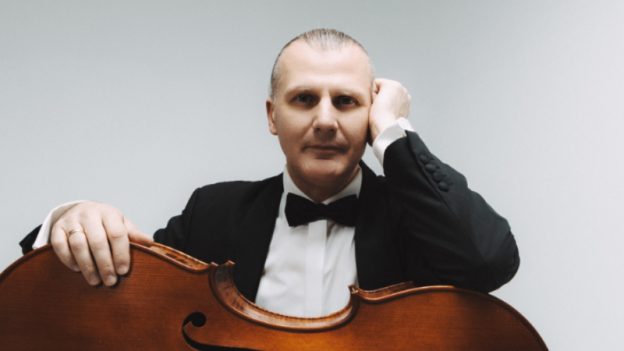
Kirill Timofeev, cello.
Joseph Marie Clément DALL’ABACO: 11 Capricci for Cello Solo
Kirill TIMOFEEV: Theme and Variations
Kirill TIMOFEEV: Bagatelle
Kirill TIMOFEEV: Summer Ride
Kirill TIMOFEEV: The Letter
Kirill TIMOFEEV: Love S…
GENUIN classics
Catalog No. GEN 26979
EAN: 4260036259797
Formats:CD, digital
Release Date: October 2, 2026
Total Duration: 52 minutes
Giorgio Koukl | 14 AUG 2026
A musical dialogue with Joseph Dall’Abaco (1710–1805) is a certainly well-chosen slogan for a debut CD containing eleven solo cello capricci of this Italian-Belgian composer and five solo works of the interpreter cellist himself. Kirill Timofeev is certainly no unknown figure among cellists. As he explains in the liner notes, he carefully selected the content of his first installment, so choosing this peculiar mixture of baroque and contemporary music must have involved a well-thought-out process.
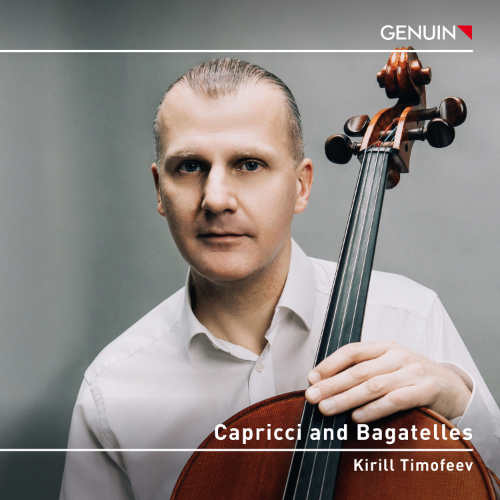
GEN26979 cover art (click to enlarge)
One thing can be said right at the beginning. Mr. Timofeev is certainly a gifted musician; his bowing and agogical choices are more than excellent. The superior recording quality also helps enormously, capturing the cello sound with great clarity and a neutral mix of post-production enhancements.
Today, the tendency is to play Baroque music with a Baroque cello setup: gut strings, no endpin, a convex bow, and the bow held well ahead of the frog. Mr. Timofeev uses none of this, and, to be honest, none of it is missed in this Genuin Records production.
Joseph-Marie-Clément dall’Abaco was an Italian-Belgian composer and celebrated cellist of the late Baroque and early Classical eras. Born in Brussels as the son of the prominent Baroque composer Evaristo dall’Abaco, he carved out a highly distinguished career across Germany and Italy, leaving a deep imprint on the evolution of cello literature. His compositions seamlessly blend the older, intricate polyphony of Johann Sebastian Bach with the expressive “Empfindsamer Stil” (sensitive style) popular in the 18th century. Although he was born only 25 years after J.S. Bach, his style has little in common with the Leipzig master, except perhaps an extraordinary freedom of expression. Few of his solo compositions survived. Fortunately, there is a 19th-century copy of his eleven Capricci for solo cello.
As Mr. Timofeev describes this copy: “…it contained obvious errors, and was only partially complete.” His contribution was to elaborate and complete this score, a laudable achievement, per se, with a memorable effect: now the eleven unaccompanied cello pieces, in their richness of inventive power, evoke the same feelings as listening to the far more common Bach cello suites.
We can admire the advantage of having an interpreter and a composer in one person; this is surely a winning combination. Only one not fully convincing detail in this rendition is a certain emotional distance, a cool approach of the interpreter, maybe too occupied to perform rather than “live” the music, which disturbs an otherwise seamless performance.
From track 12 on, Mr. Timofeev shows us his qualities as a composer.
We start with his longest work, Theme and Variations, written in 2025—as were all five of his scores here. It lasts nearly eight minutes and is the most interesting score of this section. Rapid variations followed by nicely introspective ones are written in a style difficult to define, certainly not music of the 21st century. If intended to be a “hommage” to the precedent composer, that would be a respectable achievement.
A short Bagatelle follows. In this case, defining a style becomes even more difficult. It is clearly well written for the instrument, using the full array of possibilities, from pizzicati to bichords. Still, it never goes outside a traditional box of choices that would have been fine in the 18th century but is clearly lacking originality for a composer today.
An equally short work, “Summer ride,” follows. Here we can assist with further development, partly due to a swift tempo and a quasi-“country music” influence. It shows there is plenty of room for further development in this musician’s compositional style. It is once again very well interpreted with spotless intonation and bowing.
The Letter, track 15, once again a two-minute miniature and a lyrical standalone melody, certainly has some post-romantic qualities.
The last piece, called Love S…, refreshes the echo of “Summer ride” in a minor way. Even if the listener remains unaware of who “S…” might be, the music is charming enough to evoke a romance where everybody can imagine whatever they wish.
As this is a debut album, the question arises spontaneously: why has such a gifted musician not chosen something more daring, something adventurous, something hellishly difficult? There is more than enormous existing cello literature to choose from.
But maybe this choice is exactly what Mr. Timofeev wanted to obtain: to showcase his restraint, his voluntary understatement, his somehow traditional general approach to music as interpreter and composer. In this sense he was certainly more than successful. ■
EXTERNAL LINKS:
- Kirill Timofeev: kirill-timofeev.com

Read more by Giorgio Koukl.



.png)