
September 11, 2026
Red Light Café
Atlanta, Georgia – USA
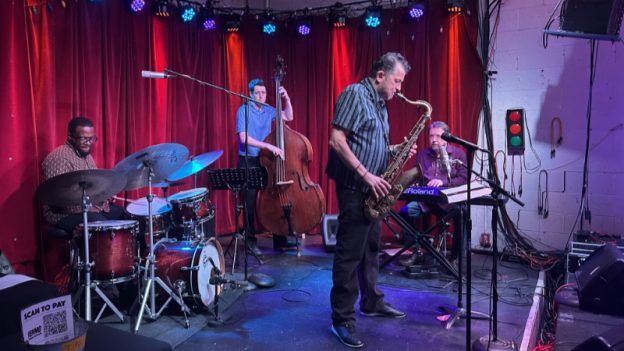
Vinnie D’Agostino, tenor saxophone; Kevin Bales, keyboard; Tommy Sauter, bass; Robert Boone, drums.
Matt T. Miller | 16 SEP 2026
Vinnie D’Agostino’s warmth and vivacious personality match his style as a saxophonist. In conversation and on the bandstand, his ideas flow freely and are passionately delivered with the spirit of a teacher who delights in introducing a new topic to his students.
At the Red Light Café on Amsterdam Avenue last Friday, September 11th, D’Agostino took the stage along with drummer Robert Boone, bassist Tommy Sauter, and keyboardist Kevin Bales in front of an enthusiastic crowd, eager to follow the saxophonist and his band as they explored a set of jazz standards with both reverence for tradition and creative abandon.
The quartet opened their set with an extended, swinging performance of Tadd Dameron’s “Good Bait,” a perfect vehicle for each member of the band to stretch out and explore the tune’s harmonic topography. D’Agostino’s solo stayed true to his band’s name, “Feel the Burn,” from the outset. Idea after idea poured from his tenor saxophone with an urgency that didn’t relent until he turned it over to bassist Tommy Sauter, who mixed walking bass sections with faster passages, allowing the form to breathe a bit, leaving room for Bales and Boone to interject their musical responses. Bales’ solo followed and was a masterpiece of pacing and motivic development. Following a quote of Monk’s “Bemsha Swing,” the pianist built to an ecstatic conclusion of gospel-inspired chords with thunderous bass notes below virtuosic octave lines that drew raucous applause from the audience. D’Agostino and Bales traded fours with Boone before the band took the melody out.
After introducing each member of the band, D’Agostino left it to Bales to musically introduce the Antonio Carlos Jobim standard “Once I Loved,” a lovely and underplayed bossa nova. The performance highlighted another aspect of the leader’s tenor playing, a more supple but still assertive sound that perfectly suited the sophisticated tune. Following Bales’ solo—developed to the point where the band gradually dropped out, leaving the pianist alone to explore the harmony in unfettered rubato—D’Agostino entered for his own statement, which echoed elements of the style of Stan Getz while still sounding original.
Following the applause, D’Agostino took a moment to highlight the recent achievements of each member of the band: Boone’s Grammy award for his work with the Count Basie Orchestra; Bales’ upcoming book, co-written with author and musician Mike Shaw; and the concert series that Tommy Sauter and his wife run in Atlanta.
He introduced the final song of the set in a historical context. “This next song is a beautiful ballad…arguably the greatest love song ever written. It’s an amazing song written by Irving Berlin in 1932. And he wrote it really out of heartbreak. It was a very tough time in his life…it’s called ‘How Deep Is the Ocean.’ It’s about how deep his love was for his wife.”
Following an introduction by Bales on keyboard that encapsulated the tune in patient and beautiful stops and starts, D’Agostino and the band entered at a surprisingly slow, ballad tempo; a smoldering pace that not all groups could pull off. The leader obviously knew every twist and turn of the melody, and that, along with Sauter’s assured quarter notes and Boone’s masterful brush work, made the final tune of the set the best. D’Agostino and Bales soloed memorably over the form, but the saxophonist’s heartfelt, patient, and tasteful interpretation of the melody was the highlight, a slow-burn that seemed to linger even after the final notes were played. ■
EXTERNAL LINKS:
- Red Light Café: redlightcafe.com
- Vinnie D’Agostino: vinniedagmusic.com

Read more by Matt Miller.




.png)