November 16, 2026
Samuel Barber, Richard Strauss, Wolfgang Amadeus Mozart
Piedmont Grand Opera House
Macon, Georgia – USA
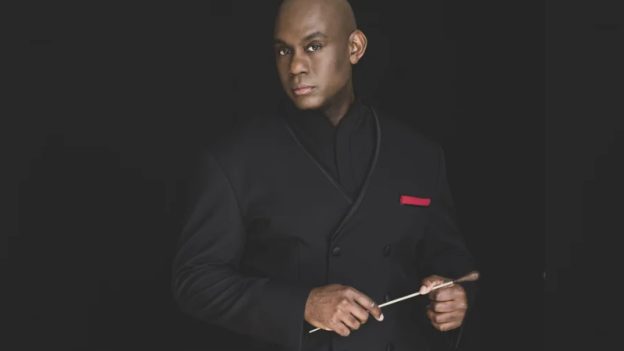
Macon-Mercer Symphony Orchestra; Joseph Young, guest conductor.
Samuel BARBER: Adagio for Strings (1936; orchestral version premiered 1938)
Richard STRAUSS: Don Juan, Op. 20 (1888)
Wolfgang Amadeus MOZART: Symphony No. 39 in E-flat Major, K. 543 (1788)
William Ford | 19 NOV 2026
The Macon-Mercer Symphony Orchestra (MMSO) is an interesting example of how a community can develop a serious orchestral institution by combining educational resources, professional musicians, and local philanthropic support. Founded in 2021 following the demise of Macon’s previous symphony orchestra, the MMSO draws heavily on the talented young string players of Mercer University’s Robert McDuffie Center for Strings, supplemented by professional musicians, including members of the Atlanta Symphony Orchestra (ASO). The result is an ensemble that combines the energy of emerging musicians with the experience and discipline of established professionals.
Its home is the historic Piedmont Grand Opera House, one of Georgia’s architectural treasures. Originally opened in 1884 as the Academy of Music and substantially reconstructed in 1904–1905, the Grand has survived changes in public taste, conversion into a movie theater, and even the threat of demolition. Restored and subsequently modernized, it retains the intimacy and character of a nineteenth-century opera house. Its balconies, ornamentation, and traditional auditorium provide a setting quite different from the modern multipurpose concert halls in which many orchestras perform.
The auditorium’s wooden floor and relatively compact dimensions contribute to its distinctive character, although the flooring’s precise acoustic contribution is difficult to establish. The stage is roughly square rather than the more familiar wide rectangle, creating some unusual orchestral seating arrangements. Nevertheless, the Grand proved capable of accommodating an impressively powerful symphonic sound.
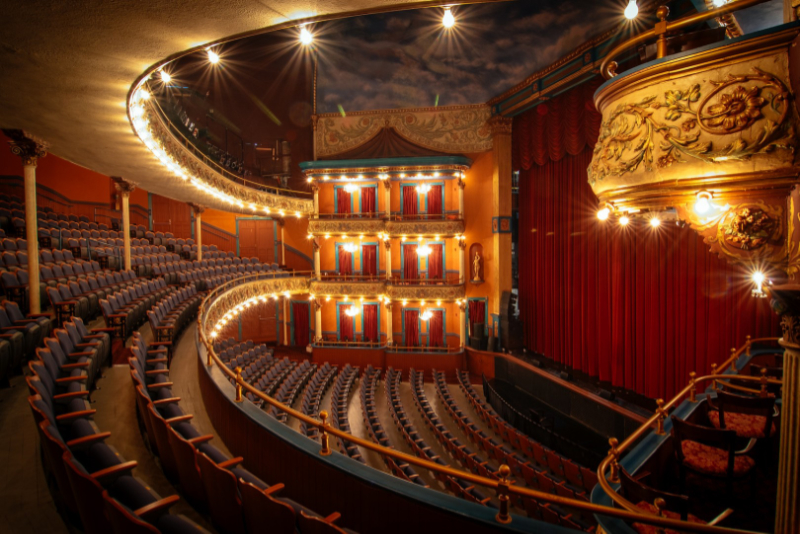
The Piedmont Grand Opera House in Macon, Georgia. (visitmacon.org)
On Monday evening, November 16, the theater was nearly sold out for a program of Samuel Barber, Richard Strauss, and Wolfgang Amadeus Mozart, conducted by Joseph Young. The substantial attendance spoke to the support the orchestra enjoys from the Macon community. Just as importantly, the concert demonstrated what the MMSO can accomplish when its talented student musicians are joined by seasoned orchestral professionals.
Young is no stranger to Atlanta audiences, having served as assistant conductor of the Atlanta Symphony Orchestra under Robert Spano and music director of the Atlanta Symphony Youth Orchestra. More recently, he completed six seasons as music director of the financially fragile Berkeley Symphony in California, concluding his tenure in June 2025. His international conducting career continues with engagements with the Polish National Radio Symphony Orchestra and South Africa’s Mzansi National Philharmonic Orchestra.
Samuel Barber: Adagio for Strings (1936; orchestral version 1938)
Samuel Barber’s Adagio for Strings began as the slow movement of his String Quartet, Op. 11, composed in 1936. Recognizing the movement’s expressive potential, Barber subsequently arranged it for string orchestra. Arturo Toscanini conducted the premiere on November 5, 1938, introducing a work that would become one of the most recognizable compositions in twentieth-century American music.
The music is deceptively simple. A long, arching melody unfolds over sustained harmonies, gradually moving through the string sections as its emotional intensity increases. The melodic lines climb higher, the harmonies become more urgent, and the music builds toward a powerful climax before subsiding into silence and a subdued conclusion. Its impact depends less on rhythmic excitement or orchestral spectacle than on the sustained control of tension, phrasing, and tonal intensity.
Over the decades, the Adagio has acquired a public identity that extends well beyond the concert hall. It has become almost synonymous with mourning and remembrance, performed or broadcast in connection with the deaths of national leaders, public tragedies, and memorial ceremonies. This familiarity creates an unusual challenge for performers: audiences often arrive with deeply established expectations about how the music should sound and what it should communicate.
Young’s performance was spare, at times almost chamber-like. The relatively small string section could not produce the lush, enveloping sonority associated with performances by larger orchestras, and some passages sounded thin. This was primarily a limitation of orchestral resources rather than an interpretive shortcoming. Indeed, the original quartet origins of the work make a more intimate treatment entirely defensible, even if the orchestral version has accustomed listeners to a richer tonal palette.
The performance gained definition as it progressed, with articulation becoming more clearly focused in its latter half. Young managed the long crescendo effectively, building toward a powerful and convincing climax despite the limited weight of the ensemble. The result was a respectable performance that communicated the work’s essential emotional trajectory, even if it lacked some of the warmth and richness that can make Barber’s Adagio so overwhelming.
Richard Strauss: Don Juan, Op. 20 (1888)
If Barber’s Adagio demonstrated the expressive possibilities of a relatively small string ensemble, Richard Strauss’s Don Juan revealed what the Macon-Mercer Symphony could become with substantially expanded orchestral resources.
Composed in 1888 and premiered the following year, Don Juan was one of the young composer’s first great successes. Inspired by Nikolaus Lenau’s dramatic treatment of the legendary seducer, the tone poem portrays a restless, passionate figure driven by an endless pursuit of romantic conquest. Rather than following a rigid narrative, Strauss translates the character’s impetuosity, sensuality, triumphs, and ultimate disillusionment into an extraordinarily colorful orchestral drama.
The work opens with an explosive orchestral gesture, immediately announcing its hero’s exuberant confidence. Sweeping string passages, brilliant brass declarations, and lyrical episodes alternate in a constantly changing musical landscape. The orchestration demands considerable technical accomplishment, particularly from the horns and other brass instruments, and the conductor must maintain structural coherence amid rapid changes in mood, texture, and dynamics. The work ultimately abandons its youthful exuberance, ending not in triumph but in exhaustion and resignation.
For this performance, musicians from the Atlanta Symphony Orchestra, including strings, woodwinds, brass, and percussion, joined the ensemble on stage. The transformation was immediately apparent. The somewhat tentative character evident in the Barber gave way to boldness, confidence, and unmistakable orchestral authority. What had sounded like a student-based community orchestra suddenly became a full-fledged symphonic ensemble, capable of delivering Strauss’s demanding score with considerable power and sophistication.
Young demonstrated impressive command of these expanded forces. Particularly noteworthy was his management of dynamics. The orchestra could produce tremendous power without allowing the sound to become uncontrolled or excessively heavy. Equally impressive were the quieter passages, where the ensemble achieved supple, beautifully controlled pianissimos. The contrasts were not merely matters of volume; they gave shape and dramatic purpose to Strauss’s constantly changing musical argument.
The brass section was brilliant. Its contribution was especially important in a work where the horns and trumpets play such prominent roles in establishing the music’s heroic character. The Grand’s roughly square stage configuration placed the brass well toward the rear of the ensemble, but the players’ projection, precision, and tonal brilliance easily overcame the distance. Their playing contributed enormously to the performance’s sense of excitement and authority.
This was the evening’s most revealing performance. It demonstrated that the Macon-Mercer Symphony, when augmented by experienced professionals, could transcend the limitations sometimes associated with community-based orchestras and perform at a level more readily identified with a substantial regional symphony. The result was not simply louder or more impressive than the Barber; it was a fundamentally different orchestral experience.
Wolfgang Amadeus Mozart: Symphony No. 39 in E-flat major, K. 543 (1788)
Mozart completed his Symphony No. 39 on June 26, 1788, the first of three extraordinary symphonies written in remarkably rapid succession during the summer of that year. Together with Symphonies Nos. 40 and 41, the work represents the culmination of his achievement in the symphonic form. Yet each of the three possesses a distinct musical personality, and the E-flat major symphony is notable for its combination of grandeur, lyricism, elegance, and rhythmic vitality.
The symphony begins with a stately slow introduction before moving into a lively “Allegro.” Its second movement offers a more reflective musical landscape, while the third movement combines a vigorous minuet with a charming, almost rustic Trio. The finale is a brilliant demonstration of Mozart’s ability to create sustained musical excitement from seemingly simple thematic material.
One of the symphony’s distinctive orchestral features is Mozart’s decision to omit oboes and employ clarinets instead. This gives the woodwind writing a particularly warm character, most notably in the Trio of the third movement, where the clarinets emerge as prominent melodic voices. Unlike the spectacular orchestral effects of Strauss, Mozart’s writing places a premium on precision, balance, articulation, and the ability to sustain musical interest through subtle changes in phrasing and dynamics.
Young approached the symphony with energy and assurance, maintaining much of the confidence established in the Strauss while adapting to the different demands of Classical style. The strings generally displayed commendable precision, and well-judged dynamic contrasts gave the music shape and vitality. The performance had a welcome sense of forward movement without sacrificing the elegance essential to Mozart’s musical language.
There were, however, some inconsistencies. In the second movement, the strings occasionally lost their precision in the more delicate passages. Mozart’s transparent textures offer little opportunity to conceal small lapses in ensemble coordination, and these moments were noticeable against the generally assured playing elsewhere in the symphony. They did not seriously undermine the performance, but they suggested that the ensemble’s refinement was not yet entirely consistent.
The third movement was particularly engaging, with the clarinets rising gracefully above the orchestral texture in the dance-like passages of the Trio. Their contribution lent charm and character to the music and demonstrated the importance of the woodwinds in Mozart’s orchestral imagination. The finale was well crafted and convincing, bringing the evening to a satisfying conclusion through its combination of rhythmic energy, clarity, and disciplined ensemble playing.
A Musical Destination Worth Discovering
There was nothing particularly adventurous about the evening’s programming. Barber, Strauss, and Mozart are familiar names, and all three works occupy secure places in the standard orchestral repertoire. Yet the concert offered something more interesting than novelty: a demonstration of how orchestral resources, professional experience, and effective conducting can transform the musical capabilities of an ensemble.
Young proved himself a capable and attentive conductor, particularly in his handling of the expanded orchestra’s dynamic range and his ability to maintain musical momentum. The Barber revealed some limitations in string sonority, while the Strauss demonstrated remarkable orchestral power and confidence. The Mozart, in turn, showed that the ensemble could bring energy, precision, and musical character to the more transparent demands of Classical repertoire, even if some refinements remain to be achieved.
Perhaps equally important was the nearly sold-out Grand Opera House. At a time when many orchestras struggle to attract audiences and sustain community interest, Macon’s enthusiastic support for its symphony is encouraging. The partnership between Mercer University, professional musicians, and the community offers a promising model for regional orchestral development.
For classical music lovers in the Atlanta area, Macon deserves consideration as a musical destination. The trip is relatively short; the historic Piedmont Grand Opera House is a pleasure to visit, and the Macon-Mercer Symphony offers performances of genuine musical substance. Those willing to venture beyond their familiar concert halls may discover that a fine orchestra in a grand old theater provides a rewarding evening of music.
The Macon-Mercer Symphony is well worth the trip. ■
EXTERNAL LINKS:
- Macon-Mercer Symphony Orchestra: mcduffie.mercer.edu
- Joseph Young: josephyoung.com

Read more by William Ford.