November 20 & 21, 2026
Meymandi Concert Hall
Raleigh, North Carolina — USA
North Carolina Symphony; Carlos Miguel Prieto, music director; Alessio Bax, piano
Gabriela ORTIZ: TZAM (2021)
Ludwig van BEETHOVEN: Piano Concerto No. 1 in C major, Op. 15 (1800; cadenza after 1804)
Dmitri SHOSTAKOVICH: Symphony No. 6 in B minor, Op. 54 (1939)
Christopher Hill | 23 NOV 2026
As the inevitable musical rituals of the holiday season approach, the North Carolina Symphony, under the baton of music director Carlos Miguel Prieto, gave this late November weekend a forceful salvo of three strongly individualistic pieces aimed directly at grown-ups. Maestro Prieto has previously taken all three pieces on tour, and he has also recorded all three with other orchestras. In short, Prieto has lived with all three works and knows them intimately.
Prieto clearly has some clarity on how he wants the three pieces to unfold for audiences. In this respect, it’s worth noting that about a week ago Prieto conducted the Chicago Symphony Orchestra, an ensemble that, on any given day, has a realistic chance of being the best orchestra in the world. His Chicago concert was highly praised in the press. Now Prieto’s back in Raleigh with his clarity and his increasingly youthful regional orchestra. How did they do? Happily, they outdid themselves, playing like the major orchestra they are becoming under their music director’s guidance.
Meymandi Concert Hall was packed. First on the program was TZAM, Gabriela Ortiz’s elegy to her father and two musical mentors, all recently departed from our vale of tears. Prieto and Ortiz have shared a close musical connection for decades. In fact, Prieto’s orchestras have often been the aural testing ground where Ortiz’s imaginative rubber has met the real-world acoustic road. Over two previous seasons, the North Carolina Symphony has performed her works Téenek — Territorial Inventions (2017) and Kauyumari (2021). Ortiz’s website says TZAM takes 17 minutes to perform; Prieto’s interpretation took 22. To your reviewer, that means the maestro found something personal in the music. Nothing dragged.
Ortiz’s musical vocabulary is rooted in “late impressionistic” tonality — that is, third-related ninth, eleventh, and thirteenth chords overlaid with bitonality. These are mixed with occasional whole-tone passages (e.g., the opening and closing fanfares) and with contrasting quartal or simple triadic paragraphs. Progressions often moved slowly, and within a single embracing chord one could hear many mixes of musical texture, varying from thick to diaphanous. Your reviewer is a sucker for this sort of sound world, and he was greatly affected by Ms. Ortiz’s musical ruminations. I’d gladly rehear this music any number of times. The orchestra’s expanded cello section has never sounded more eloquent; the brass were beautifully balanced and richly sonorous; and the principal clarinetist enhanced the depth of feeling with his spotlight solo. The audience applauded sincerely at the end, although one got the impression that elegiac ruminations, however finely essayed, may not have been first priority for some attendees. Well, concerts are for learning, too.
Any reluctant aesthetes, however, were in for a treat with the performance of Beethoven’s First Piano Concerto. It’s been over ten years since the North Carolina Symphony last performed it, and that was in a summer (not a subscription) concert. (In contrast, Beethoven’s “Emperor” concerto has been performed in three subscription concerts over the same time span.)
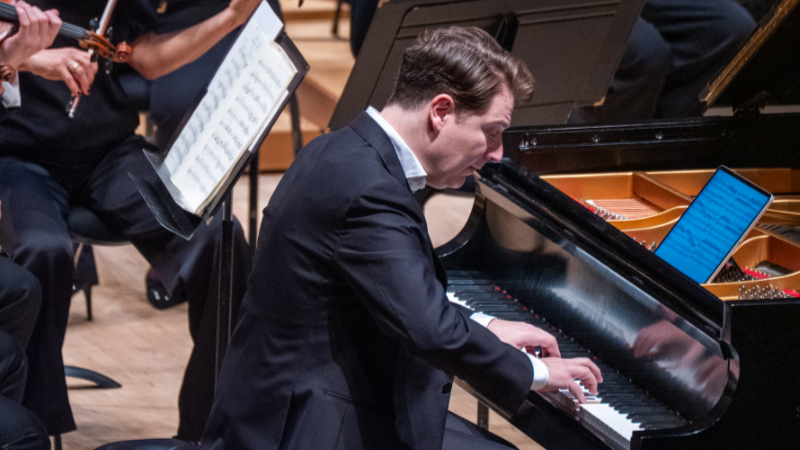
Pianist Alessio Bax performs Beethoven’s ‘Piano Concerto No. 1’ with the North Carolina Symphony, conducted by Carlos Miguel Prieto. (courtesy of North Carolina Symphony)
The soloist, Alessio Bax, played most recently with the North Carolina Symphony during the 2025/26 season, when he was featured in a performance of de Falla’s Noches en los jardines de España. Unfortunately, that work (which your reviewer had heard before only in recordings) came across as an ungrateful vehicle in which the nearly constant arpeggiations of the soloist behind the orchestra’s urgent utterances could have been played by a mime to equal effect. This season in Raleigh Bax was given a second (or perhaps first) chance to be heard as well as seen. This time the vehicle was one written by an actual performing pianist named Ludwig van Beethoven.
Prieto and Bax’s realization of Beethoven’s concerto paid little heed to period performance practice. Instead, it focused on authentic 21st-century performance practice, the result of ten generations of pianists who have spent significant parts of their lives exploring this concerto, trying to fathom its secrets. Bax proved an exemplary student of this lineage. His reading was rooted in a commitment to emotional stability, shown in how virtually every phrase of the piece, while having its say, allowed every other phrase to have its say as well. The result was a conversation, not an argument. Within that linear sequence of amiable phrasings, Bax found an unexpectedly wide range of affects, from mystery to tenderness to solemnity to nobility to grandeur, all conveyed freshly, with no stigma of study tarnishing them.
The most remarkable aspect of this performance, evident in every movement but especially in the central Largo, was the orchestra’s remarkably sensitive way of following the soloist’s semi-improvisatory offerings. It’s one thing to aspire to playing orchestral music as if it were chamber music. It’s quite another thing to achieve this result perfectly. And that is what the North Carolina Symphony did this weekend. They even made the result sound easy. No European or American ensemble your reviewer has personally witnessed has done this better.
The concerto itself was a milestone in Beethoven’s career. He first performed it in 1795, then fussed with it for six years before publication, and some ten years after that first performance, he was still writing cadenzas for it. In the first movement, Bax joined pianists like Evgeny Kissin, Martha Argerich, and Krystian Zimerman in playing Beethoven’s second cadenza, the one that doesn’t come across like something the snake had to unhinge its jaws to swallow. (The long third cadenza could arguably be preferable with a fortepiano, where the soloist is otherwise not quite as front and center.)
As an encore, Bax played the first movement of the “Moonlight” sonata with the same sort of unstudied sensitivity displayed in the concerto — spontaneous romanticism encapsulated within classical phrasing.
After intermission, Prieto appeared at a lectern to present the 2026 Music Educator Awards to teachers from far-flung corners of the state. The audience really got into this; perhaps some actually came for the presentation (though your reviewer saw the honorees-to-be gathered together outside before the hall’s doors opened; no family members or friends were in evidence). In any event, it is heartening to see something that could devolve into pure formality become a meaningful shared experience bringing pleasure to a thousand strangers.
The sole work played in the concert’s second half was Shostakovich’s 33-minute Sixth Symphony. Some readers may know the composer and his travails in the 1930s from William Vollmann’s Europe Central. In a pre-concert talk, Prieto mentioned that, when apartment-dweller Shostakovich wrote his Sixth Symphony, he kept a suitcase packed for the moment he heard an ominous knocking at the door. You see, Stalin was something of an aesthetic theoretician himself, and he had a gulag big enough to accommodate composers whose music sounded impudent to his ears. Had Stalin lived in our own time, he might have called Shostakovich’s works “fake music.”
Prieto has been conducting the Sixth Symphony since before 9/11. In a pre-concert chat, he said he keeps finding new things in it. This weekend, to your reviewer’s ears, Prieto interpreted the Sixth as though Shostakovich’s music and message from Stalinist Russia were entirely pertinent to the 2020s. It’s hard to imagine a movement more desolate than the opening Largo (18’52” in this performance), with ensemble passages that evoke broadly shared feelings giving way to solos that could hardly sound more solitary, isolated, and hopeless. Kudos to piccoloist Alexandra Stokes, English hornist Joseph Peters, flutists Megan Torti and Mary E. Boone, bassoonist Aaron Apaza, oboist Melanie Wilsden, and an unnamed bass clarinetist, all of whom carried forward a musical argument that seems to require baring one’s soul.
The story is told that Stalin asked Shostakovich to make sure his symphony’s last movement was very upbeat from the very downbeat. Shostakovich complied with two fast movements, an Allegro sounding very much like a scherzo and lasting 6’32” (in this performance) and a Presto sounding very much like the William Tell Overture and lasting 7’10” (in this performance). To better balance the length of the first movement, Prieto chose to play these two movements without a break.
You know the narrative vocabulary of classical music has reached beyond some previous threshold when it becomes possible to express irony. Satie may have done it first with his tongue-in-cheek interpolations — for instance, misquoted Chopin. Mahler did it without resorting to quotation, often by using unexpectedly crude tone colors. Prokofiev, Kodaly, and possibly the witty Poulenc carried this forward even more extensively and subtly. For the most part, though, all these composers restricted irony to selected paragraphs of their music. With Shostakovich, the irony, once begun, needs never stop. He could have been thinking something along the lines of, “Fake music, huh? I’ll show you some fake music.”
Your reviewer came late to Shostakovich, and one reason is that so many conductors use exaggerated gestures to underscore Shostakovich’s irony, placing a Mahler template over Shostakovich and applying crude intonations and tone colors. There’s no doubt that Shostakovich both knew and greatly admired Mahler’s music. But he wasn’t Mahler. He went a step further than Mahler, in fact. You’ve probably heard how if you act a certain way (even though you don’t feel that way), you can end up actually feeling that way. For example, throwing your head back and laughing from your belly for a minute or two can positively affect a depressed state. (Don’t try this at the mall, though.) Shostakovich’s fake high spirits are like that. Yes, they’re full of irony. And yet … by the end of a movement, by golly, there’s some real positive energy flowing.
What your reviewer especially liked about Prieto’s reading of the last two movements was that he captured this duality, never imposing an aesthetic that doesn’t grow out of the music itself. His scherzo was full of irony but also full of musical muscle and metric invention, with a central fugato that anchored the piece in dignity and undisguised self-affirmation. The finale was tinged with bitterness, to be sure, but as it continued, a growing sense of the sheer fun Shostakovich was having in writing it emerged. The finale’s hyperbolic closure (still less hyperbolic than the ending of Beethoven’s Fifth) has so little logic that it’s easy to revel in the musical hijinks, as if your fake belly laugh has started to become a real laugh. The audience literally couldn’t wait to stand and cheer.
In sum, Prieto’s reading rendered irony without sneering — and without forgetting that the last two movements have quite a bit in common with the bleak first movement. It was a brilliant interpretation, splendidly played by an ensemble our state can take pride in. This was a memorable concert from start to finish. ■
EXTERNAL LINKS:
- North Carolina Symphony: ncsymphony.org
- Carlos Miguel Prieto: carlosmiguelprieto.com
- Alessio Bax: alessiobax.com

Read more by Christopher Hill.