

May 23, 24 & 25(m), 2025
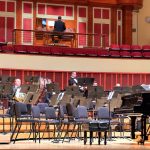
Jones Hall
Houston, Texas – USA
Houston Symphony, Juraj Valčuha, conductor; Bruce Liu, piano.
George WALKER: Icarus in Orbit (2003)
Frédéric CHOPIN: Piano Concerto No. 1 in E minor, Op. 11 (1830)
Robert SCHUMANN: Symphony No. 2 in C major (1847)
Lawrence Wheeler | 28 MAY 2025
Saturday evening, Houston Symphony music director Juraj Valčuha led the second of three concerts at Jones Hall featuring pianist Bruce Liu, who performed Chopin’s Piano Concerto No. 1 in E minor. The concert began with Icarus in Orbit by George Walker and concluded with Robert Schumann’s Symphony No. 2 in C major.
George Walker is remembered for his many ground-breaking “firsts” that broke barriers for generations of Black musicians who followed. An accomplished pianist, in 1945, he was the first Black artist to give a recital at New York’s Town Hall, to solo with the Philadelphia Orchestra, and to graduate from the Curtis Institute. In pursuing a concert career, he felt he was subjected to discrimination since agents and orchestras were not enthusiastic about promoting the career of a Black classical pianist. He turned to composing music, finding more if somewhat limited success. In 1996, he was the first Black composer to win the Pulitzer Prize for music. His music has programming merit that exceeds simply checking a diversity box.
Icarus in Orbit follows Ovid’s tale of Daedalus and his son Icarus, who were forced to stay on the island of Crete by King Minos. Daedalus fashions wings from wax and feathers so they can make their escape. He warns Icarus not to fly too close to the sun, or the wax would melt. Succumbing to youthful vanity, Icarus ignores his father’s admonition and flies ever higher. After losing his feathers, he tries flapping his bare arms but falls into the sea. The story contains morals: sons ignore their father’s advice at their own peril, vanity leads to one’s downfall, and human beings desire to be free. For Walker, he may have identified with Icarus, where the quest for ever higher success was met with a wall of resistance. Icarus in Orbit was originally written for a youth orchestra. While well-crafted, it is not one of Walker’s more musically complex works. It was given an attentive reading by Valčuha and the orchestra.
Bruce Liu was the first prize winner of the 2021 Chopin Piano Competition. Fittingly, he is making his Houston Symphony debut with Chopin’s Piano Concerto No. 1. He brought an exceptionally high level of artistry by means of an intimate performance technique, neither showy nor slick, that seemed to be channeling Chopin. Confining his motions to his fingers and hands, he produced an exquisitely nuanced and sensitive tone with fluid phrasing. Using the slightest rubato, the music breathed and flowed effortlessly as Chopin’s musical poetry unfolded before us. The Jones Hall audience was held spellbound, transported by magical playing that felt unconstrained by time and space. Valčuha was supportive and sensitive. Balance was well regulated, giving Liu ample flexibility to be expressive within a wide range of dynamics.
The audience responded to the concerto with very enthusiastic applause. As an encore, Liu performed Chopin’s Fantaisie-Impromptu in C-sharp minor. His effortless technique, voicing, and tonal control were stunning.
Liu is a Deutsche Grammophon artist, and this concert was being live-streamed by DG, giving international exposure to the Houston Symphony.

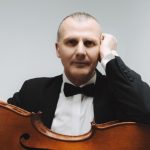
Juraj Valčuha (jurajvalcuha.com)
Schumann wrote his Second Symphony during a period of depression and poor health. In spite of this, the symphony expresses joy and serenity. It seems as if Schumann wrote this music to hide his feelings or perhaps to convince himself he could overcome his state of mind with music of a different sort. Schumann’s music does not play itself–it requires clarity of thought to delineate the composer’s use of harmony and counterpoint. This evening was some of the best yet produced by Valčuha and the Houston Symphony musicians.
In the first movement, Valčuha found a balance between light and dark, with various stages of musical mood lighting. The quiet and restrained “Sostenuto assai” opening was subdued but not gloomy, as pianissimo brass fanfares ambiguously foretold either a tragic or heroic ending. Highly expressive wind solos complemented the strings. Dancing and joyful sections of the “Allegro ma non troppo” were buoyant as Valčuha encouraged the orchestra to play freely. At times, the sound had the transparency heard in the Chopin. Rhythmic and dynamic running notes were played with energy and precision, leading to an affirmative conclusion of the first movement.
The second movement “Scherzo” contains violin passages that show up on every audition list in the world due to their difficulty. Valčuha’s tempo was fast, but not unreasonably so, allowing the first violins to show their stuff. Sixteenth-notes were passed from section to section without a hitch. In the Trio, the woodwinds matched that virtuosity with cleanly articulated triplets. The violins had a brief moment of insecurity when transitioning back to the “Scherzo.”
The third movement, “Adagio espressivo,” is the most deeply personal of Schumann’s symphonies. In it, he uses falling sevenths for mournful expression, intervals later employed by Edward Elgar for the same purpose. Valčuha masterfully conveyed the heart-wrenchingly incomplete passion within. The orchestra responded with compelling and involved playing.
The “Allegro molto vivace” finale breaks the mood with a joyful flourish. The opening theme is a quote from Mendelssohn’s Italian Symphony, which was quite deliberate. Schumann greatly admired Mendelssohn, who conducted the work’s premiere. Valčuha led the musicians in an exuberant performance. ■
EXTERNAL LINKS:
- Houston Symphony: houstonsymphony.org
- Juraj Valčuha: jurajvalcuha.com
- Bruce Liu: bruce-liu.com

Read more by Lawrence Wheeler.



.png)