

May 23, 2025
“Deep Rooted”
Midtown Arts & Theater Center Houston
Houston, Texas – USA
KINETIC — Natalie Lin Douglas, founder and artistic director.
Mason BYNES: Gallop (2025, World Premiere)
Evan ZIPORYN: In Light of Sound (2024, Texas Premiere)
Giancarlo LATTA: Orbital (2025, World Premiere)
Benjamin BRITTEN: Variations on a Theme of Frank Bridge, Op. 10 (1937)
Lawrence Wheeler | 27 MAY 2025
Formed in 2015, Kinetic Ensemble is a 16-member conductorless string orchestra “that seeks to amplify diverse, under-performed and newly-composed classical music to audiences in and beyond Houston through flexible chamber and orchestral ensemble performances.” A stated pillar of Kinetic Ensemble’s motivation is to invest in the communities in Houston and to bring people together at a time when much of our day-to-day lives encourages separation. Friday’s concert was subtitled “Celebrating 10 Years of Music-Making in Houston.”
The program began with a well-produced video retracing the group’s first ten years. The founder, Natalie Lin Douglas, was a doctoral student at Rice University’s Shepherd School of Music. She asked two other Shepherd School students, Giancarlo Latta and Patricia Ryan, to join her in forming a string ensemble. Additional Shepherd School students filled out the roster. In the spirit of musical entrepreneurship, they formed a 501(c)3 non-profit organization and set to work. That the group successfully passed the critical three-year point for a non-profit organization is a testament to their hard work and generated support from the community. Artistically, their musical product is first class. Nationally, there are very few comparable string orchestra groups.
Kinetic has premiered over 30 works, and Friday evening’s performance featured three–a Texas premiere and two world premieres.
The first piece, Gallop, was written by Black composer Mason Bynes. Based on sketches of songs she wrote on her guitar while growing up in Houston, it incorporates rasgueado finger strumming techniques, with rhythm and speed that evokes a galloping horse, heard in the player’s strumming on their instruments. A much larger portion of the piece is devoted to lyrical passages based on her training as a vocalist. Richly harmonized with a minimum of dissonance, it often sounded like American music with a British accent. The Kinetic musicians produced a well-blended and beautifully resonant sound, surprisingly so given the dead acoustics of the hall. The repeated dynamic swells were well unified and balanced, with bow speed taking priority over pressure. With much of the composer’s previous output focussed on choral works, this new work for strings is an admirable effort.
Second on the program was the Texas premiere of In Light of Sound by Boston composer and MIT faculty member Evan Ziporyn. Comprised of three distinctly different sounding yet loosely related movements, it explores a wide range of rhythms, harmonies, and string techniques. While the Bynes piece was music from the heart, this piece felt more intellectual. According to Ziporyn, the first part, “Ear-i-descence,” is “a pond under shifting winds creating gentle, unpredictable turbulence.” This is represented by the composer’s use of Balinese gamelan-inspired “ametric” (and therefore unpredictable) rhythms, along with subtly dissonant chords. “Different hues appear based on one’s own vantage point.” Ziporyn has the ad-vantage of being familiar with the written rhythms. For this listener, they seemed non-intuitive and random. It did serve to create a non-industrial aesthetic where clock time is not the priority, first explored by Debussy in Afternoon of a Faun.
The second movement, “Bird Math,” has several sounds representing birds. The musicians did some so well they could have been recognized by the phone app Merlin. Woodpecker sounds were particularly well done by cellos and basses slowly dragging their bows across the strings. It is a novel technique, somewhat related to John Deak’s choppa-choppa. The woodpecker sounds started to multiply, causing a certain level of anxiety, which was the desired effect. The movement ends quietly with two violas sounding like a pair of loons cooing.
The third movement, “Unraveling,” features sections trading motifs through call and response, sometimes repeating and sometimes countering. Kinetic performed the entire piece with care and commitment.
Violinist Giancarlo Latta has recently composed a new work titled Orbital. It has an energetic opening that later relaxes into arpeggiated figures in the violins, not unlike those heard later in the Britten. With totally idiomatic string writing, it invites a repeat hearing.
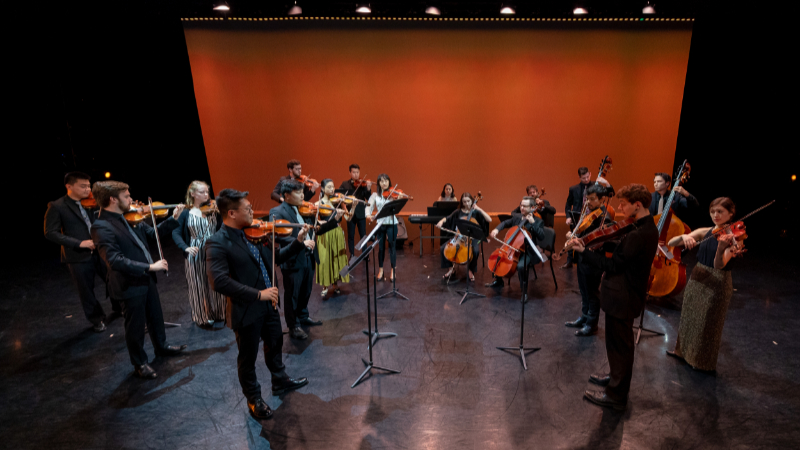
KInetic Ensemble (credit: Ben Doyle)
Kinetic first performed Benjamin Britten’s Variations on a Theme by Frank Bridge in 2015. Their first official season was 10 years ago, and five of those musicians were on stage this evening. The work begins with an “Introduction” where the “Theme” is loosely presented, followed by 10 Variations of different characters reflecting Bridge’s personality. Variation 1 is a solemn “Adagio” representing Bridge’s integrity. The following “March” has energetic dotted and triplet rhythms. The “Romance” is a charming waltz. Variation 4 is a Rossini-esque “Aria Italiana.” While meant to be humorous, it is anything but for the first violins–while everyone else strums, they have treacherous high notes. The traditional sounding “Bourrée classique” features a solo violin. Variation 6 is an enthusiastic “Wiener Waltzer.” The following “Moto perpetuo” was perfectly coordinated with vitality and precision. Variation 8, “Funeral March,” expresses Bridge’s sympathy, and the “Chant” his reverence. Variation 10 begins with a skilled “Fugue,” followed by a “Finale” where Bridge’s “Theme” is at last presented clearly. The form of variations and theme was also used by Britten a decade later in Lachrymae, a piece for viola and piano.
Kinetic’s performance of the Britten was fantastic. The precision of ensemble and intonation was truly remarkable, tonal beauty was exceptional, and musical concepts were faultless (although there was perhaps too much time between variations). Special mention to the first violins, who had the greatest responsibility and carried it with aplomb. It was a most enjoyable concert and a credit to Houston.
In January of this year, the National Endowment for the Arts awarded Kinetic Ensemble a $20,000 grant to support the development, premiere, and recording of new music through a series of activities that were set to continue until December 2026. Winning an NEA grant is a major signifier of an arts organization’s growth. Just four months later, the NEA changed its mind. Under the direction of the Trump administration, the NEA terminated active grants awarded to non-profit organizations nationwide. This move is part of a concerted attack on educational, creative, and artistic activities that stimulate intellectual and spiritual growth, encourage critical thinking, and bring people together.
Music elicits emotions, connects communities, preserves histories, and imagines new and better futures. All these outcomes have a very real impact on our lives and should be preserved. ■
EXTERNAL LINKS:
- Kinetic Ensemble: kineticensemble.org
- Midtown Arts & Theater Center Houston (MATCH): matchouston.org

Read more by Lawrence Wheeler.



.png)