

January 23, 2026
Jones Hall
Houston, Texas – USA
Houston Symphony, Marin Alsop, conductor; Yoonshin Song, violin.
Samuel BARBER: Essay for Orchestra No. 2, Op. 17 (1942)
Leonard BERNSTEIN: Serenade after Plato’s “Symposium” (1954)
Johannes BRAHMS: Symphony No. 2 in D major, Op. 73 (1877)
Lawrence Wheeler | 26 JAN 2026
In Friday evening, esteemed conductor Marin Alsop returned to Jones Hall after a 16-year hiatus to lead a program devoted to “three Bs”—Barber, Bernstein, and Brahms. Houston Symphony concertmaster Yoonshin Song was soloist in Leonard Bernstein’s Serenade. All three composers hold personal significance for Alsop: she has recorded the complete orchestral works of Samuel Barber and most of the orchestral music of both Bernstein and Brahms—just a portion of her remarkable 100-CD discography. Alsop’s appearance was greeted with cheers and a standing ovation, enthusiasm that was fully justified by a trio of outstanding performances.
Alsop is a master interpreter of American music, and the first half of the program showcased two of the country’s greatest composers, beginning with Barber’s Second Essay, one of his most frequently performed orchestral works. The title suggests a literary analogy—Barber employs an essay-like form through the musical transformation of three thematic elements. The opening section presents two themes, the first introduced by solo flute, bass clarinet, English horn, and oboe over a dark backdrop of tuba and bass drum. Timpani strokes hint at contemporary events; Barber himself remarked that “although it has no program, one perhaps hears that it was written in wartime.” The second theme emerges in the violas, then oboe. A fugato middle section, propelled by a rapid triplet figure, soon incorporates the earlier material. The work concludes with a hymn-like theme that might easily be mistaken for Copland.
Despite its brevity, Second Essay contains a striking range of emotional and musical content. Alsop conducted with inspiration and clarity, offering decisive cues throughout. The orchestra responded with rich sonorities and cohesive ensemble playing, highlighted by glistening flute solos and agile execution of the fragmented viola lines.

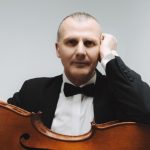
Houston Symphony concertmaster Yoonshin Song.(houstonsymphony.org)
Leonard Bernstein remains the greatest musician this country has produced. As conductor, composer, pianist, and educator, his influence and output are unequaled. Bernstein himself considered the Serenade his finest composition. I have long held a personal affection for the work, having heard its first performance by Hilary Hahn when she was just 13—she was then my chamber music student at ENCORE, a summer music program.
Completed in 1954, the Serenade was inspired by Bernstein’s deep love of literature and a rereading of Plato’s Symposium, written c. 385–370 BC. The dialogue presents seven speeches by leading philosophers, exploring the nature and meaning of love during a symposium—a banquet and drinking party. The speeches were likely composed by Plato himself. From this source, Bernstein created a five-movement work for solo violin, strings, harp, and percussion. The piece was last heard in Houston in 2018, again with Hilary Hahn as soloist.
A protégée of Bernstein, Alsop brings authority and deep insight to his music, qualities she shared generously with the Jones Hall audience. This performance featured Houston Symphony concertmaster Yoonshin Song, whose playing combined refinement and expressive depth. The first movement—“Phaedrus, Pausanias”—opens with an extended violin solo, which Song delivered with tender intimacy, superb bow control, and scrupulous observance of Bernstein’s markings—slides omitted, as instructed. The first violins echoed the melody before it accelerated into a mixed-meter, Stravinsky-inflected scherzo introduced by violas and cellos. Song dispatched the double-stops and ricochet bowings with ease, while Alsop maintained ironclad rhythmic control through the constantly shifting meters.
The second movement—“Aristophanes”—contrasts two melodies representing the myth of humans once being double beings—male/female, male/male, and female/female—until the gods split them apart, condemning humanity to eternal searching for their other half. Song played with gentle charm, navigating double-stops and artificial harmonics effortlessly, though Aristophanes’ famous hiccups might have benefited from greater humor. Alsop was attentive to balance, allowing Song’s beautiful, if not large, tone to project naturally. In the central section, violas introduced another Stravinsky-like idea and concluded the movement divisi, performing admirably.
The third movement—“Eryximachus”—is a fleeting fugato scherzo that passes in a flash. Its brisk tempo and presto chango mixed meters were immaculately prepared by Alsop and brilliantly executed by both soloist and orchestra.
The emotional core of the Serenade lies in the fourth movement—“Agathon”—which Bernstein described as “a simple three-part song.” Quiet echoes of earlier material precede a soaring, high-lying violin melody, played by Song with vulnerability and poise. Alsop and the orchestra provided sensitive support as the violas led a crescendo into a violin cadenza, punctuated by harp chords. Song played the cadenza passionately before returning to the opening material, now marked dolcissimo. Here, a slightly broader vibrato might have heightened the sense of release following the cadenza’s intensity.
The final movement—“Socrates, Alcibiades”—opens with a dense, dramatic orchestral statement, reinforced by pedaled timpani, before the solo violin enters forte. This was the only point where balance was briefly an issue. A solo cello soon joins the violin, representing Socrates (cello) in dialogue with Diotima (violin), the wise woman from whom Socrates claims to have learned all he knows of love. Principal cellist Brinton Smith contributed his signature warmth and polish. The movement culminates in the riotous interruption of Alcibiades and his drunken entourage: dance rhythms grow jazzy, speech slurs, and the music deliberately veers off balance. Throughout the coda, Alsop served as the ensemble’s designated driver, guiding the performance to a brilliant close. Applause erupted intermittently between movements, and the work ultimately received four curtain calls.
Brahms’ four symphonies are often associated with the seasons; the Second Symphony traditionally linked with spring. While its pastoral warmth supports that notion, Brahms’ music is never without shadows. Alsop captured both its lyricism and underlying drama through judicious tempos and scrupulous attention to balance, allowing the music to unfold naturally, without imposed interpretation. Her intentions were clear from the outset: she took the exposition repeat and avoided exaggeration of the opening bar, a gesture sometimes burdened with undue significance. Conducting without a score, Alsop was fully immersed in shaping phrases and cueing the ensemble. Her motions were purposeful rather than showy, although her red shirt cuffs did add a bit of flair. Important musical lines were highlighted, providing structure. Alternating between three beats per measure and one, she never let the music collapse under its own weight– a common flaw of less experienced conductors. Tempi were directed forward as required by sequences and modulations. The Houston Symphony musicians appeared at ease as Alsop influenced rather than controlled the progress of the music. Hers is a collaborative approach. With unified rhythms and articulations, the first movement was nearly flawless–save for a single stray cello pizzicato.
The second movement opens with a deeply expressive cello melody, answered by a bassoon countermelody. This yearning theme establishes the movement’s emotional world. Brahms’ characteristic displacement of the strong beat—here to the fourth beat—was handled with sensitivity, musicians following phrase shapes rather than bar lines. Alsop elicited expressive playing through a refined vocabulary of gesture. Light figures danced gracefully, while dramatic climaxes remained firmly grounded.
The third movement begins as a triple-meter Ländler, with Brahms accenting the third beat to create lift. Winds dominate until a sudden shift to brisk duple meter, where strings play spiccato with accents on the fourth beat. A robust, rustic melody follows—hobnail boots and thigh-slapping practically visible. An abrupt retreat to pianissimo sustains the quiet until the Ländler returns, now more serious in character. Rapid triplet figures (in compound meter felt as one) lead to a final reprise of the dance. The revelry subsides; the music gently says goodnight. I mention all these details to show how much accurate direction and playing is necessary to have it performed as exceptionally well as it was.
The Finale begins in a whisper sustained for 22 bars before exploding in a forte entrance on the second eighth note—a gesture recalling Beethoven’s Fifth Symphony. Alsop’s precise cueing, combined with the orchestra’s trust and commitment, produced a razor-sharp attack. This is joy orchestrated, exhilarating to hear and play. Brahms continues to energize the music through displaced accents, while lyrical triplets briefly soften the mood before the recapitulation. One final offbeat eruption drives the music forward, yielding at last to a radiant, life-affirming hymn. Echoes of Beethoven’s Fifth ring out in the brass as Brahms seals the triumphant D-major conclusion. Bravo to all.
Throughout the evening, flutist Aralee Dorough contributed golden-toned solos. Recently retired, she returned especially for this concert, affirming that she departs at the height of her artistry. As expected in Brahms, the symphony includes prominent horn writing, beautifully played by principal horn William VerMeulen. Several violinists were substitutes due to retirements and health-related absences, yet the section functioned cohesively. Across the board, the Houston Symphony was in excellent form.
On Thursday, the Cliburn, the Houston Symphony, and Rice University’s Shepherd School of Music jointly announced that the Cliburn International Competition for Conductors will take place in Houston in June 2028—the first major international conducting competition in North America. Marin Alsop will serve as jury chair and lead an Artistic Advisory Committee including Miguel Harth-Bedoya, Kent Nagano, Robert Spano, Xian Zhang, and Houston Symphony Music Director Juraj Valčuha. This landmark initiative underscores a shared commitment to artistic excellence and the cultivation of future musical leaders. ■
EXTERNAL LINKS:
- Houston Symphony: houstonsymphony.org
- Marin Alsop: marinalsop.com
- Yoonshin Song: houstonsymphony.org/musicians/yoonshin-song/

Read more by Lawrence Wheeler.



.png)