
February 1, 2026
St. Mark’s Evangelical Lutheran Church
Jacksonville, Florida – USA
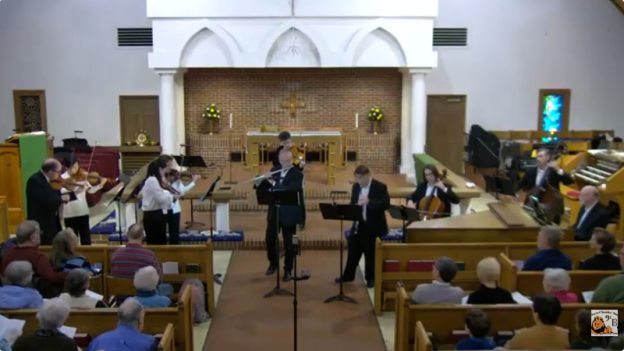
Les Roettges & Sophia Jean, flutes; Eric Olson & Daniel Rios, oboes; Yi-Ping Tsai, Megan McClendon Rios, Chris Chappel, & Jee Hee Kang, violins; Ellen Olson, viola; Brian Magnus, cello; Patrick Bilanchone, bass; Peter DeWitt, harpsichord.
Johann Friedrich FASCH: Concerto in E minor (L:e1), for flute, oboe, and strings
Tomaso ALBINONI: Concerto a cinque , Op. 5, No. 2
Antonio VIVALDI: Piccolo Concerto in C major, RV 443
Antonio VIVALDI: Concerto for Two Oboes in C major, RV 534
Georg Philipp TELEMANN: Concerto for Two Flutes and Two Oboes, TWV 54:B2
Mark Gresham | 2 FEB 2026
Nestled just south of downtown Jacksonville, Florida, the neighborhood of San Marco has long cultivated an identity that values walkability, historic architecture, and a strong sense of local arts engagement. With its Mediterranean Revival buildings, independent businesses, and close-knit residential streets, the district often feels more like a small town than part of Florida’s largest city—an atmosphere well suited to intimate cultural gatherings such as chamber music concerts.
That sense of refuge was especially welcome on Sunday evening, February 1, as an unseasonable cold snap pushed deep into the Southeast, bringing brisk temperatures and gray skies to northeast Florida. Inside St. Mark’s Lutheran Church, however, warmth prevailed—both literal and figurative—as musicians and listeners alike gathered for an hour of buoyant Baroque music that offered a bright counterweight to the chill outside.
Founded to bring high-quality chamber music to the heart of San Marco, the San Marco Chamber Music Society has built a loyal following through its emphasis on accessibility, community, and thoughtfully curated programs. Its annual “Goes for Baroque” concert has become a familiar winter tradition, pairing historically informed repertoire with an informal, welcoming presentation style.
The society presented its “Goes for Baroque 2026” program to an enthusiastic audience at St. Mark’s, filling the sanctuary with early 18th-century concertos performed by a conductorless chamber orchestra of 12 musicians. Admission was free, reinforcing the organization’s commitment to broad community access and helping draw a capacity crowd that responded attentively and generously throughout the concert.
Soloists included flutists Les Roettges and Sophia Jean, oboists Eric Olson and Daniel Rios, plus violinists Yi-Ping Tsai and Chris Chappel. The ensemble approach emphasized collaboration over display per se—appropriate to both the repertoire and the society’s communal ethos.
The program opened with Johann Friedrich Fasch’s Concerto in E minor (L:e1) for flute, oboe, and strings, with flutist Roettges and oboist Olson as soloists. The outer “Allegro” movements moved with lightness and forward momentum, if not always absolute precision, while the central “Adagio” offered a moment of calm lyricism, shaped with care.
Tomaso Albinoni’s Concerto a Cinque, Op. 5, No. 2 followed, with violinists Tsai and Chappell in the concertante roles, its graceful “Largo” movement unfolding with understated charm. The closing “Allegro” leaned toward a convivial, conversational spirit, carrying the music engagingly forward.
Antonio Vivaldi’s Piccolo Concerto in C major, RV 443, proved one of the evening’s highlights. Sophia Jean approached the demanding solo piccolo part with confident sparkle, navigating the brisk outer movements with evident enjoyment. The warmly played “Largo” created a more intimate moment within the concerto.
Vivaldi’s Concerto for Two Oboes in C major, RV 534, featured Olson and Rios in lively exchange. Their interplay emphasized character and rhythmic vitality, particularly in the “Allegro” movements, while the “Largo” offered expressive phrasing.
The concert was capped with Georg Philipp Telemann’s Concerto for Two Flutes and Two Oboes, TWV 54:B2. Roettges, Jean, Olson, and Rios blended effectively across the work’s four varied movements, from the flowing “Andante,” energetic “Presto” and songful “Cantabile” to a final “Allegro” that closed the program on an upbeat, celebratory note.
Throughout the program, the ensemble favored momentum, clarity of texture, and stylistic awareness over meticulous polish. Occasional lapses in intonation or ensemble alignment did little to dampen the overall effect, as the musicians’ evident engagement and mutual responsiveness kept the performances alive and communicative.
Equally notable was the devoted audience itself, which listened attentively and responded enthusiastically. In the welcoming environment of St. Mark’s Lutheran Church, the San Marco Chamber Music Society demonstrated how thoughtfully presented live music can strengthen the cultural fabric of a neighborhood—even, or perhaps especially, on an unusually cold winter evening in Florida. ■
EXTERNAL LINKS:
- San Marco Chamber Music Society: hsanmarcochambermusic.org

Read more by Mark Gresham.


.png)