
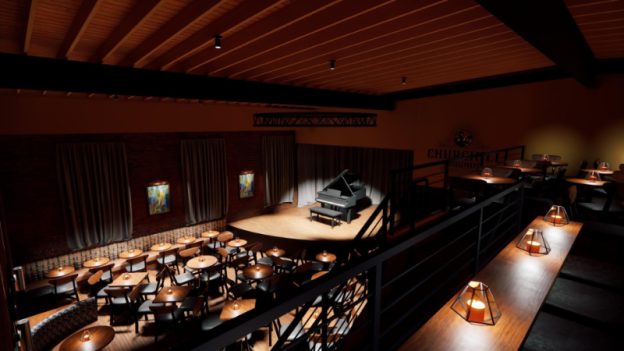
saxophonist and entrepreneur Will Scruggs explains how a grassroots-funded vision became the Mary Lou Williams Jazz Center, set to open this fall.
Mike Shaw | 16 MAY 2026
This fall, Atlanta will get a long-awaited and highly anticipated new jazz club. Its stature is reflected in its name, Churchill Grounds, a direct descendant of the iconic jazz venue next to the Fox Theatre in downtown that for so long featured not only Atlanta’s best but also jazz greats from across the nation, a club owned and operated by Atlanta’s premier jazz enabler of the time, Sam Yi. The closing of the club in 2016 and the eventual passing of Yi are difficult moments in the city’s jazz past, but now comes the heir apparent, the resurrection, in the form of the new Churchill Grounds at the Mary Lou Williams Jazz Center in Decatur.
Owner and operator Will Scruggs, a saxophonist with a distinguished performing and recording career with high-profile bands and individuals as well as his own groups, is in the midst of his third year of immersion in the project, bringing it to life, converting his dream and that of many others into a reality expected to debut this fall. EarRelevant’s Mike Shaw talked with Will about the project, the club, and the scope of the soon-to-be Jazz Center.
Mike Shaw: The passion and drive you have for this project is admirable. Tell us how this all came about.
Will Scruggs: I’m going to start with the name, Churchill Grounds, because the people of the jazz community in Atlanta and beyond were friends and admirers of the great Sam Yi. None of what I’ve accomplished in my music career would have been possible without Sam giving me a start at Churchill Grounds. It was a place where I sat in as a college student and started to envision myself as a band leader, as a jazz artist. It was Sam and the people that I met at Churchill Grounds that formed my community and formed my love of the music. And it was when Churchill left the Fox in 2016 that I started dreaming of a new jazz club for Atlanta.
I was pulling hard for Sam before he passed to open his club in East Atlanta. I thought about not going forward with my idea out of loyalty to Sam. But something inside me told me I needed to go ahead in case that didn’t happen. And the ultimate dream was to have two clubs, one in Decatur and one in East Atlanta, and have a real Atlanta jazz scene.
MS: What was the concept and how did you get started?
WS: I started the project in 2023 by creating a company called the Cornerstone Jazz Collective. I went back to my business school roots, to my Emory professors and a dean of the undergraduate program, Andrea Hershatter. I told them I thought I had a plan that could make this dream possible. And so my friends at Emory helped me get it rolling. We created the Jazz Collective and were able to gather almost 200 small investors across the jazz community and throughout Atlanta and Decatur to pitch in together as a small corporation to buy a historic property and develop it into a multi-use jazz center.
MS: You’re calling it the Mary Lou Williams Jazz Center. How did that come about?
WS: We formed a partnership with the Mary Lou Williams Foundation. She was born in Atlanta in 1910 and became an incredibly important figure in the history of jazz. She left her rights to all of her music to that Foundation before she passed.
MS: What else beyond the new Churchill Grounds will the Center offer?
WS: We will open the restaurant first, a wonderful Cuban restaurant, Clave, operated by the husband and wife team, Luis Fernandez and Yanin Cortes. The restaurant is a tenant in the building, on a revenue-sharing lease. When we fill up the club, we get revenue from the restaurant. That’s part of the business model designed to make the Jazz Center sustainable for the long term.
In a way, that flips the traditional jazz club model on its head. In the traditional model, the musicians are at the bottom of the economic totem pole. They usually play for the door. The club owner makes money from the bar and is trying to pay the landlord, who is trying to pay the bank. But by owning the building, we get a chance to put the community and the musicians at the top of that totem pole.
MS: Where did you get the drive or desire to take on that role, that is, to provide a service to the jazz community?
WS: I really believe it was a calling. I don’t think it was something I chose to do. I think it was something that happened to me. I am a person of great faith. And I believe that sometimes you are put in a position where there’s a need, and there’s no one stepping into it. And when you know that you have the ability to do it, you feel obligated in some way to do it.
MS: Tell us about the building and how you went about selecting that property for the Center.
WS: I’ve always been involved with real estate. As soon as I paid off my student loans, I bought a house, and I rented rooms to friends, other musicians, a lot of times. I had no rent, and I was building equity. And that’s how I segued into full-time gigging, using real estate as leverage. Eventually, my wife and I came to own several rental properties, residential properties. And so I wondered if we could replicate that on a commercial scale. What if we could buy a building and have spaces in that building attractive to tenants, and have those tenants cover the mortgage, enabling us to create this space for a jazz club?
MS: Beyond the restaurant, what do you envision in terms of those other tenants? I know you have some things already planned.
WS: We’re going to have a woodwind specialty store and a community jazz academy. The store will be called Scrugg’s Woodwinds, and it will be on the lower level of the building. We’ll have saxophone consignments, vintage horns, and mouthpieces, and a repair area where specialists can come in for a day and interface with their customers and do small repairs on site, then take the big repairs back to their shops. The name doesn’t just refer to me, but to Mary Lou Williams, whose maiden name was Mary Scruggs. So it’s a little nod to her.
What’s most exciting is the music school, the academy we’re envisioning. We’ll offer private lessons, but we’re also going to try to create a community version of a college jazz program: a jazz history course, a jazz theory course, and combos. We even hope to have a community-type big band, like a lab band, so we can draw adult as well as young students. We’ll attract students studying with other teachers, not to pull them away from their teachers, but to enhance their opportunities. So the lower level is really going to be focused on education and gathering musicians together, and hopefully informing the next generation.
We’ll also have a recording studio in the building, managed by studio engineer Marty Kearns, with the control room on our upper level. We’ll be able to record live from the stage, and we’ll have three rooms on the lower level that will be wired for recording, two of those with baby grand pianos.
MS: We get the picture of this as a multi-faceted and very substantial initiative, which translates to, from a financial perspective, a very substantial commitment.
WS: It is a huge project. When I was getting started, there were folks who said, “Maybe you should start smaller.” I started looking at a smaller building, and I started considering an idea that was much smaller. Then I came across the Greene’s Fine Foods building, which was the 1935 Post Office for the City of Decatur. It’s a beautiful white marble building that has the look of an institution.
Getting to the real answer to your question, we have those 200 small investors who make up the parent company that is funding this. I’m the only person who bears an outsized risk, about 40 percent of that company when everything is finalized. When we bought the building, it was 6,000 square feet of leasable space. After our renovation, it’s going to be 9,000 square feet of leasable space with an elevator that makes the lower level accessible. So we’re creating an asset of value for our investors right off the bat—and again, hopefully, an asset that will lead us to sustainability. Plus, those are 200 stakeholders who care about this club being full. And that’s another part of the strategy. I know all these folks will bring friends, and they will come back, because, you know, when people get close to jazz, they fall in love with jazz.
MS: It’s hard to imagine that someone opening a restaurant or a retail business would get this kind of grassroots support. What do you think it is about jazz, or music in general, that attracts people like you have witnessed?
WS: I’m really selling the art of jazz and the community of all these great players we have in this town. I believe Atlanta should be a jazz mecca. I don’t know if that’s the best answer to your question, but I think it’s the music. It’s something about the soul of the music.
This is an $8.5 million project. We found a bank to finance half of it and the community stepped up for the other half. That is incredible. And it speaks to the power of the music. But also, Atlanta has a special jazz community. We nurture each other here. We want to see our colleagues get great gigs and great opportunities. We have a way of wrapping our arms around each other, and I think this project typifies that.
MS: So when will people be able to come and hear music at the new Churchill Grounds?
WS: We don’t have a specific date yet, but we’re working toward a grand opening in the fall. ■
EXTERNAL LINKS:
- Cornerstone Jazz Collective: cornerstonejazz.com

Read more by Mike Shaw.
RECENT POSTS
[display-posts exclude_current=”true” include_date=”true” date_format=” \• d M Y” offset=”0″ posts_per_page=”5″ image_size=”thumbnail” wrapper=”div” wrapper_class=”display-posts-listing image-left” meta_key!=”_thumbnail_id”
.png)