October 23, 2026
The Cathedral of St. Philip
Atlanta, Georgia – USA
Atlanta Baroque Orchestra, Julie Andrijeski, artistic director & concertmaster; Chase Loomer, organ; Cathedral Schola, Dale Adelmann, conductor.
Johann Sebastian BACH: Cantata Wir danken dir, Gott, wir danken dir, BWV 29 (Sinfonia, Chorus, and Chorale)
Johann Sebastian BACH: Orchestral Suite No. 1 in C major, BWV 1066
Johann Sebastian BACH: Cantata Ein feste Burg ist unser Gott, BWV 80
Mark Gresham | 26 OCT 2026
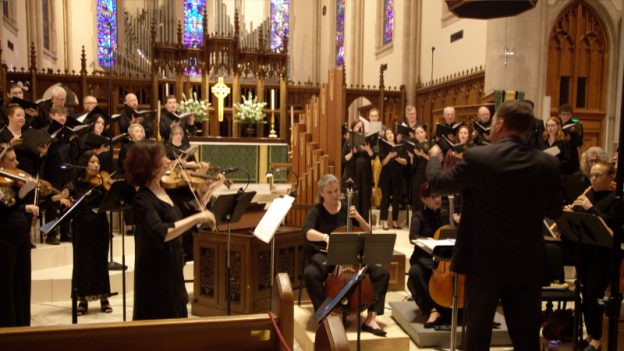
The music of Johann Sebastian Bach can make a church seem less like a building than an instrument in its own right. At the Cathedral of St. Philip in Atlanta, the Atlanta Baroque Orchestra and the Cathedral Schola brought that possibility into focus on Oct. 23 with an all-Bach program that joined instrumental music and cantata selections in a collaboration between ABO and the Friends of Cathedral Music.
The concert, titled “Leipzig Churches & Coffeehouses: A Festive Collaboration — Music of J.S. Bach,” continued the Atlanta Baroque Orchestra’s 10th-anniversary celebrations as artist-in-residence at the Cathedral of St. Philip. Its centerpiece, Bach’s cantata Ein feste Burg ist unser Gott, BWV 80, recalled the beginning of the orchestra’s relationship with Friends of Cathedral Music, forged through a 2013 performance of the work.
The program began with selections from Bach’s Wir danken dir, Gott, wir danken dir, BWV 29, conducted by Dale Adelmann, the cathedral’s canon for music. The cantata’s opening Sinfonia is a festive instrumental movement built around an elaborate solo organ part performed by organist Chase Loomer. Adapted from the “Preludio” of Bach’s Partita No. 3 in E major for unaccompanied violin, the music sets the organ’s flowing passagework against an orchestral texture punctuated by trumpets and timpani, establishing a buoyant momentum.
The ensuing chorus, “Wir danken dir, Gott, wir danken dir,” is among Bach’s most highly regarded choral movements; he later reused its music in the Mass in B minor for the “Gratias agimus tibi” and “Dona nobis pacem.” Together with the final chorale, “Sei Lob und Preis mit Ehren,” it framed the cantata excerpts in complementary expressions of thanksgiving: the chorus through intricate counterpoint and cumulative grandeur, the chorale through its direct, hymnlike affirmation.
The orchestra then turned to the Orchestral Suite No. 1 in C major, BWV 1066, led by ABO concertmaster and artistic director Julie Andrijeski. The opening Ouverture followed French overture conventions, beginning with stately, sharply dotted rhythms before shifting into a faster, fugal section in which instrumental lines passed between the winds and strings. The return of the imposing opening material brought the movement to a ceremonial close. The succeeding dances offered contrasting courtly characters, from the Courante’s flowing motion and the Forlane’s lilting sway to the paired dances’ shifts in texture and mood, ending with a buoyant pair of Passepieds. The woodwinds added a distinctive color against the strings, particularly in the contrasting sections of the Gavottes, Menuets and Bourrées.
The cantata Ein feste Burg ist unser Gott, BWV 80, brought the program back to the church setting that shaped so much of Bach’s professional life. Based on Martin Luther’s hymn, the work combines Lutheran chorale tradition with the expressive resources of Baroque vocal and instrumental writing.
Before the performance, the audience was asked to sing the hymn using the familiar English translation (“A Mighty Fortress Is Our God”) but with somewhat unfamiliar musical phrasing; while well-intended, this left the audience struggling to sing as a single body. No matter, as it was intended as a lesson about the chorale tune, not a performance.
The cantata itself unfolded as a progression from confident declaration to personal reflection and, finally, communal affirmation. The opening chorale fantasia sets Martin Luther’s hymn in an elaborate contrapuntal texture, with the chorale melody anchoring the interweaving vocal lines and instrumental writing. The following movements alternate arias, recitatives and chorales, moving between the hymn’s public assertion of faith and more intimate expressions of trust, vulnerability and spiritual resolve. Soloists drawn from the choir (though not identified in the printed program) added to this personal dimension through individual arias and a duet.
The cantata concluded with the chorale “Das Wort sie sollen lassen stahn,” affirming the steadfastness of God’s word. Yet this ending felt strangely more restrained and less triumphant than the text might suggest.
The evening’s collaboration also carried a significance beyond the program itself. The orchestra’s return to a work it first performed with Friends of Cathedral Music in 2013 gave the evening a sense of institutional continuity, while the combination of cantata excerpts and a complete orchestral suite presented different facets of Bach’s musical world without separating the sacred from the secular too neatly. ■
EXTERNAL LINKS:
- Atlanta Baroque Orchestra: atlantabaroque.org
- Friends of Cathedral Music: cathedralatl.org/worship/music/friends-of-cathedral-music

Read more by Mark Gresham.