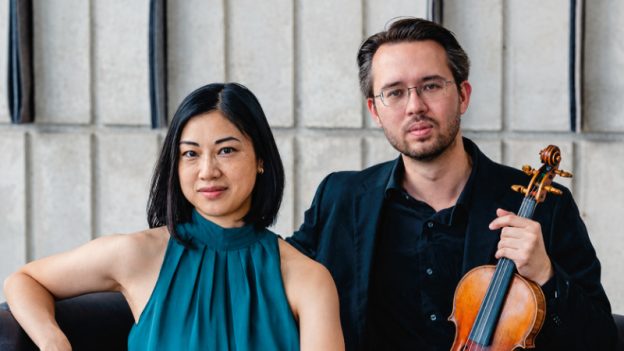
Natalie Lin Douglas, violin; Patrick Yim, violin and viola.
Lei LIANG: Gobi Canticle (violin and viola)
Zhou TIAN: Duo (violin and viola)
Chen YI: Energetic Duo (two violins)
Kai-Young CHAN: Echoes of the Autumn Night (two violins)
Yao CHEN: Four Mini Duets: Chinese Dolls (violin and viola)
Texu KIM: Homage to Anonymous Ancient Fiddlers (two violins)
Meilina TSUI: Etude for Violin and Viola (violin and viola)
Clarence MAK: The Approach of the Day (violin and viola)
Lei LIANG: Lakescape III (two violins)
Doming LAM: Retrograde (two violins)
Jungyoon WIE: Dan Poong (Autumn Leaves; two violins)
ORCHID CLASSICS
Catalog No. ORC100426
Release Date: April 24, 2026
Ten of the eleven works are identified by the label as first recordings.
Lawrence Wheeler | 22 OCT 2026
Violinist Natalie Lin Douglas is joined by Patrick Yim on violin and viola in the Orchard Classics CD Gobi Canticle, a buffet of 11 string duos by 10 composers of Asian heritage. Five are for violin and viola, and six are written for two violins. All but one selection are first recordings. The players are well matched in this warm yet detailed recording. Sonically, Yim is always on the left, and Douglas is always on the right, whether playing violin I or violin II. This required a bit of mental adjustment since it is not always typical concert hall staging, where the first violin is always on the left.
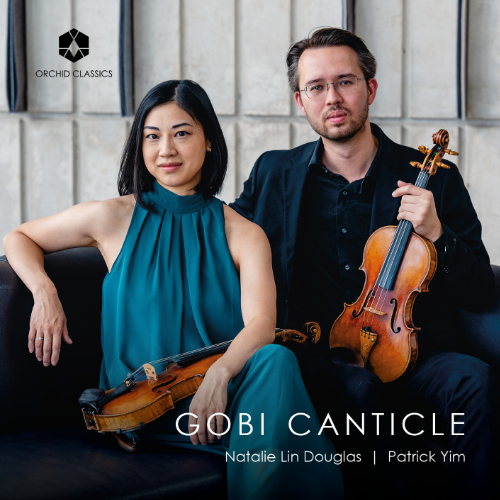
ORC100426 cover art (click to enlarge)
While some of the works show a mix of Western and Asian influences, most rely on poetry, a painting, calligraphy, nature, and traditional Chinese music for inspiration. Through listening to the CD several times, I found several identifiable factors that set this music apart from traditional Western classical music. While some pieces had an identifiable form, that did not sound like it was a priority. Neither was the formal structure inherent in rhythm, meter, and harmonic progressions. With many pieces through-composed, there is a horizontal rather than vertical feel—with the music flowing like a stream rather than built on blocks. The music was more about creating a state of mind versus expressing emotions. It feels less ego-centric, with no need for great or memorable proclamation.
Regardless, sensitivity did not mean a lack of virtuosity. There were plenty of very challenging passages, expertly played individually and together by Douglas and Yim—but that never seemed to be their point. They were celebrating the music and giving it the best possible representation.
The titular work, Gobi Canticle, was written by the celebrated Chinese-American composer Lei Liang. At 10½ minutes, it is the longest work on the CD, possessing a meditative mood while incorporating novel techniques. Liang gains influence from Chinese culture, past and present—in his music ancient history meets modernity.
Zhou Tian’s Duo for violin and viola is a virtuosic showpiece and one of the more Western-sounding pieces. Its strong rhythms and syncopations could have been written in 1980 by an American composer. Douglas’ fleet fingers were perfectly aligned with Yim’s fine viola playing, which ranged from intensely throbbing low notes to very articulated high notes.
Chen Yi is the oldest composer represented on the CD. Yi served as an opera concertmaster in Beijing during the Cultural Revolution. Her Energetic Duo for two violins is one of the shortest pieces, featuring dynamic contrasts and motives but no melody. There are references to a Chinese percussion ensemble, but I found nothing that invited repeat listening.
Kai-Young Chan’s Echoes of the Autumn Night is one of several works that Yim has performed with Joel Smirnoff, former violinist of the Juilliard Quartet. Chan is inspired by ancient and contemporary Asian cultural traditions. Some melodic lines in Echoes reflect the reading of Cantonese poetry. Autumnal images, such as fireflies and stars, are represented by fluttering harmonics. The writing follows tonal contour vs. form.
Yao Chen’s Chinese Dolls is one of Four Mini Duets for violin and viola, and is the CD’s shortest piece. Deceptively difficult, it features ricochet and glissandos. Playful and humorous, it ends with the dancing dolls in a heap.
Texu Kim’s Homage to Anonymous Ancient Fiddlers incorporates virtuosic passagework using precisely timed hocket writing, ricochet bowing, and multiple double-stops. These elements were done quite well by the duo violinists. The composer directs the second violin to tune slightly lower in order to give the piece an “ancient flavor.” This effect quickly became irritating, leaving a bad taste in my mouth.
Mellina Tsui is the youngest composer represented. Born in Kazakhstan, she is Hong Kong-American. Written when Tsui was only 22, the Etude for Violin and Viola is in ternary form and shows an intimate knowledge of string technique. The middle section, marked “molto vibrato, espressivo,” has echoes of Zoltán Kodály’s Serenade, Op. 12. Yim’s expressive viola playing is particularly arresting.
Clarence Mak’s Approach of Day is a kaleidoscope of colors and textures. Even when moving freely between rhythmic and free, tonality and bent tones, it has an improvised effect but never sounds random. The duo’s playing is a model of chamber music.
Liang’s Lakescape III is a meditative piece with pitch shifts evoking light on a calm water surface. The overall effect could have been accomplished in half of its six minutes’ time.
Doming Lam was the “father of Hong Kong modern music.” Written for two violins, Retrograde was inspired by the crab canon in Bach’s The Musical Offering. A charming piece, its use of pentatonic scales maintains consonance while imparting a Chinese flavor. It is a fine example of musical acculturation.
Jungyoon Wie’s violin duo Dan Poong refers to green leaves changing color in late autumn. Conceived during the COVID-19 pandemic, its seven-plus minutes of mesmerizing non-metrical shapes are best enjoyed with a clear mind and a clear schedule.
Gobi Canticle is a valuable introduction to contemporary string music of Asian origin, exceptionally well conceived and presented by these two outstanding string players. As with any buffet, you may choose to go back for seconds or leave some pieces on your plate. ■
EXTERNAL LINKS:
- Natalie Lin Douglas: natalielindouglas.com
- Patrick Yim: patrickyimviolin.com

Read more by Lawrence Wheeler.
RECENT POSTS
 Houston Symphony pairs Stravinsky’s austerity with Mozart’s grandeur, Mackey’s inventiveness • 20 Oct 2026
 Raven Chacon’s “Voiceless Mass” anchors an immersive evening with ensemble vim and Bent Frequency • 19 Oct 2026