
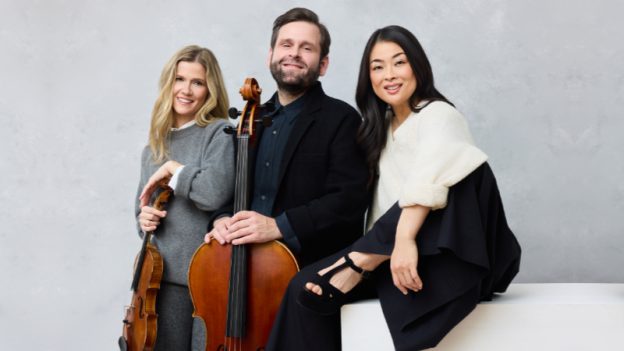
Anna Williams, violin; Mikhail Veselov, cello; Eri Nakamura, piano.
Clara SCHUMANN: Piano Trio in G minor, Op. 17
Cécile CHAMINADE: Piano Trio No. 1 in G minor, Op. 11
Dora PEJAČEVIĆ: Piano Trio No. 2 in C major, Op. 29
Chandos Records CHAN 20368
Formats: CD, digital
Release Date: February 6, 2026 (worldwide)
Total Duration: 85:16
Giorgio Koukl | 19 FEB 2026
Each time a new CD featuring only women as composers is released, curiosity about discovering fresh, unknown music is high.
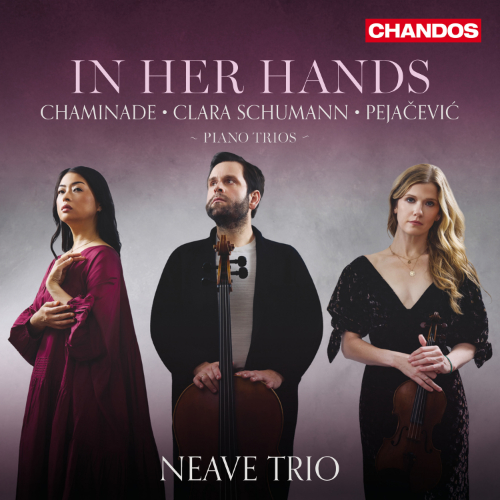
CH20368 cover art. (click to enlarge)
This time, the Neave Trio has chosen well-known scores by Clara Schumann and Cécile Chaminade for this Chandos album, as well as a real gem: the Piano Trio No. 2 by Croatian composer Dora Pejačević.
The musicians, violinist Anna Williams, cellist Mikhail Veselov, and pianist Eri Nakamura, are an ensemble with a distinctive sound. In fact, they are fine and solid in all aspects, with perfect intonation and very elegant. What is lacking, somehow, is any interpretative effort that would go outside the mainstream way of playing. But in this case, playing mostly romantic repertoire which requires solid bowing technique, nicely formed agogical finesse, and calculated choice of dynamics, they deserve a big bravo for the interpretation.
But let us look at the three individual components of this installment.
The journey starts with pianist, composer, teacher, and editor Clara Schumann (1819-1896). She was one of the greatest pianists of the 19th century, admired throughout Europe for her intellectual depth and technical mastery. In 1840, she married Robert Schumann despite her father’s strong opposition. She bore eight children while continuing to perform, compose, and support her family financially. After Robert’s mental illness and death in 1856, Clara became the primary guardian of his legacy, editing and performing his works.
Her Trio in G minor, Op. 17, composed in 1846, has four movements: “Allegro moderato,” “Scherzo. Tempo di minuetto,” “Andante,” and “Allegretto.” The general mood is typical of her time. Strongly lyrical, often intimate and song-like phrases are carefully balanced by the Trio, with expressive smoothness implied rather than raw drama. This is definitely a repertoire that the Neave Trio are real masters of, and maybe the best part of the CD.
The Trio No. 1of Cècile Chaminade is from her early years and still strongly leans on romantic models. She writes as if Debussy or Ravel would never have existed, but the music has its silent charm, once again well rendered by the musicians of the Neave Trio.
Chaminade’s music occupies a distinctive place between salon music and serious late-Romantic composition. Her music is immediately recognizable for its elegant, singable melodies. Even in instrumental works, lines often resemble vocal phrasing, reflecting her sensitivity to text and song. Frequent use of chromatic color, modal inflections, and expressive modulations adds warmth without destabilizing form. Chaminade valued classical balance and transparency. Many works follow traditional forms (ternary, rondo, sonata-like structures), making them accessible to performers and audience . In this sense, the rendering offered by the Neave Trio has all the restraint necessary to be well shaded, even if it does not fully hide the uneven quality of the score.
Finally, Dora Pejačević (1885 -1923) wrote her Trio No. 2 Op. 29 in C Major in 1910. It has the classical four movements: “Allegro con moto,” “Scherzo. Allegro,” “Lento” and “Finale. Allegro risoluto.”
Dora Pejačević was born into a prominent Croatian noble family. She began composing very young; her first works date from around age 12. Besides composing, she served as a paramedic during World War I, an experience that deeply influenced her later music. In 1921, she married Ottomar von Lumbe and moved to Munich. A month after the birth of her son in 1923, she died of complications from childbirth at the age of 37. Although well-known during her lifetime across Europe in places like Vienna, Dresden, and Budapest, her music was relatively forgotten after her death. A revival began in the 1970s and has accelerated in recent decades.
Once again, the musicians of the Neave Trio find the right mood to render this fragile music with elegance and restraint.
A special deserved mention goes to the pianist Eri Nakamura, with a quite intricate and technically challenging score to play. Generally speaking, this is the score that offers to the single musicians more space to showcase their technical abilities. ■
EXTERNAL LINKS:
- Neave Trio: neavetrio.com

Read more by Giorgio Koukl.



.png)