
February 19, 2026
Emerson Hall, Schwartz Center for Performing Arts
Atlanta, Georgia – USA
Sphinx Virtuosi; Sterling Elliott, cello..
José White LAFITTE: La Bella Cubana (arr. Robert Debbaut)
Clarice ASSAD: Selections from Impressions
Jessie MONTGOMERY: Chemiluminescence
William Grant STILL: Suite for Violin or Cello and String Orchestra
Quenton BLACHE: Visions of Peace
Sergei PROKOFIEV: Piano Sonata No. 7 in B-flat Major, op. 83 “Stalingrad” * (arr. Rubén Rengel)
Manuel PONCE: Estrellita (arr. Rubén Rengel)
Mark Gresham | 20 FEB 2026
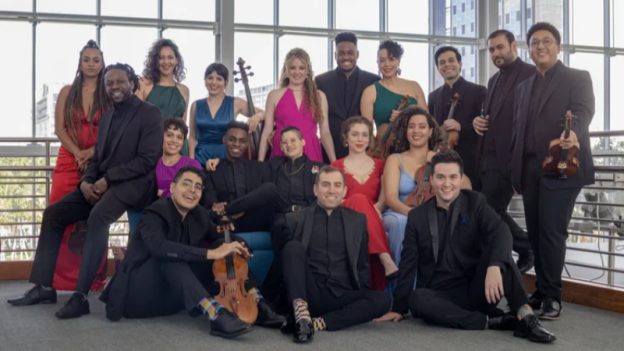
The Sphinx Virtuosi, the flagship conductorless chamber orchestra of the Sphinx Organization, delivered a thoughtfully curated performance on Thursday at Emory University’s Schwartz Center for Performing Arts in Atlanta as part of the Candler Concert Series. Featuring cellist Sterling Elliott as soloist, the ensemble presented its “Visions of Peace program”—a thematic exploration of conflict, resilience, reconciliation, and unity through a blend of historical works, contemporary commissions, and bold arrangements.
The concert opened with José White Lafitte’s La Bella Cubana (arr. Robert Debbaut), a charming habanera originally composed in the 19th century by the Afro-Cuban violinist and composer (1836–1918). The lyrical, dance-infused melody—rooted in Cuban rhythms and spread across the string sections—served as an inviting, joyful entry point. The arrangement allowed the ensemble’s collective virtuosity to shine in melodic solos, setting a tone of cultural vibrancy and historical reclamation that aligns with Sphinx’s mission to elevate underrepresented voices.
This transitioned seamlessly into a pair of selections from Clarice Assad’s Impressions (“II. Fusion, Dança Brasileira” and “IV. Precision, Perpetual Motion”). Assad’s suite infuses classical string textures with Brazilian rhythmic vitality—hints of choro, samba, and salon dances—creating a lively dialogue between tradition and innovation. The “Dança Brasileira” movement brought infectious energy through syncopated grooves and colorful orchestration, while Perpetual Motion delivered relentless drive and precision, showcasing the Virtuosi’s tight ensemble cohesion and rhythmic agility.
Jessie Montgomery’s Chemiluminescence(co-commissioned by the Sphinx Organization, New York Philharmonic, and Bravo! Vail) followed as a luminous highlight. Premiered in 2025, the work evokes “light emitting from a non-light source”—an unexpected wonder—through shimmering, ethereal textures and gradual builds that suggest luminescence emerging from darkness. The piece’s subtle harmonic shifts and luminous string writing provided a moment of introspective beauty, contrasting the preceding rhythmic fervor and foreshadowing the program’s deeper reflections on hope amid adversity.
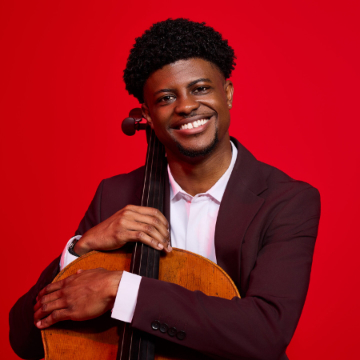
Sterling Elliott (credit: Titilayo Ayangade)
The first half culminated in William Grant Still’s Suite for Violin or Cello and String Orchestra arranged by violinist Randall Goosby, with cellist Sterling Elliott as soloist. Drawing from Still’s original Suite for Violin and Piano, the three movements—”African Dancer,” “Mother and Child,” and “Gamin—infuse African American vernacular elements with orchestral elegance. Elliott’s warm, expressive tone brought poignant lyricism to the tender “Mother and Child” and spirited character to the outer movements, while the Virtuosi provided sensitive, idiomatic support. This performance underscored Still’s pioneering role in American classical music and the arrangement’s effectiveness in translating intimate piano textures to the string ensemble.
When the Sphinx Virtuosi perform it again this Saturday (February 21) at the University of Georgia’s Performing Arts Center in Athens, Georgia, Goosby, the arranger, who is a prominent rising solo violinist as well as a member of the Virtuosi, will be the featured soloist.
After intermission, Quenton Blache’s Visions of Peace (co-commissioned by the Sphinx Organization, Carnegie Hall, and New World Symphony) took center stage as the program’s thematic core. Composed by the young cellist-composer, also a member of the Sphinx Virtuosi, the work envisions reconciliation and unity through hopeful, expansive string writing—likely incorporating lyrical arcs and harmonic resolutions that evoke a sense of shared humanity. It offered an optimistic counterpoint to the preceding reflections on struggle.
The program then turned to Sergei Prokofiev’s Piano Sonata No. 7 in B-flat Major, Op. 83 “Stalingrad”arranged by Rubén Rengel. One of the composer’s “War Sonatas” from 1942, dedicated to friends lost in conflict. Rengel’s arrangement for string orchestra reimagines the sonata’s harrowing intensity—the restless “Allegro inquieto,” brooding “Andante caloroso,” and ferocious “Precipitato”—through layered string sonorities. The ensemble captured the work’s angular rhythms, emotional weight, and explosive energy, transforming a solo piano masterpiece into a communal meditation on war’s anguish and the resilience that follows. This was, for me at least, the pinnacleof the concert, a convincing, ear-opening transcription of Prokofiev’s work.
The evening closed with Manuel Ponce’s beloved Estrellita (also arranged by Rubén Rengel), a gentle, nostalgic Mexican serenade rendered in lush, romantic string textures. It provided a tender, affirming resolution—evoking a small star of hope after the storm.
The concert’s design was one of its greatest strengths: a deliberate arc from joyful cultural affirmation to wonder and tenderness, then post-intermission confrontation with conflict (Blache’s hopeful vision, Prokofiev’s war-torn sonata), and finally gentle resolution. This progression created a narrative journey toward peace without forcing didacticism, allowing diverse voices—spanning centuries, geographies, and aesthetics—to converse organically. The inclusion of multiple Sphinx-commissioned or co-commissioned works highlighted the organization’s commitment to new music and emerging talents like Blache and Montgomery, while arrangements by Goosby and Rengel demonstrated creative adaptability in recontextualizing classics for chamber strings.
Throughout, the Sphinx Virtuosi performed with characteristic precision, passion, and unity. Elliott’s solo contribution added depth and emotional immediacy. In an era when classical programming often grapples with relevance, this concert stood out for its intellectual rigor, emotional range, and unapologetic optimism: music as an emissary of peace, resilience, and shared humanity. ■
EXTERNAL LINKS:
- Sphinx Virtuosi: sphinxmusic.org/sphinx-virtuosi
- Sterling Elliott: sterlingelliott.com

Read more by Mark Gresham.



.png)