

February 21, 2026
Jones Hall
Houston, Texas – USA
Houston Symphony, Juraj Valčuha, conductor; Alexi Kenney, violin (Houston Symphony debut).
Sofia GUBAIDULINA: In Tempus Praesens (“For the Present Time”) (2006)
Augusta HOLMÈS: “La Nuit et l’Amour” from Ludus pro Patria (1888)
Pyotr Ilyich TCHAIKOVSKY: Romeo and Juliet Overture-Fantasy (1869)
Alexander SCRIABIN: Le Poème de l’extase (The Poem of Ecstasy), Op. 54 (1908)
Lawrence Wheeler | 23 FEB 2026
Music Director Juraj Valčuha returned to Jones Hall for the second concert of the Houston Symphony’s “Doomed Lovers” Festival. Violinist Alexi Kenney was the soloist in Sofia Gubaidulina’s In Tempus Praesens. The program also included a short work by Augusta Holmès and The Poem of Ecstasy by Alexander Scriabin, with Pyotr Ilyich Tchaikovsky’s Romeo and Juliet Overture-Fantasy providing the explicit link to the festival’s “doomed lovers” theme.
Sofia Gubaidulina passed away last March at age 93. One of the most adventurous and distinctive composers of the past half-century, her music is not confined by traditional concepts of harmony and rhythm. For Gubaidulina, rhythm operates as a structural foundation, while pitch clusters frequently supplant conventional tonal centers and triadic harmony. Hearing her music is a process of discovery.
In an adventurous—if not courageous—decision, the Violin Concerto opened the program. It is not an easy work to absorb, nor is it intended to be. Gubaidulina employs elements of the Fibonacci sequence and the golden ratio, shaping the concerto in a pyramidal form, with sections articulated by tam-tam rolls. At its apex stands an episode of ritual sacrifice—the Crucifixion—derived from the final chorale of Johann Sebastian Bach, written on his deathbed. As Gubaidulina described it, “The integral experiencing of this pyramidal form produces lasting present time.”
The composer juxtaposes dissonant clusters and consonant chords; fluid, loosely woven rhythms and sharply defined pulses (“consonant rhythm and dissonant rhythm”); clear melodic lines and those obscured by trills and her characteristic glissandos. The writing feels improvisatory, yet every detail is meticulously notated. The solo violin and orchestra exist largely in opposition—the individual versus society—a duality traceable to the Baroque concerto grosso and its ritornello structure. Moving from darkness toward light, the concerto achieves consensus—or perhaps resignation—only in its final moments.
The scoring is striking: a large orchestra—without violins. Four solo violas carry the viola writing. In addition to full winds, the score calls for two harps, five percussionists, three Wagner tubas, celesta, cembalo, piano, and amplified harpsichord (largely inaudible in performance). The absence of orchestral violins creates a distinctive timbral separation, heightening the soloist’s individuality.
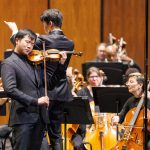
Making his Houston Symphony debut, Kenney offered a demonstrative—even theatrical—performance. His clear tone and impeccable intonation carried him through the concerto’s formidable technical demands with conviction and expressive commitment. The cadenzas unfolded with dramatic narrative shape. A master colorist, Kenney delivered an interpretation worthy of comparison with the finest recorded accounts.
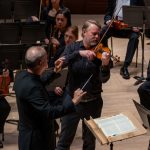
Valčuha maintained firm command of the complex, multi-layered score, his precise beat and abundant cues ensuring cohesion. Contemporary idioms present no obstacle to his technique. The Houston Symphony musicians responded in kind. Notable moments included a deft piccolo–xylophone pairing, a sharply timed slapstick crack at a climactic point, and fearless high horn punctuations executed with remarkable assurance. Audience response to this modern masterpiece was, perhaps unsurprisingly, mixed.
After intermission, the violins returned for La Nuit et l’Amour (“Night and Love”) by Augusta Holmès. Composed in 1888 as part of a cantata—at a time when Paris favored opera and ballet over symphonic music—the piece offers a graceful, French-inflected lyricism. The Houston Symphony cello section rendered its principal melody beautifully. Still, the music’s sweetness borders on the cloying, and it felt somewhat out of place on an otherwise serious program. Valčuha, ever the consummate professional, shaped it with care.
Tchaikovsky’s Romeo and Juliet Overture-Fantasy frames Shakespeare’s tragedy through the solemn voice of Friar Laurence, suggested at the outset by organ-like sonorities. The friar’s theme yields to the impassioned narrative: a tender love theme for the young couple, borne aloft by harp arpeggios of destiny; and the vehement Montague–Capulet conflict, underscored by crashing cymbals and martial intensity. The score contains one of the most beloved love themes in the symphonic repertory, here expansively shaped by Valčuha.
In the recapitulation, Valčuha observed tempo relationships often neglected, carefully alternating between love and conflict themes to heighten dramatic tension. His command of the score was authoritative. While the orchestra played admirably, the presence of numerous substitute string players resulted in ensemble that lacked its customary precision.
The Poem of Ecstasy combines Scriabin’s connection between mysticism and the erotic. Throughout the piece, the harmonies are replete with yearning and tension. Using whole-tone chords, he avoids harmonic resolution until the final note. Expressive flute, violin, and cello solos provided intimacy. A full brass section—including eight French horns—supplied immense power. Principal trumpet Mark Hughes introduced the work’s three principal themes with gleaming tone and confident projection. Valčuha paced the mounting intensity with expert skill, driving the performance to a thrilling, incandescent conclusion. ■
EXTERNAL LINKS:
- Houston Symphony: houstonsymphony.org
- Juraj Valčuha: jurajvalcuha.com
- Clara-Jumi Kang: alexikenney.com

Read more by Lawrence Wheeler.


.png)