
September 24–27, 2026
Jarvis Opera Hall, DePaul University
Chicago, Illinois – USA
Haymarket Opera Company & The Newberry Consort; Craig Trompeter and Liza Malamut, co-artistic directors; Chase Hopkins, stage director and Haymarket general director; Kimberly McCord, Zachary Wilder, Emily Mwila, Hannah De Priest, Emily Fons, Alexis Peart, Ryan Belongie, Patrick Kilbride, Michael St. Peter, Evan Bravos, Jonathan Woody, Leo Radosavljevic, Dorian McCall and David Govertsen.
Claudio MONTEVERDI: L’Orfeo (1607)
Michael Moore | 1 OCT 2026
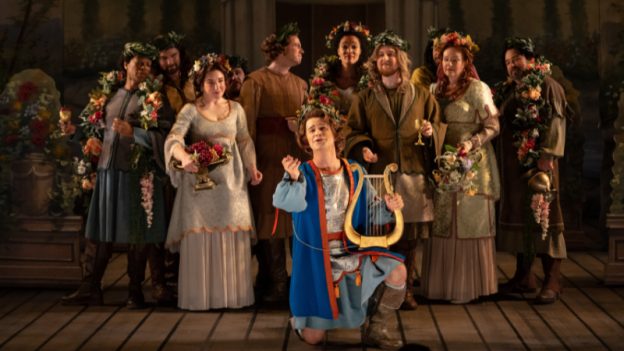
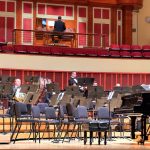
From September 24–27, 2026, I had the distinct privilege of attending all four performances of Monteverdi’s seminal L’Orfeo—a work that has remained a personal favorite since my late teens. This production was a collaboration between two titans of the Chicago Early Music scene: the Haymarket Opera Company and the Newberry Consort, staged in the intimate 160-seat Jarvis Opera Hall at DePaul University. First commissioned as a Carnival piece for the Gonzaga Ducal Palace in 1607, L’Orfeo stands as the earliest complete opera in the modern sense. Its enduring appeal has been bolstered over the centuries by key revivals, notably by Vincent d’Indy in 1904 and Nikolaus Harnoncourt’s definitive 1978 Zürich film, and over 50 recordings and videos. In 2026 alone, the work has seen seven major worldwide productions, with further stagings slated for 2027.
For those drawn to third-relation chord progressions, intense chromaticism, and the rhythmic vitality of “mixed meter” dance, Monteverdi’s three extant operas are essential. With L’Orfeo, Claudio Monteverdi pioneered the seconda pratica, vaulting the musical world from the late Renaissance into the dawn of the Baroque. While his madrigals and choral works alone secure his place in the musical pantheon, L’Orfeo represents a stroke of genius that transformed the Florentine Camerata’s intellectual revival of Greek theatre into a structured, emotive genre. Through-composed and devoid of traditional breaks, the work flows seamlessly for approximately two and a half hours, making it frustratingly impossible to applaud the many “show-stoppers” in the moment. Maestro Craig Trompeter’s pacing was brilliant, offering subtle variations across the four nights, while his new English supertitles mirrored the original Italian with impressive nuance.
Having recently attended William Kentridge’s version at Glyndebourne (complete with picnic), I found myself overwhelmed by the sensory overload of Kentridge’s modernized visual elements; it was a production best enjoyed with eyes closed. By contrast, the Haymarket production was a relief in its restraint. Wendy Washout-Barrett’s elegant sets and Stephanie Cluggish’s historically accurate costumes, paired with Megan Pirtle’s period makeup and wigs, transported the audience to mythical Thrace and the Underworld. In an era where companies often insist on “modernizing” classics to presumably attract audiences—exemplified by recent farcical interpretations of Tannhäuser including a clown costume and Burger King parking lot—this production’s commitment to the original context was refreshing and effective.
The production’s scale was impressive, involving roughly 75 artists and technicians. Co-Artistic Directors Craig Trompeter and Liza Malamut masterfully led the 25-piece orchestra. The brass section—comprising two cornetti and five sackbuts with some doubling—was superb, from the opening Gonzaga Fanfare to the dark energy of the second half. To accommodate the 465Hz “Venetian” pitch, the virtuosic recorder parts were expertly transposed. The continuo section was particularly rich, featuring three theorbos, two harpsichords, a portative organ, and a rare authentic regal (which required a dedicated bellows-operator). Claire Happel-Ashe provided exquisite solos on the double harp, while the six-piece string section grounded the ensemble, with the lower strings also providing tight continuo work. Joining the orchestra were the production team of 25, the 10-person creative team, ably led by Stage Director and Haymarket General Director Chase Hopkins, and the singing cast of 15, seven of whom performed multiple roles.
The narrative arc was beautifully realized. The prologue, sung enchantingly by Kimberly McCord as La Musica, transitioned seamlessly into Act I, where tenor Zachary Wilder made a stunning Haymarket debut. Wilder “owns” the role of Orfeo, blending authentic gesture with a youthful energy that felt fresh and sincere. The early acts, filled with the bawdy duets and spirited dances of shepherds and nymphs (choreographed by Sarah Edgar), provide a stark, effective contrast to the sudden shift in the middle of Act II. When Emily Fons entered as La Messaggiera to announce Euridice’s untimely death, the atmosphere shifted instantly. Fons’ delivery was perhaps the finest I have seen in decades; her ability to convey soul-crushing sorrow was visceral (bringing me to tears in each performance). This led into Orfeo’s haunting Tu se’ morta, leaving the audience spellbound in a silence that lasted long after the first half curtain fell each night.
The journey into the Underworld in Act III was marked by a triumphant sinfonia and the steady guidance partway of Speranza (Alexis Pert). The encounter with Caronte (Jonathan Woody) was highlighted by the nasal, otherworldly timbre of Gwendolyn Toth’s regal. Orfeo’s Possente Spirto was a masterclass in virtuosity, underscored by intricate echo duets with the violins and cornetti. In Act IV, the sensuality of Hannah de Priest as Proserpina provided a luminous contrast to the imposing Plutone (David Govertsen) who nonetheless agrees to allow Orfeo to collect his bride and return to the land of the living- with the caveat that If Orfeo sees as much as a glance of Euridice enroute they will lose each other for eternity. (We all know how that turned out!)
New Zealand–Zambian soprano Emily Mwila, with only 36 measures in the entire opera, delivered every one of them brilliantly.
The finale returned to the fields of Thrace. After a lengthy, passionate recitative in which Orfeo laments his loss, his father, the god Apollo (Evan Bravos), arrives to offer a celestial resolution. The difficult duet Saliam contan d’al Cielo was handled with technical precision, leading into a lively final sinfonia and a spirited Moresca, capped by Liza Malamut’s brilliant tambourine work. It is worth noting that in the very first version, Orfeo displayed rage and contempt for all other women, leading Bacchus’s female worshipers to tear him limb from limb. Fortunately, Monteverdi soon adopted a more consoling conclusion.
Combined with a season-opening performance by the Chicago Symphony under their impressive young Maestro Klaus Mäkelä, this week was a highlight of my musical life offstage. To witness L’Orfeo evolve over four consecutive nights was a rare thrill. The Haymarket Opera Company remains a national treasure, and their collaboration with the Newberry Consort—who coincidentally continues their wonderful tradition of partnering with our own Atlanta Baroque Orchestra—proves that Chicago is a premier destination for the authentic realization of Baroque masterpieces.
■
EXTERNAL LINKS:
- Haymarket Opera Company: haymarketopera.org
- The Newberry Consort: newberryconsort.org
- Zachary Wilder, tenor: zacharywilder.com
- Emily Fons, mezzo-soprano: emilyfons.com

Read more by Michael Moore.

.png)