The Pulitzer Prize-winning opera by Kevin Puts and Mark Campbell revisits the 1914 Christmas Truce through an expansive theatrical canvas and an intimate portrait of soldiers on opposing sides
November 7, 10, 13 & 15, 2026
Cobb Energy Performing Arts Centre
Atlanta, Georgia – USA
Kevin PUTS: Silent Night
Iván López Reynoso, conductor; Tomer Zvulun, production director; Mark Campbell, librettist. Cast: Susanne Burgess (Anna Sørensen), Kameron Lopreore (Nikolaus Sprink), Luke Sutliff (Lt. Audebert), Aleksey Bogdanov (Lt. Horstmayer), Jonathan Bryan (Lt. Gordon), Christian Sanders (Jonathan Dale), Wayd Odle (Kronprinz), Mark Diamond (Father Palmer), Joseph Lattanzi (William Dale), Edward Nelson (Ponchel), David Crawford (British Major), Wayne Tigges (French General), Page Michels (Madeleine Audebert). Creative: Erhard Rom, scenic & projection designer; Vita Tzykun, costume designer; Robert Wierzel, lighting designer; Conor Hanratty, associate director; Lindsey Ewing, wig & makeup designer; Jacobsen Woollen, assistant conductor; Gregory Luis Boyle & Madeleine Snow*, assistant directors; Daniel Chervinsky, chorus master. [*Studio Artist]
Mark Gresham | 10 NOV 2026
Above all I am not concerned with Poetry.
My subject is War, and the pity of War.
The Poetry is in the pity.
—Wilfred Owen (1918)
The battlefield in Silent Night is a place of terrible contradictions. Men are ordered to kill one another, yet they share the same fears, the same longing for home and the same uncertainty about whether they will survive to see their families again. When, on Christmas Eve 1914, soldiers from opposing armies put down their weapons and venture into No Man’s Land, the gesture is at once extraordinary and profoundly ordinary: a brief recognition of the humanity that military necessity has sought to erase.
The Atlanta Opera’s production, directed by general and artistic director Tomer Zvulun, approaches this episode of World War I history through an expansive theatrical conception that increasingly draws the audience into the soldiers’ immediate experience. Kevin Puts’ opera, with a libretto by Mark Campbell, received the 2012 Pulitzer Prize for Music. Based on the 2005 French film Joyeux Noël, it moves among French, German and Scottish soldiers, tracing the events that lead to the spontaneous Christmas cease-fire and its eventual suppression by military authorities.
The opera begins by establishing the personal lives that war will disrupt. An opera singer, Anna Sørensen (Susanne Burgess), and her partner, Nikolaus Sprink (Kameron Lopreore), are caught up in Germany’s mobilization; in Scotland, young Jonathan Dale (Christian Sanders) enlists alongside his brother William (Joseph Lattanzi); and French Lieutenant Audebert (Luke Sutliff) faces separation from his pregnant wife, Madeleine (Page Michels). These parallel stories give the conflict a human dimension before the soldiers ever reach the battlefield.
Puts’ polystylistic score moves with cinematic fluency between the brutality of battle and the stillness of the truce. Percussion-driven dissonances and machine-gun textures give way to luminous strings, harp ostinatos, and impressionistic interludes. Music also functions within the drama itself, establishing the cultural identities of the three armies before gradually becoming a means of communication across them. Campbell’s multilingual libretto is central to this structure. The largely continuous vocal writing remains singable and textually clear, while the orchestra supports intimate exchanges without sacrificing the force of larger ensembles. The multilingual “Sleep” chorus, Audebert’s spare listing of the dead, and the burial sequences stand out for their emotional precision.
Under the baton of Iván López Reynoso, the Atlanta Opera Orchestra brought both the score’s martial edge and lyric transparency into clear focus, balancing the large ensembles with the more intimate passages so that the singers remained consistently audible and the cinematic shifts registered with precision.
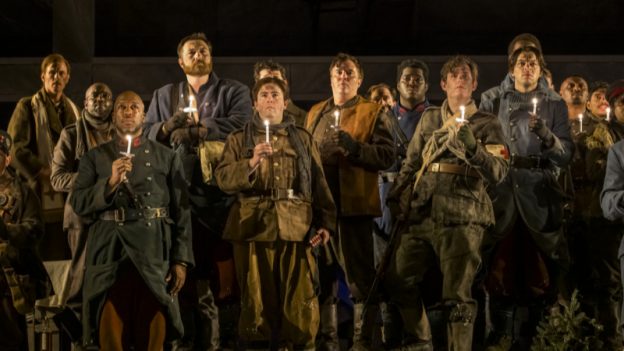
The dramatic turning point comes on Christmas Eve, when music crosses the battlefield before the soldiers do. A Scottish bagpiper and the singing of Father Palmer (Mark Diamond) draw responses from the German position. Nikolaus, returning from a performance with Anna, raises a Christmas tree above the German bunker. Cautious exchanges of greetings and gifts gradually develop into a gathering in No Man’s Land. Soldiers share food, photographs and stories; Father Palmer celebrates Mass in an improvised church. For a brief interval, men who have been trying to kill one another recognize their common humanity.
The principal cast gives this transformation its personal dimension. Burgess and Lopreore establish the opera’s central romantic connection as Anna and Nikolaus, their contrasting characters bound by a shared artistic life disrupted by war. Burgess brings a bright, flexible soprano and poised dramatic presence to Anna, while Lopreore’s warm, well-projected tenor conveys Nikolaus’ conflict between artistic vocation and military duty.
Sutliff gives French Lieutenant Audebert a focused baritone and understated dignity, conveying the officer’s growing moral unease. Aleksey Bogdanov’s darker vocal color and tighter characterization distinguish German Lieutenant Horstmayer, whose professional rigidity gradually gives way to mutual recognition. Jonathan Bryan completes the trio as Scottish Lieutenant Gordon, making the officer’s transition from suspicion to reluctant respect convincing. Among the supporting cast, Edward Nelson’s Ponchel makes a particularly strong impression, bringing comic timing and a communicative tenor to the French side without diminishing the larger drama.
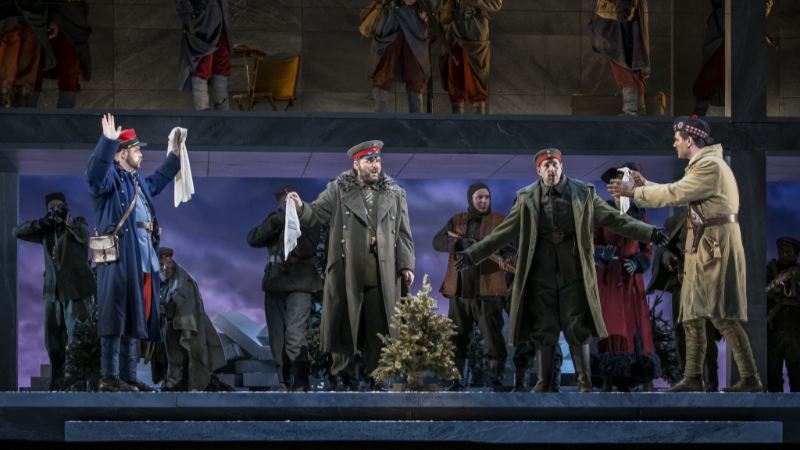
From left to right, Luke Sutliff as French Lt. Audebert, Aleksey Bogdanov as German Lt. Horstmeyer, Kameron Lopreore as Nikolaus Sprink, and Jonathan Bryan as Scottish Lt. Gordon meet in No Man’s Land. (credit: Raftermen)
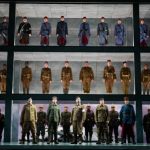
The ensemble is equally important to the opera’s success. Its members function both as individual soldiers and as a collective presence, making the battlefield’s transformation into a temporary community feel credible. Erhard Rom’s set design and Zvulun’s staging give the three armies a strikingly literal vertical separation: the Scots occupy the uppermost tier across the back of the stage, the French the middle, and the Germans the ground-level trench below. The projections and cinematic effects are especially striking in the early battlefield sequence, where rapidly shifting images amplify the violence and disorientation of combat, extending the battlefield beyond the physical confines of the set. This arrangement makes the divisions between the armies immediately visible, lending greater theatrical force to their eventual convergence in No Man’s Land.
The truce, however, cannot last. By December 26, military authorities have learned what happened and begin dispersing the soldiers. Jonathan, whose brother William has died, is drawn back into the violence when he shoots a German soldier under orders; tragically, it is Ponchel in disguise, trying to make his way back from his mother’s house across German lines. Audebert faces transfer to another front, while Anna and Nikolaus seek refuge across enemy lines. The soldiers are separated, and the battlefield returns to its former purpose.
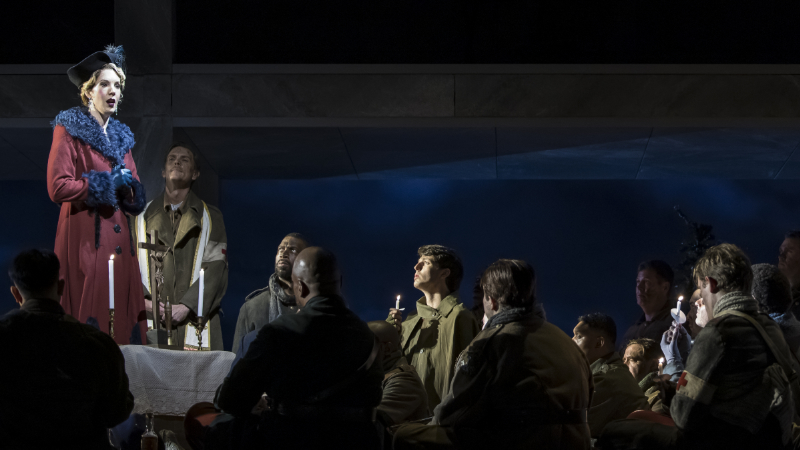
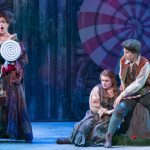
Susanne Burgess, far left, as Anna Sørensen sings to the troops. (credit: Raftermen)
This refusal of an easy resolution is essential to the opera’s meaning. The Christmas Truce did not end the war, nor did it permanently alter the institutions that sent these men to fight. Instead, it offered a brief demonstration of what became possible when military allegiance gave way to personal recognition. The production makes that distinction compelling. In the final sequence, the swift succession of orders, punishments, and departures has an emotional force of its own: the truce’s fragile community seems to disappear almost as quickly as it came into being, leaving the sense of a loss that the characters—and the audience—have scarcely had time to absorb.
More than a century after the event it commemorates, Silent Night remains a work about the distance between the institutions that wage war and the individuals required to fight it. The Atlanta Opera’s production brings that distinction into personal focus, reminding us that recognizing the humanity of an enemy may not end a war, but it can momentarily reveal what war threatens to destroy. ■
EXTERNAL LINKS:
- The Atlanta Opera: atlantaopera.org
- Kevin Puts: kevinputs.com
- Mark Campbell: markcampbellwords.com
- Iván López Reynoso: ivanlopezreynoso.com
- Tomer Zvulun: tomerzvulun.com
- Erhard Rom: erhardrom.com
- Susanne Burgess: susanneburgess.com
- Kameron Lopreore: kameronlopreore.com
- Luke Sutliff: lukesutliffbaritone.com
- Aleksey Bogdanov: alekseybogdanov.com
- Jonathan Bryan: jonathanbryanbaritone.com

Read more by Mark Gresham.