October 31, 2026
Spivey Hall, Clayton State University
Morrow, Georgia – USA
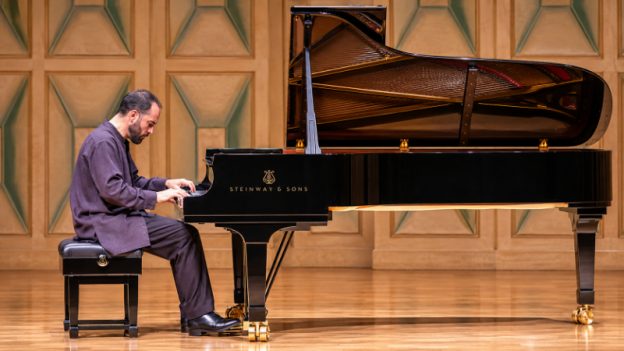
Igor Levit, piano.
Ludwig van BEETHOVEN: Piano Sonata No. 1 in F minor, Op. 2, No. 1
Ludwig van BEETHOVEN: Piano Sonata No. 17 in D minor, Op. 31, No. 2, The Tempest
Ludwig van BEETHOVEN: Piano Sonata No. 25 in G major, Op. 79
Ludwig van BEETHOVEN: Piano Sonata No. 21 in C major, Op. 53, Waldstein
William Ford | 3 NOV 2026
Spivey Hall has long been one of metropolitan Atlanta’s great musical treasures, a recital venue whose extraordinary acoustics can reveal the finest details of a performance. On October 31, internationally acclaimed pianist Igor Levit returned to the hall for an afternoon devoted entirely to Beethoven. The audience filled approximately 60 percent of the seats, and unfortunately, it was a rather noisy gathering. Frequent coughing punctuated the music, an especially noticeable intrusion in a hall where even the softest pianissimo can be heard with remarkable clarity.
There was also an unexpected moment of comedy when someone’s phone rang. Levit immediately identified its key as D minor, the same key as Beethoven’s “Tempest” Sonata, which was next on the program. His observation drew an appreciative chuckle from the audience, turning an irritating interruption into a moment of shared amusement.
I approached the recital with some trepidation. Four Beethoven piano sonatas, however magnificent individually, represent a substantial concentration of one composer’s musical language. Only three days earlier, I had attended a concert at Emory University’s Schwartz Center devoted entirely to the chamber music of Eleanor Alberga. That experience had raised a question that seemed equally applicable here: Does an evening devoted to one composer deepen our understanding, or does it eventually become too much of a good thing? Even Beethoven, surely, must have his limits.
Born in Nizhny Novgorod, Russia, in 1987, Levit moved to Germany with his family at age eight and has established himself among the leading pianists of his generation. His 2019 recording of Beethoven’s complete 32 piano sonatas confirmed a particularly close artistic relationship with the composer, making him an ideal interpreter for a program of this kind.
The afternoon offered four contrasting examples of Beethoven’s remarkable musical imagination.
- Piano Sonata No. 1 in F minor, Op. 2, No. 1 (1795). Beethoven’s first published piano sonata combines Classical elegance with restless energy, sharp dynamic contrasts, and rhythmic urgency. Its four movements range from the tightly organized opening Allegro to a lyrical Adagio, a vigorous Minuet, and a turbulent finale. The work retains the formal clarity of the Classical sonata while introducing a more forceful dramatic character.
- Piano Sonata No. 17 in D minor, Op. 31, No. 2, “Tempest” (1802). The “Tempest” alternates mysterious, hesitant passages with sudden eruptions of dramatic intensity. Unexpected silences, recitative-like passages, and abrupt changes in tempo and dynamics create an atmosphere of tension and uncertainty. The restless, flowing finale provides a striking contrast to the interruptions and dramatic contrasts of the opening movement.
- Piano Sonata No. 25 in G major, Op. 79 (1809). Sometimes called the “Cuckoo” Sonata, this brief three-movement work offers a welcome change of character. Its playful opening, gently melancholy slow movement, and spirited finale combine rhythmic vitality with melodic simplicity. The sonata’s compact proportions and lighthearted character provide a contrast to the larger, more dramatically intense works on the program.
- Piano Sonata No. 21 in C major, Op. 53, “Waldstein” (1803–1804). The “Waldstein” combines dazzling virtuosity with expansive musical architecture. Its driving opening movement develops from rapidly repeated chords into passages of lyrical breadth, while a brief, contemplative introduction leads directly into the radiant finale. The work’s wide dynamic range, brilliant keyboard writing, and extended development give it a scale and intensity that distinguish it from Beethoven’s early sonatas.
For me, what emerged during the afternoon was a renewed appreciation for Beethoven’s genius as a master of musical development and contrast. His ability to take a relatively simple musical idea and transform it through changes in rhythm, harmony, dynamics, and texture remains astonishing. Levit made these processes exceptionally vivid, revealing the composer’s imagination through playing that combined formidable technical command with an almost theatrical intensity.
Indeed, Levit seemed physically at one with the music. His movements at the keyboard frequently suggested that he was acting out Beethoven’s dramatic intentions. At one sudden transition from forte to piano, he placed a finger before his lips, as though instructing his own fingers to be quiet. Elsewhere, he raised a fist to his mouth in an expression resembling astonishment. During a lyrical passage, his free left hand moved as though conducting an invisible ensemble. At another moment, his right hand swept across the keyboard as if brushing away an imaginary speck of dust.
Beethoven is already a dramatic composer. Levit seemed inclined to add another 20 percent.
Such gestures might easily become distracting in the hands of a lesser musician. With Levit, however, they appeared closely connected to the musical expression. His command of dynamics was exceptional, with powerful fortissimos giving way almost instantaneously to the most delicate pianissimos.
At the conclusion of the “Waldstein”’s first movement, the gentleman seated beside me released an audible sigh, as though he had been holding his breath throughout. It was a small but telling indication of the tension Levit had sustained and the release that followed.
Perhaps most impressive was Levit’s ability to sustain a coherent musical narrative. His playing illuminated the architecture of the sonatas while preserving their spontaneity and emotional force.
As an encore, Levit offered one of Mendelssohn’s Songs Without Words, providing an opportunity to appreciate another dimension of his musicianship. His physical demeanor became noticeably more restrained, and the emphasis shifted from Beethoven’s dramatic volatility to the delicate shaping of a lyrical melody. It was a lovely contrast to the intensity of the preceding program.
By the end of the afternoon, my initial concern about an all-Beethoven recital had disappeared. Rather than becoming tiresome, the program grew increasingly rewarding. Levit had delivered a great recital, demonstrating that technical brilliance and interpretive imagination can make even the most familiar masterpieces compelling
Once again, Spivey Hall has demonstrated its ability to attract the world’s finest soloists. As new performing arts venues emerge across metropolitan Atlanta, including spaces dedicated to chamber music, it is difficult to imagine any surpassing Spivey’s extraordinary acoustics. Competition can enrich the region’s cultural life, and Atlanta is certainly large enough to support multiple venues. Still, one hopes that Spivey Hall will maintain its distinctive place in the musical landscape and continue to enjoy the international reputation it has so richly earned. ■
EXTERNAL LINKS:
- Igor Levit: igor-levit.com
- Spivey Hall: spiveyhall.org

Read more by William Ford.