October 29, 2026
Schwartz Center for Performing Arts, Emory University
Atlanta, Georgia – USA
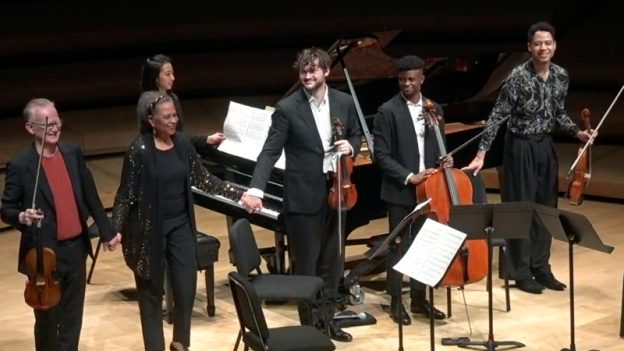
The Green Room Ensemble: Thomas Bowes and Nathan Meltzer, violins; Jordan Bak, viola; Sterling Elliott, cello; Eleanor Alberga, piano.
Eleanor ALBERGA: String Quartet No. 1 (1994)
Eleanor ALBERGA: Piano Quintet No. 2, Stark (2022)
Eleanor ALBERGA: String Quartet No. 3 (2001)
Eleanor ALBERGA: String Quartet No. 2 (1994)
William Ford | 2 NOV 2026
Eleanor Alberga is a Jamaican-born British composer whose music reveals a fertile imagination, a fascination with instrumental textures, and an unmistakable appetite for rhythmic energy. Yet her ability to develop these elements into coherent and compelling musical structures varies considerably. This unevenness was evident during the Green Room Ensemble’s October 29 performance at Emory University’s Schwartz Center for Performing Arts, a program devoted entirely to Eleanor Alberga’s three string quartets and her Second Piano Quintet.
Insistent staccato writing built tension, followed by renewed fragmentation and piano-driven turbulence.
An attractive exchange between viola and piano, subsequently taken up by the cello, offered a moment of genuine musical interest. At other points, the music became almost ethereal or intensely animated. Yet throughout its approximately twenty-minute duration, Alberga returned repeatedly to the same vocabulary: isolated string notes, brief bowed gestures, pizzicato punctuations, and rapid, scurrying piano figures. Changes in intensity and instrumental color provided variety without much apparent development. Ultimately, the work became tedious, its considerable surface activity failing to establish a persuasive musical trajectory.
The String Quartet No. 3 (2001) revealed a different side of Alberga’s imagination. Its opening movement featured longer, more sustained violin phrases, creating an atmosphere of passion and apprehension despite the dissonant harmonic language. The movement ended quietly, with rapid pianissimo figures in the violins, an effective conclusion that preserved the prevailing tension without an emphatic gesture.
The second movement returned to the jagged, frenetic writing heard in the earlier works. But the third movement was a revelation. Beginning with something approaching conventional melody, the music gradually accumulated energy and volume. Fleeting lyrical passages, at times suggestive of Sibelius-like late Romanticism, emerged alongside Alberga’s characteristic angular figures. Here, those gestures seemed integrated into a developing musical argument. The movement possessed an expressive continuity and structural purpose largely missing from the preceding music. It was among the evening’s most convincing achievements.
The concluding String Quartet No. 2 (1994) was the most satisfying complete work on the program. Its musical language was noticeably more coherent, with ideas building naturally upon one another rather than appearing as isolated events. Greater use of unison playing reinforced the sense of ensemble unity, while vigorous, technically demanding passages generated genuine forward momentum.
Particularly striking were moments when the dissonant writing gave way to unexpected tonal warmth and harmonic richness. These contrasts seemed organically connected to the surrounding material. The substantial, dramatic finale placed formidable demands on the musicians, bringing the quartet to an exhilarating and convincing conclusion. For once, Alberga’s rhythmic energy and instrumental imagination were fully supported by musical architecture.
The Green Room Ensemble, a chamber music collective that brings together accomplished musicians in changing combinations, deserves considerable credit for undertaking such a demanding program. Violinists Thomas Bowes and Nathan Meltzer, violist Jordan Bak, and cellist Sterling Elliott navigated music filled with abrupt rhythmic changes, intricate exchanges, and formidable technical challenges. Alberga joined them at the piano for the quintet. The ensemble approached the evening with energy, precision, and commitment, particularly impressive in the physically demanding final quartet.
The auditorium was about 60 percent full at the start of the concert, and a noticeable number of patrons left at intermission. Whether their departures reflected reactions to the music or other considerations is impossible to know, but the evening clearly presented considerable demands on its audience as well as its performers.
Perhaps Alberga deliberately favors the immediate experience of musical sound over conventional ideas of thematic development and structural progression. There is certainly room for such an aesthetic. But even music conceived as a succession of sonic events must sustain the listener’s interest over time.
The evening’s strongest moments demonstrated that Alberga can do considerably more than create arresting instrumental effects. In the Third Quartet’s final movement and throughout the Second Quartet, her ideas acquired relationships, direction, and expressive consequence. Those achievements made the less convincing works all the more frustrating.
Alberga knows how to create musical moments. Her finest music demonstrates that she also knows how to make those moments add up to something greater. ■
EXTERNAL LINKS:
- Eleanor Alberga: eleanoralberga.com
- Green Room Ensemble: greenroomensemble.org
- Schwartz Center for Performing Arts: schwartz.emory.edu

Read more by William Ford.