Oct. 23 – Nov. 8, 2026
Brown Theater, Wortham Theater Center
Houston, Texas – USA
Carlisle FLOYD: Susannah
James Gaffigan, conductor; Patricia Racette, director; Carlisle Floyd, composer and librettist. Cast: Sylvia D’Eramo (Susannah Polk), Rod Gilfry (Reverend Olin Blitch), Bille Bruley (Sam Polk), Aaron Blake (Little Bat McLean), Deborah Nansteel (Mrs. McLean), Malcolm MacKenzie (Elder McLean), Ziniu Zhao (Elder Ott), Martin Luther Clark (Elder Hayes), Luka Tsevelidze (Elder Gleaton), Elizabeth Hanje (Mrs. Gleaton), Leia Lensing (Mrs. Ott), Scarlett Jones (Mrs. Hayes). Creative: Erhard Rom, scenic and projection designer; Eric Southern, lighting designer; Michael Yeargan, costume designer; Courtney Jones, choreographer; Richard Bado, chorus director; HGO Orchestra & Chorus. A Houston Grand Opera production.
Sherry Cheng | 28 OCT 2026
Music Director Emeritus Patrick Summers has described Carlisle Floyd as the “guardian angel” of the Houston Grand Opera, a composer whose long and fruitful relationship with the company is unparalleled in American operatic history. Over the last half century, HGO has commissioned and premiered five of Floyd’s 12 operas and presented numerous other productions of his works. Along with then-General Director David Gockley, Floyd also co-founded the HGO Studio (now Butler Studio) in 1977, the pre-professional powerhouse that has trained many of today’s most accomplished opera stars. To put it simply, Carlisle Floyd’s artistic imprint is an essential strand of HGO’s DNA. Last season’s production of Floyd’s Of Mice and Men was a triumph for the emerging artists of the current Butler Studio and a fitting tribute to Floyd’s enduring legacy at HGO.
So it is only natural that the Houston Grand Opera chose to open its 2026–27 season with Floyd’s quintessentially American masterpiece Susannah, continuing the company’s centenary celebration of the American opera icon. Since its premiere in 1955 at Florida State University with the great Phyllis Curtin as the titular character, Susannah has become one of the most beloved and frequently produced American operas, second only to Porgy and Bess. A heartbreaking tale of the destruction of innocence, Susannah serves as a potent critique of mob mentality, oppressive intolerance, and religious hypocrisy. At its core, Susannah is a very human story of loneliness, vulnerability, and loss. It feels particularly relevant and devastating today, when women are still being judged and shamed for their sexuality, and religion is still being weaponized to enforce conformity.
Floyd’s libretto is based on the story of Susanna and the Elders from the Apocrypha, transplanted to New Hope Valley, a fictional rural community in the mountains of East Tennessee. Against the backdrop of summer revival meetings with a fiery visiting preacher, the dramatic action builds in quick succession to its tragic denouement. Floyd was the son of a Methodist minister and grew up going to many revival meetings. His use of plainspoken Appalachian vernacular, speech-driven rhythms, spoken dialogue and declamation, as well as folk songs and hymns, makes the story feel entirely authentic.
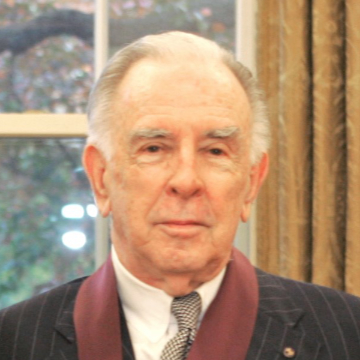
Carlisle Floyd at the White House in 2004, being presented with the National Medal of Arts (credit: Susan Sterner)
This HGO production had everything in it—gripping music, compelling singing and acting, taut visual narrative, dramatic power, and a deep emotional connection with the audience. Grammy-winning soprano Patricia Racette, who has a long personal history with the opera, brought her unique experience and insights from the other side of the curtain to her HGO directorial debut. While in college, Susannah was her first full-length role in an opera, and later on she performed the role to great acclaim in San Francisco Opera’s 2014 production.
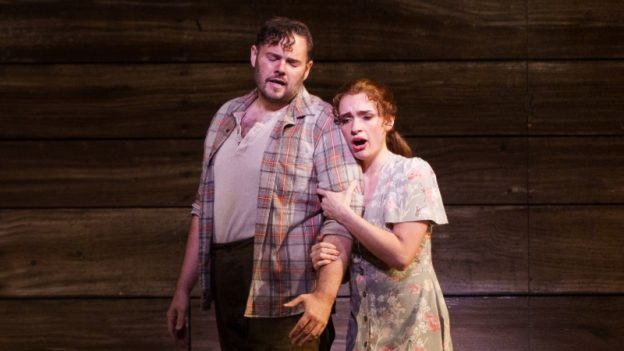
Along with set and projection designer Erhard Rom and lighting designer Eric Southern, Racette crafted a visual narrative that heightened the inner struggles of the main characters and deepened the emotional impact of the story. By using several layers of scrim for the scenic projections, the landscape melded seamlessly with the set, taking the audience from verdant forest to shimmering creek, from the spare Polk cabin to the oppressive church, from expansive mountain ridges at sunset to starlit evening skies. Visual metaphors abound—the imposing high wooden walls of the church create an almost claustrophobic effect; the ever-present cross hovers over Susannah like the sword of Damocles; the jagged crack splitting the ground represents the creek (or perhaps an opening to hell), which turns from a place of cleansing to a place of death and damnation; the cross is illuminated onto the ground in the creek scene and looms large in the interior of the church as Reverend Blitch seeks forgiveness for his sins against Susannah. Chiaroscuro lighting highlights Susannah’s vulnerability and isolation, and the dramatic blinding white light at the end announces her shocking transformation. Every visual detail actively tells the story. Credit also goes to costume designer Michael Yeargan and choreographer Courtney Jones. In the square-dancing scene, Susannah stood out in her free-flowing silk swing dress, in contrast to the other women’s plain calico cotton dresses, dancing joyfully to her heart’s content. She was a picture of innocence and freedom.
Soprano Sylvia D’Eramo, who was superb in HGO’s production of Silent Night last season, delivered a tremendous performance in her role debut as Susannah Polk. Her transformation from an innocent, fun-loving young woman full of bright dreams to a hardened, cold survivor of trauma is as convincing as it is devastating. She was radiant in the first-act aria “Ain’t It a Pretty Night,” effortlessly executing the arching vocal leaps that express her yearning for the world beyond the valley. She is expressive throughout the entire dynamic range, especially in the high notes, where she can be ardent in one moment and soften to a caress in the next. In the second-act aria “The Trees on the Mountain,” coming immediately after she endures Reverend Blitch’s terrifying sermon and the condemnation of the congregation, rejects their judgment and runs away, D’Eramo turns inward and makes visible to the audience her pain, isolation, and vulnerability. The clarity and straightforward simplicity of her delivery make this folk-like aria even more heartbreaking, knowing that the worst is still to come. Beyond her vocal range, D’Eramo also embodied a huge range of emotions as her character evolved throughout the story. She reveled in dancing and playing with her friend Little Bat, suffered in humiliation, quivered in anguish and frustration, withdrew in tiredness and resignation, and lashed out in a final rejection of society. She is a consummate actor.
Acclaimed baritone Rod Gilfry cut a charismatic figure as the conflicted Reverend Olin Blitch in his role debut. Gilfry brought complexity to the character—his confidence and self-righteousness when introducing himself in “I Am the Reverend Olin Blitch”; his moral authority and terrifying power in the rousing sermon and laying on of hands; his loneliness and weakness in “I’m a Lonely Man”; and finally his guilt and spiritual struggle as he seeks forgiveness from Susannah and from God in the prayer “Hear Me, O Lord.” His declamations were delivered with heft and clarity. Gilfry’s Blitch was not a caricature of the “fire and brimstone” traveling revivalist, but a flawed human being confronting his own moral failure.
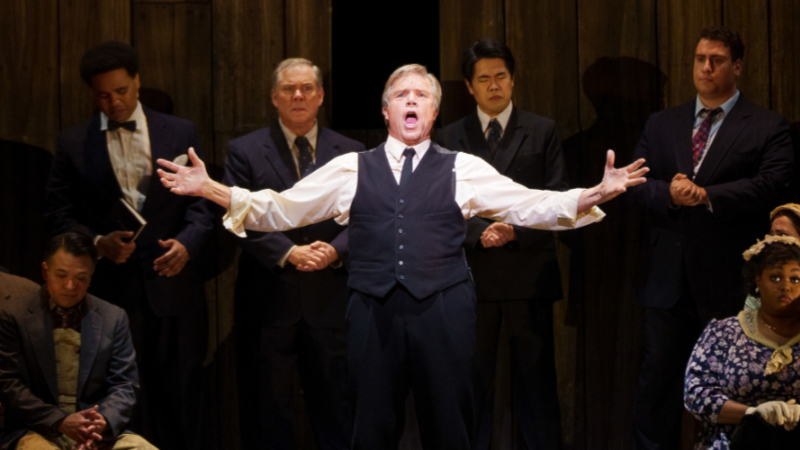
Rod Gilfry as Reverend Olin Blitch in Carlisle Floyd’s ‘Susannah’ at Houston Grand Opera. (credit: Michael Bishop)
The standout performance came from tenor Bille Bruley as Susannah’s brother Sam Polk. He shone in every scene with Susannah. His singing was open and clear, his expression honest and warm, and his Appalachian accent sounded especially natural and unaffected. He is the loving brother, singing the charming folk song “Jaybird” at Susannah’s request. When he tries to comfort her and urges her to have faith, he speaks the truth: “The Lord’s great heart must break at seeing’ how men treat one another an’ say they’re doin’ it all fer His sake.” Sam lives freely outside the oppressive community. He sees it clearly for what it is, yet he cannot protect Susannah from it, nor escape it, and in the end it drives him to commit violence.
Tenor Aaron Blake made a sympathetic Little Bat McLean. His vulnerability is visible in his crouched posture, never able to stand up for himself, always shrinking in fear. The supporting cast were all superb. The four Elders, played by Malcolm MacKenzie, Martin Luther Clark, Ziniu Zhao, and Luka Tsevelidze, were excellent in the scene where they discover Susannah bathing naked in the creek. The four Elders’ wives were clearly drawn as the spiteful, judgmental women who make Susannah’s life hell. The slightly sympathetic Mrs. Gleaton, wonderfully sung by Elizabeth Hanje, is quickly brought into line by Mrs. McLean, the harshest judge of them all. Deborah Nansteel did a superb job of portraying her severity and meanness. Every time she delivers a judgment, it sends a chill up the spine.
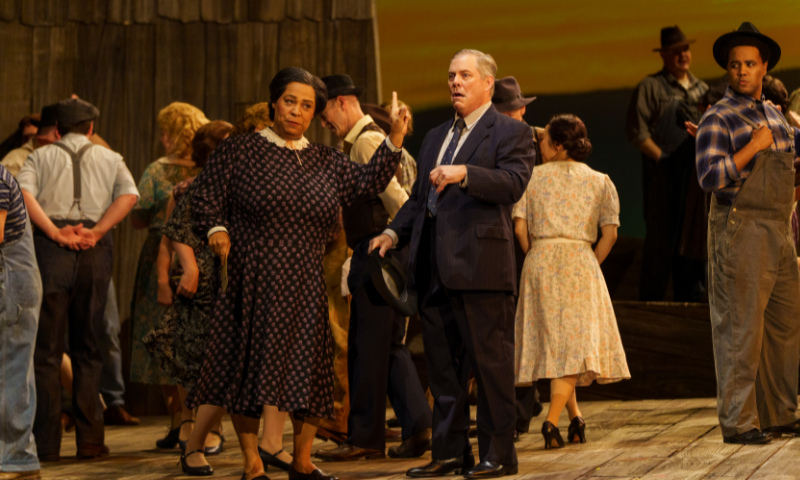
Deborah Nansteel (Mrs. McLean) and Malcolm MacKenzie (Elder McLean) in Carlisle Floyd’s ‘Susannah’ at Houston Grand Opera. (credit: Michael Bishop)
The HGO chorus was in fine form under the direction of Richard Bado. Staged as a monolithic group towering over Susannah, their powerful presence and fervor instill fear, particularly in the climactic sermon scene, as their hands create a mass of menacing shadows on the backdrop. They sing hymns with fervor, gossip maliciously in small groups, move as one in condemnation. Their collective presence is formidable, and their mob mentality is the scariest thing on stage. Susannah only triumphs over them when she instills fear, the only thing they understand.
It was Maestro James Gaffigan’s first outing as HGO Music Director Designate and also his first Susannah. He unleashed the drama and sweeping power of Floyd’s score, guiding the HGO orchestra with emotional precision and attention to detail—the sinister brass, the aching harp accompaniment that opens “The Trees on the Mountain,” the ominously inflected rhythmic motifs, and the sweeping lyricism that carries so much emotional weight. Occasionally, the swell of the orchestra overpowered the singers, particularly in their lower register. The stage was compressed and set farther back from the pit and the audience than usual, which could have affected the balance as well.
In the final scene, the audience witnesses Susannah’s devastating transformation. She is no longer a victim, but the price she pays for survival is the loss of her innocence and goodness. Susannah leaves a mark on its audience, and this production will be long remembered for its powerful emotional impact. ■
EXTERNAL LINKS:
- Houston Grand Opera: houstongrandopera.org
- Carlisle Floyd (composer and librettist): carlislefloyd.org
- James Gaffigan (conductor): jamesgaffigan.com
- Patricia Racette (director): patriciaracette.com
- Erhard Rom (scenic and projection designer): erhardrom.com
- Sylvia D’Eramo: sylviaderamo.com
- Rod Gilfry: rodgilfry.com
- Bille Bruley: billebruley.com
- Aaron Blake: aaronblaketenor.com
- Malcolm MacKenzie: malcolmmackenzie.org
- Deborah Nansteel: deborah-nansteel.com

Read more by Sherry Cheng.