October 24, 2026
Spivey Hall, Clayton State University
Morrow, Georgia – USA
Hilary Hahn, violin; Matthias Goerne, baritone; Gloria Chien, piano.
Ludwig van BEETHOVEN: Violin Sonata No. 5 in F Major, Op. 24
Ludwig van BEETHOVEN: Adelaide, Op. 46
Ludwig van BEETHOVEN: Mailied, Op. 52, No. 4
Ludwig van BEETHOVEN: Der Liebende, WoO 139
Ludwig van BEETHOVEN: An die ferne Geliebte (To the Distant Beloved), Op. 98
Reena ESMAIL: Wir (world premiere; co-commissioned by Spivey Hall)
J.S. BACH: Arias for Bass and Violin, from Liebster Jesu, mein Verlangen, BWV 32, and Der Friede sei mit dir, BWV 158
Mark Gresham | 30 OCT 2026
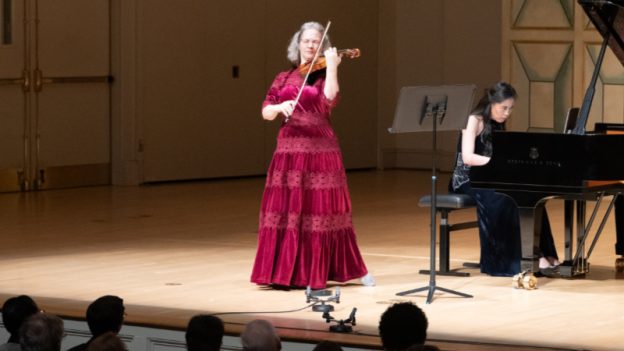
A program spanning a Beethoven violin sonata and songs, a new work by Reena Esmail, and two arias by J.S. Bach brought violinist Hilary Hahn, baritone Matthias Goerne and pianist Gloria Chien to Spivey Hall on Oct. 24 for a recital that placed a contemporary musical meditation within a framework of classical and sacred traditions.
The concert included the world premiere of Esmail’s Wir, written for Hahn and Goerne and co-commissioned by Spivey Hall and five other presenting organizations. The approximately 30-minute work sets a new text by poet and librettist Rebecca Gayle Howell alongside German-language fragments by Paul Celan. Scored for violin and voice without piano, it explores the value of silence in a world increasingly crowded by noise.
Although atypical in form, the evening unfolded as a coherent journey through successive ideas of distance and connection. The repertories never fully dissolved into one another, but the shared thematic thread of absence (the distant beloved, the lost quiet, the world one leaves behind) gave the sequence a persuasive logic.
The program opened with Beethoven’s Violin Sonata No. 5 in F major, Op. 24, commonly known as the “Spring” Sonata. Its four movements move between lyrical expansiveness, introspection, and playful energy, serving as a clear instrumental prologue that established the evening’s scale, sound world, and emotional baseline before the program turned toward voice, longing, and silence.
Once Goerne entered, the same Beethovenian lyricism was redirected toward absence. The three selected Beethoven songs — “Adelaide,” Op. 46; “Mailied,” Op. 52, No. 4; and “Der Liebende,” WoO 139 — take the warmth of the Spring Sonata and place it at a distance—love that cannot be fully reached. Especially, Beethoven’s An die ferne Geliebte (“To the Distant Beloved”), Op. 98, extended that exploration into a six-song cycle published in 1816. Rather than presenting six entirely separate songs, Beethoven links them into a continuous emotional and musical trajectory, making the work a landmark in the development of the unified song cycle.
The world premiere of Esmail’s Wir followed, bringing the recital from Beethoven’s early 19th-century concerns with love and distance into a contemporary meditation on the loss of silence. The title, German for “we,” suggests a collective rather than solitary response to that loss. Howell’s text interweaves her English poetry with fragments of Celan’s German, creating a dialogue between voices separated by language and history.
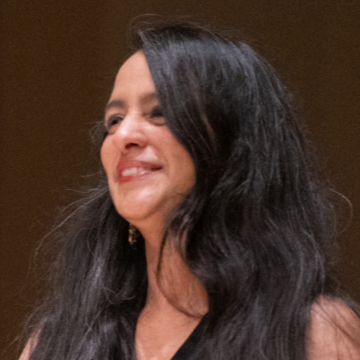
Composer Reena Esmail takes a ow at Spivey Hall after the world premiere of “Wir” at Spivey Hall. (credit: Rand Lines)
A seven-part cycle for violin and voice, Wir occupied the center of the evening. Scored without piano, the work proceeded in a series of relatively self-contained yet cumulative sections that alternate between more continuous vocal lines and passages in which the texture thins to sustained tones, isolated gestures, and deliberate silences. Dynamics remained largely restrained, and the two voices neither merged nor opposed each other, but left space in which the absence of sound carried the argument. The juxtaposition of Howell’s English with Celan’s German fragments created a measured dialogue rather than a stark collision,
While Esmail’s broader language draws on Hindustani practice, the character of Wir in this hearing felt more like a spare, contemporary idiom that treats silence and sustained sound as structural materials.
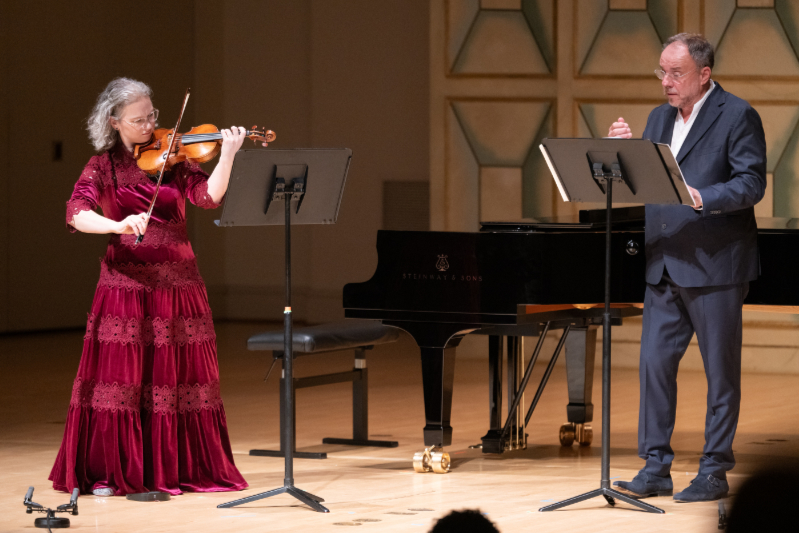
Violinist Hilary Hahn, baritone Matthias Goerne perform the world premiere of “Wir” by Reena Esmail at Spivey Hall, Oct. 24, 2026. (credit: Rand Lines)
The program concluded with two Bach arias for bass and solo violin, accompanied by piano substituting for continuo. In “Hier in meines Vaters Stätte,” from Liebster Jesu, mein Verlangen, BWV 32, the violin’s flowing line intertwines with the bass voice over a continuo foundation. “Welt, ade, ich bin dein müde,” from Der Friede sei mit dir, BWV 158, likewise interweaves the voice and violin over continuo. However, this performance omits the oboe-and-soprano voice chorale—the first verse of Johann Georg Albinus’s 1649 chorale of the same name. The texts of the bass voice and the chorale tune are thematically very close and deliberately layered, but not identical. In the original, the soprano sings a fixed chorale stanza; the bass sings a freer poetic expansion written to be performed simultaneously; nevertheless, this violin, bass, and continuo version works for the program’s purpose and narrative conclusion.
“Hier in meines Vaters Stätte” offers a moment of sacred finding and binding—the Soul locating Jesus in the Father’s dwelling. “Welt, ade” is more explicitly a leave-taking: weariness of the world’s strife and a turn toward eternal peace. Together they closed the recital on sacred ground after Beethoven’s human longing and Esmail’s meditation on silence, with the second aria supplying the clearest image of departure.
The recital was performed without intermission, allowing the sequence to unfold uninterrupted as a single coherent arc. ■
EXTERNAL LINKS:
- Hilary Hahn: hilaryhahn.com
- Matthias Goerne: matthiasgoerne.org
- Gloria Chien: gloriachien.com
- Reena Esmail: reenaesmail.com
- Spivey Hall: spiveyhall.org

Read more by Mark Gresham.